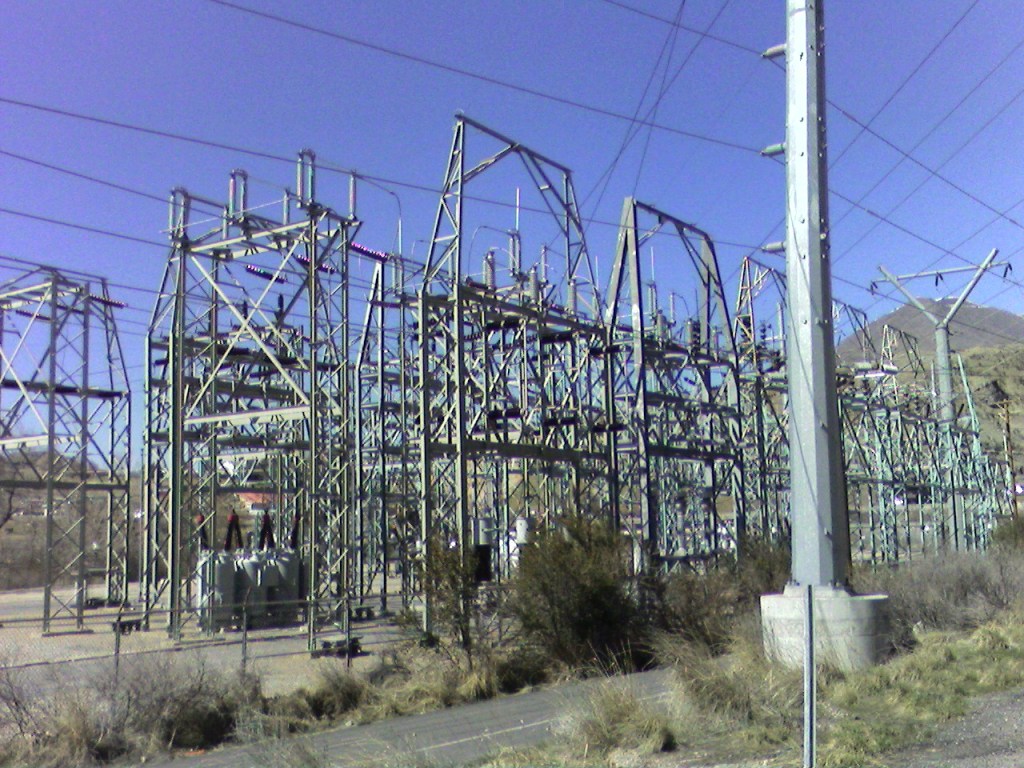
Electricity networks must accommodate new data centers, electric vehicles and heat pumps while maintaining safe operating conditions. On November 10, 2026, LF Energy announced $2.5 million in Google.org funding, administered by INCO and awarded to Linux Foundation Europe. The two-year program supports four existing open-source projects and implementation assistance for European grid operators. It funds software and adoption, rather than construction of additional generating capacity.
LF Energy’s 2024 PowSyBl webinar demonstrates electrical network simulation and analysis. Watch on YouTube. Featured photograph: Staplegunther, Wikimedia Commons, public domain; archival transmission substation, not a project installation.
1. OpenSynth: data for planning without household records
Grid planners need representative patterns of electricity consumption to estimate demand. Actual smart-meter records can reveal details about people’s routines. Synthetic datasets offer an alternative for some research applications by generating plausible patterns rather than distributing individual customer histories. The OpenSynth community provides access to a dataset containing ten million synthetic household load profiles, alongside network data. Synthetic data require validation against relevant populations, weather patterns and consumption distributions; their scale alone does not establish accuracy or privacy guarantees.
2. PowSyBl: calculate what happens when the grid changes
Transmission operators use load-flow analysis to estimate electrical quantities such as voltage, current and power across a modeled network. Security analysis examines whether the grid remains within operating limits after a contingency, such as the loss of a transmission line. PowSyBl provides reusable software components for such studies. TenneT Netherlands built its ReFlow orchestration platform around the engine, using parallel calculation workloads on Kubernetes. An April 2026 case study reports a tenfold or greater improvement over its preceding solution and a five-month initial deployment. The result is operator-reported, not a universal benchmark.
3. Power Grid Model: evaluate local distribution constraints
Distribution networks deliver electricity to end users through feeders and transformers. As households add electric vehicles, rooftop solar and electric heating, engineers must estimate how different combinations affect voltage and equipment loading. Power Grid Model supports high-throughput scenario analysis. LF Energy reports more than ten million software downloads; that figure does not represent ten million active users or installations. Dutch utilities including Alliander, Enexis and Stedin participate in its development.
LF Energy’s January 2025 Power Grid Model webinar explains collaborative development of grid calculation software. Watch directly.
4. OpenSTEF: forecast the next period of electricity demand
Forecasts estimate future load and generation so operators can prepare for potential congestion. OpenSTEF supports machine-learning workflows for short-term predictions. At the September 2026 summit, its community introduced a modular fourth major version. Forecast uncertainty remains important: weather errors, changes in consumer behavior and rapidly changing industrial demand can reduce predictive accuracy. Engineers must combine forecasting with measured network conditions and established protection practices.
Official LF Energy Summit recording: OpenSTEF 4 launch, published September 25, 2026. Watch on YouTube.
Industry commentary: Niclas Sigholm discusses the grant and collaborative grid software on LinkedIn.
Digital capacity is not the same as physical capacity
Better software can help operators locate unused headroom, coordinate flexible loads and prioritize reinforcement. It cannot raise a transformer’s thermal rating or replace needed lines. Related reporting includes flexible computing loads, Kubernetes energy monitoring, long-duration storage and German battery infrastructure. Funding outcomes should be assessed against documented deployments, forecast quality, operational reliability and measurable planning improvements.
We volunteer daily to ensure the credibility of the information on this platform is Verifiably True. If you would like to support to help further secure the integrity of our research initiative, please scan the QR code below.



Leave a Reply