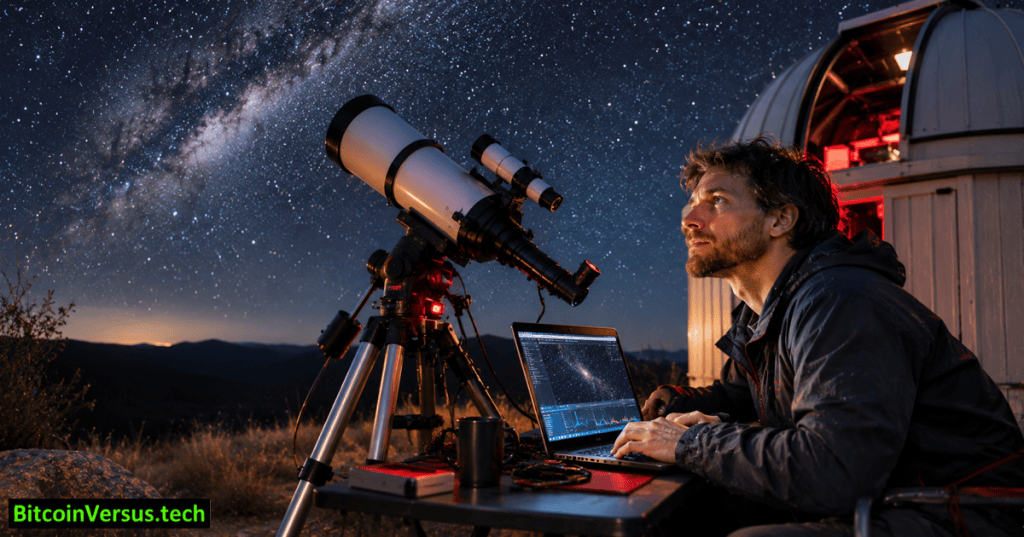
When two neutron stars collide, the resulting light can fade in days. Catching it requires more than powerful instruments: observatories must also be able to point at the right patch of sky while the event remains visible. On November 24, 2026, NASA invited amateur astronomers to join Kilonova Catcher, a distributed network preparing for alerts from the Nancy Grace Roman Space Telescope. The network already has over 150 registered participants across several continents and has contributed to more than 64 scientific reports.
Original project outreach video: GRANDMA and Kilonova Catcher invite amateur astronomers to participate. The video predates the November 2026 NASA announcement. Watch on YouTube.
Why light from a stellar collision matters
A neutron star is the collapsed remnant of a massive star. When two neutron stars merge, gravitational waves carry information about their orbital motion and the collision. Material ejected during the merger can undergo rapid neutron capture, producing heavy nuclei. Radioactive decay subsequently heats the expanding debris, generating an optical and infrared transient called a kilonova. Observing both light and gravitational waves gives scientists complementary measurements of the same event.
In 2017, observatories located the optical counterpart of GW170817 in the galaxy NGC 4993 after gravitational-wave detectors registered the merger. Hubble observations then documented the transient fading. A ground-based telescope network extends the opportunity for follow-up when clouds, daylight or scheduling make individual observatories unavailable.
Twelve exposures, one measurable afterglow
A recent example shows how the network operates beyond kilonova searches. On November 23, the collaboration published General Coordinates Network Circular 46348, reporting an optical counterpart to gamma-ray burst GRB 261122B. A volunteer-operated CDK17 telescope in San Pedro, Chile, captured twelve 300-second exposures. The combined integration was 3,600 seconds, or one hour. The team measured an r-band magnitude of 19.83 ± 0.12, with the midpoint of the observations 4.07 hours after the gamma-ray trigger.
The researchers combined the frames and subtracted archival images from the Pan-STARRS survey to isolate the changing source. Their processing pipeline calibrated brightness against cataloged stars. Stacking images can improve the signal relative to random noise, provided the frames are correctly aligned and systematic errors are controlled. The report concerns a gamma-ray burst afterglow; it does not establish that the event was a kilonova.
NASA Goddard’s 2023 overview of Roman’s time-domain astronomy explains how repeated observations reveal changes in the sky. Its original schedule references predate the mission’s 2026 milestones. Watch on YouTube.
Distributed astronomy and the next generation of alerts
The network’s equipment guide recommends a tracking telescope with an aperture of at least 200 millimeters and a camera suitable for long exposures. Participants can also use equipment available through clubs or observatories. Weather, sky brightness and the position of each target determine whether an observation is useful.
Our coverage of Roman’s upcoming first images, Euclid’s galaxy survey, Hubble’s gravitational lens observations and Webb’s stellar merger research illustrates the value of combining complementary instruments. Roman is expected to generate many new opportunities for follow-up; the number of successful observations remains unknown.
Interested observers can register through the Kilonova Catcher project. Distributed astronomy does not replace professional observatories. It adds geographic coverage and additional observing capacity to the process of turning a fleeting signal into reproducible scientific evidence.
We volunteer daily to ensure the credibility of the information on this platform is Verifiably True. If you would like to support to help further secure the integrity of our research initiative, please scan the QR code below.



Leave a Reply