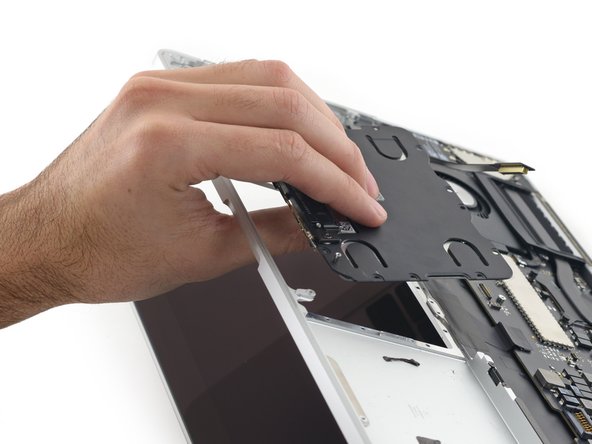
Mute a MacBook’s speakers and its glass trackpad can still produce a recognizable voice. On November 22, 2026, developer Cody Collier demonstrated NO SPEAKER, an MIT-licensed Swift program that repurposes Apple’s Force Touch haptic actuator for sound synthesis. The experiment turns an interface designed for tactile feedback into a tiny acoustic transducer, revealing a surprising overlap between mechanical engineering and digital signal processing.
A click is already a mechanical waveform
Apple’s Force Touch documentation explains that supported trackpads detect pressure and produce haptic feedback. Unlike a conventional hinged button, the assembly can simulate the sensation of clicking through controlled mechanical forces. In a 2015 teardown, iFixit identified electromagnetic actuators interacting with a metal rail beneath the trackpad. Later designs may differ in construction, but the underlying principle remains mechanical actuation.
An actuator converts electrical energy into motion. When a solid surface oscillates, its movement displaces surrounding air and creates pressure variations. Those variations become audible if their frequencies and amplitudes fall within a listener’s hearing range. A purpose-built loudspeaker optimizes that process; a trackpad instead prioritizes tactile response.
How software turns vibration into speech
According to the project’s source repository, the program starts with synthesized speech produced by macOS. It analyzes the recording in 10-millisecond intervals, estimating pitch, amplitude and two dominant vocal resonances called formants. Formants are spectral peaks shaped by the vocal tract and help distinguish vowel sounds. By selecting a small subset of the original spectrum, the software can create a recognizable approximation without reconstructing the entire waveform.
NO SPEAKER sends vibration instructions through the private MultitouchSupport framework. Its author reports frequencies reaching approximately 4 kHz, with particularly clear output near 1 kHz. A 1 kHz oscillation completes one cycle every millisecond; at 4 kHz, the period is one-quarter of a millisecond. Mechanical resonances affect which frequencies the surface can reproduce effectively.
Why two tones can outperform three
The developer found that using two dominant resonances rather than three produced clearer speech in a reported listening comparison. A limited actuator must distribute its available drive among multiple components. Reducing the number of simultaneous tones can preserve the most perceptually useful information. The result resembles a robotic voice rather than ordinary high-fidelity audio.
Related hardware and software coverage includes Apple’s MacBook Pro update, the evolution of Mac input interfaces, modular laptop hardware and open computer architectures.
An experiment, not a replacement speaker
The developer reports successful testing on an Apple Silicon Mac and an Intel Mac. Older macOS versions and external Magic Trackpads have not been comprehensively tested. The private framework can change without notice, and although the project says it limits actuator strength, long-term wear under repeated acoustic use remains unmeasured. MacRumors also notes that the application cannot serve as a general audio output device. Review the source before executing third-party software.
The engineering insight extends beyond laptops. A component’s physical capabilities can exceed its advertised function, provided software can control its behavior. Researchers exploring haptic communication, embedded diagnostics and accessible interfaces may find value in the principle, even when a conventional speaker remains the better practical choice.
We volunteer daily to ensure the credibility of the information on this platform is Verifiably True. If you would like to support to help further secure the integrity of our research initiative, please scan the QR code below.



Leave a Reply