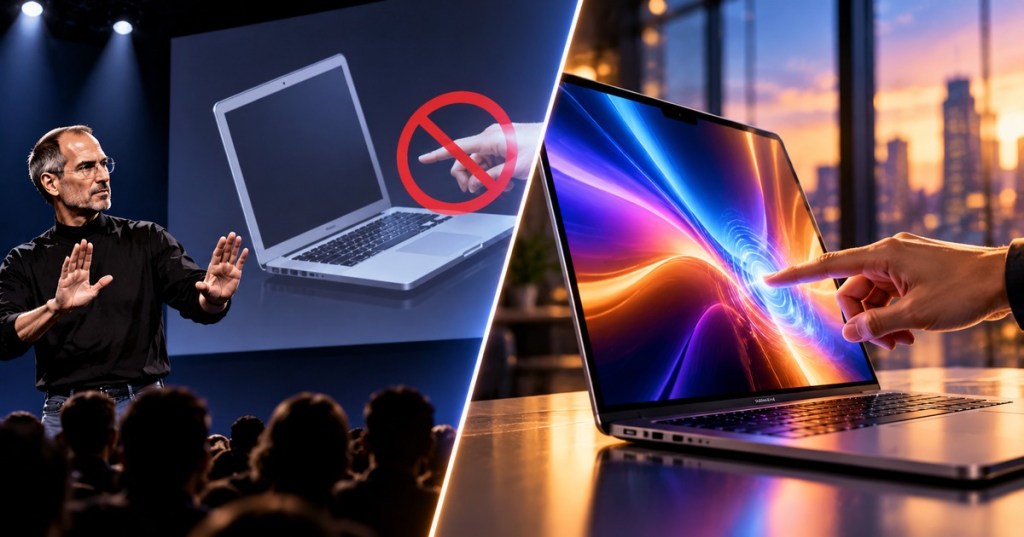
Apple introduced its first touchscreen MacBook Pro on October 28, 2026, reversing a position that co-founder Steve Jobs publicly defended in 2010. The new 14-inch and 16-inch laptops feature a PROLED XDR tandem-OLED display, M5 Pro or M5 Max chips, and touch gestures integrated directly into macOS 27.
The reversal is notable because Jobs argued at Apple’s October 2010 Back to the Mac event that vertically positioned touchscreens caused arm fatigue. His objection concerned ergonomics, not the usefulness of touch itself: Apple had already built its iPhone and iPad businesses around touch interfaces.
Watch the original Steve Jobs video above, then compare it with Polymarket’s post about Apple’s new touchscreen MacBook Pro below.
Apple’s new MacBook Pro keeps the familiar keyboard and trackpad rather than becoming a convertible tablet. Users can now swipe through pages, pinch to zoom, manipulate creative applications, and touch window controls. Apple says a redesigned hinge and stabilization systems help the laptop remain steady during direct interaction.
What changed at Apple?
The official announcement highlights a 120Hz variable refresh rate, up to 2,000 nits of peak HDR and SDR brightness, and a claimed 10,000,000:1 contrast ratio. Apple’s new Dynamic Island also brings notifications, Siri AI and Live Activities to the Mac. These are manufacturer specifications, not independently measured test results.
The 14-inch model starts at $2,899 and the 16-inch at $3,399, with preorders opening October 28 and availability beginning November 6. The price premium places the new touch display squarely in Apple’s professional lineup rather than its entry-level notebook range.
In an interview with WIRED, Apple executives explained that touch had become familiar to a generation raised on phones and tablets. CEO John Ternus emphasized that the Mac remains primarily designed for keyboard and trackpad use; touch is an additional option, not a replacement.
The shift follows years of evolution in Apple’s hardware. Earlier BitcoinVersus.Tech coverage compared Apple’s M4 Max compute performance with professional graphics hardware and examined MacBook Pro technology and long-term value. This redesign adds a new human-interface dimension to that progression.
For Jobs, the concern was whether reaching toward a vertical display felt natural for extended periods. Apple’s latest answer is to keep indirect controls while allowing touch when useful. Whether that compromise succeeds will become clearer when customers begin using the machines in November.
BitcoinVersus.Tech Editor’s Note:
We volunteer daily to ensure the credibility of the information on this platform is Verifiably True.
If you would like to support our work and help further secure the integrity of our research initiatives, please scan the QR code below to donate 5,000 sats.



Leave a Reply