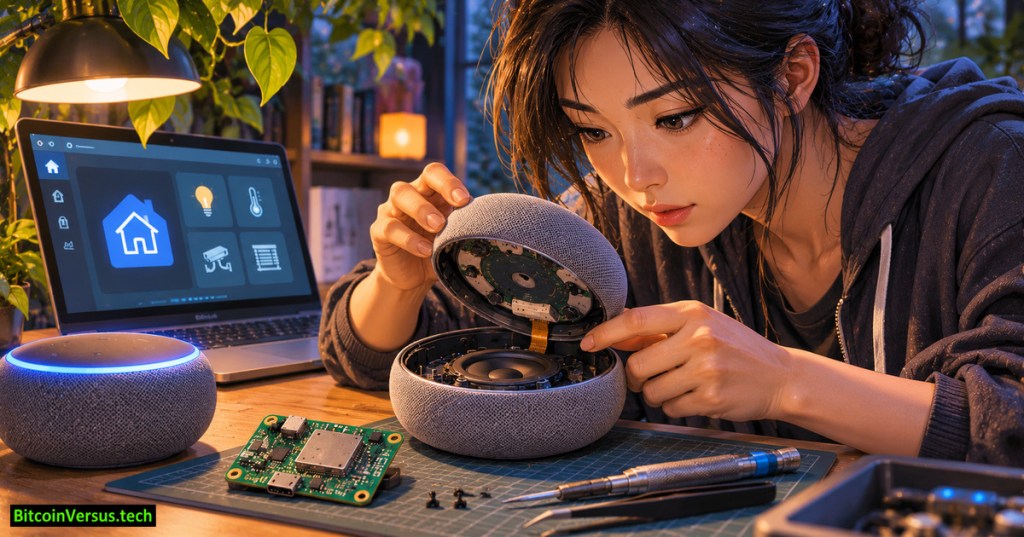
A smart speaker can become obsolete without a single microphone or loudspeaker failing. Its dependence on a remote software platform can make otherwise functional electronics less useful to owners who prefer local control. LocalDot, a replacement circuit board developed by Italy-based AAElectronics, aims to give third-generation Amazon Echo Dots another operating system and another purpose: a voice interface for the open-source Home Assistant platform.
On November 23, 2026, CircuitDigest reported that the $50 board had attracted more than $46,000 in crowdfunding against a $7,500 target. Shipments were projected to begin April 17, 2027. Those dates represent campaign expectations, not completed deliveries.
Independent demonstration: Automation Addict replaces Alexa with Home Assistant using LocalDot. Watch on YouTube.
Two processors divide the work
The proposed board measures 83 by 37 millimeters and retains the original enclosure, microphones, loudspeaker, buttons and LED ring. According to the project documentation, an ESP32-S3 manages connectivity and device controls, while an ESP32-P4 handles the audio pipeline. A TAS5805-series amplifier drives the existing speaker.
Separating networking from audio processing allows the device to dedicate resources to recognizing a wake word and conditioning sound. Multiple microphones can help isolate a speaker’s voice through beamforming, while acoustic echo cancellation attempts to remove sound produced by the device itself. Those operations are particularly important when music or a spoken response is already playing.
Original developer discussion: the LocalDot creator explains the motivation for replacing the mainboard rather than abandoning functional hardware. Read the original Reddit post.
What local voice control actually means
The speaker is a voice endpoint, not a complete artificial intelligence server. After wake-word recognition, a request can travel over the home network to a separate computer running Home Assistant. Its local voice documentation describes speech recognition through Whisper or Speech-to-Phrase and speech synthesis through Piper. The server interprets commands and returns an audio response.
A fully local configuration can avoid sending speech to external services, but privacy depends on the chosen integrations, server configuration and network security. More capable speech models also require additional computing resources. A constrained command recognizer may handle lighting and thermostat requests faster than a general transcription model on modest hardware.
Repairability includes software
LocalDot illustrates a principle explored in our coverage of repurposed Wii controllers, upgradeable computers, local AI workspaces and open circuit-board design: hardware longevity depends partly on the software that controls it.
The LocalDot repository documents two compatible third-generation Echo Dot variants. The clock-equipped model works as a standard Dot according to the developer, but its display remains untested. Revision 2.0 design materials are partly published; additional firmware and manufacturing files are still planned. The project targets an open-hardware license, but buyers should assess what has actually been released before committing funds.
A replacement board also consumes materials and requires a working donor device. No independent lifecycle assessment, security audit or comparative microphone benchmark was available for the article. The engineering significance lies in separating useful physical components from the service that originally controlled them.
We volunteer daily to ensure the credibility of the information on this platform is Verifiably True. If you would like to support to help further secure the integrity of our research initiative, please scan the QR code below.



Leave a Reply