The competition for artificial intelligence infrastructure increasingly concerns the energy required to generate an answer, not merely the speed of a processor. South Korean semiconductor developer HyperAccel announced an eight-accelerator inference server for Supercomputing 2026, held November 17–19 in Chicago. Its November 12 announcement described a planned remote demonstration using computing systems in Korea.
The company reports that its LLM Processing Unit (LPU) platform exceeded a comparison system using NVIDIA RTX PRO 6000 Blackwell Server Edition GPUs by more than 3.5 times in token throughput per watt and per dollar during internal evaluations of Qwen3-32B and Llama3-70B. The figures are manufacturer results, not independent laboratory findings.
Why memory matters during inference
Generating text with a large language model often involves repeatedly accessing model parameters and cached intermediate data. During autoregressive decoding, limited memory bandwidth can constrain token generation even when a processor has abundant arithmetic capacity. Grouping multiple requests into batches can improve parameter reuse, but may introduce latency trade-offs.
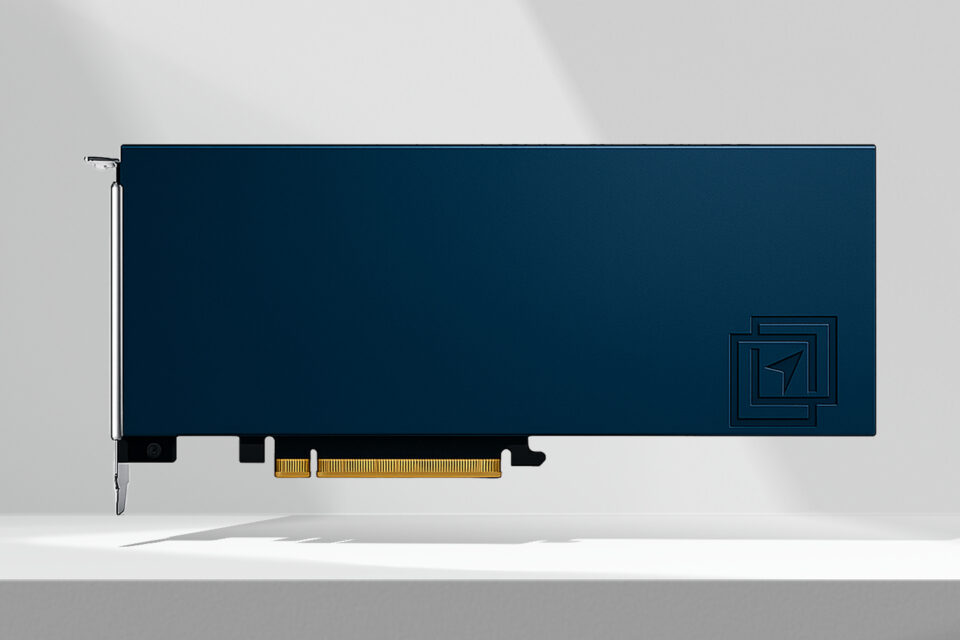
HyperAccel’s Bertha 500 specifications list a 4 nm manufacturing process, 128 GB of LPDDR5X memory with a maximum configuration of 256 GB, 546 GB/s of memory bandwidth and 768 TFLOPS of FP8 arithmetic throughput. The dual-slot accelerator carries a 250 W thermal design power rating.
The company uses an inference-oriented dataflow design to reduce wasted memory transfers. Its reported bandwidth utilization cannot be assumed for every model, request pattern or software configuration. General-purpose GPUs retain advantages where workloads require broader software support or different numerical and computational capabilities.
Comparing eight accelerator cards
At the disclosed nominal ratings, eight 250 W LPUs correspond to 2,000 W of accelerator power, compared with 4,800 W for eight 600 W graphics accelerators. The arithmetic difference is 2.8 kW, or 58.3% of the higher rating. If both groups continuously consumed their respective nominal power, the difference would equal 24,528 kWh over a 365-day year. Actual consumption depends on utilization and hardware behavior; host processors, networking and cooling are excluded from the calculation.
Token throughput per watt is equivalent to generated tokens per joule when throughput and power are measured over the same interval. Establishing a 3.5-fold improvement requires matched model precision, output quality, context lengths, latency targets and measurement boundaries. A power-rating comparison alone cannot establish that result.
Deployment economics need comparable measurements
The SC26 event page describes another internal comparison involving four LPU cards plus a host system against an NVIDIA H200 SXM node. That evaluation uses a different configuration and should not be merged with the RTX PRO 6000 results. Purchase prices, utilization, support costs and service-level guarantees also determine the economic outcome.
Related BitcoinVersus.Tech coverage examines Axelera’s Titania architecture, MemryX’s multi-chip accelerator, Ezurio’s edge inference module and SATO’s GPU deployment. HyperAccel’s next meaningful milestone would be independently reproducible benchmarks under realistic production workloads.
Featured image: HyperAccel’s official Bertha 500 product image, not a photograph of the eight-card SC26 server.
We volunteer daily to ensure the credibility of the information on this platform is Verifiably True. If you would like to support to help further secure the integrity of our research initiative, please scan the QR code below.



Leave a Reply