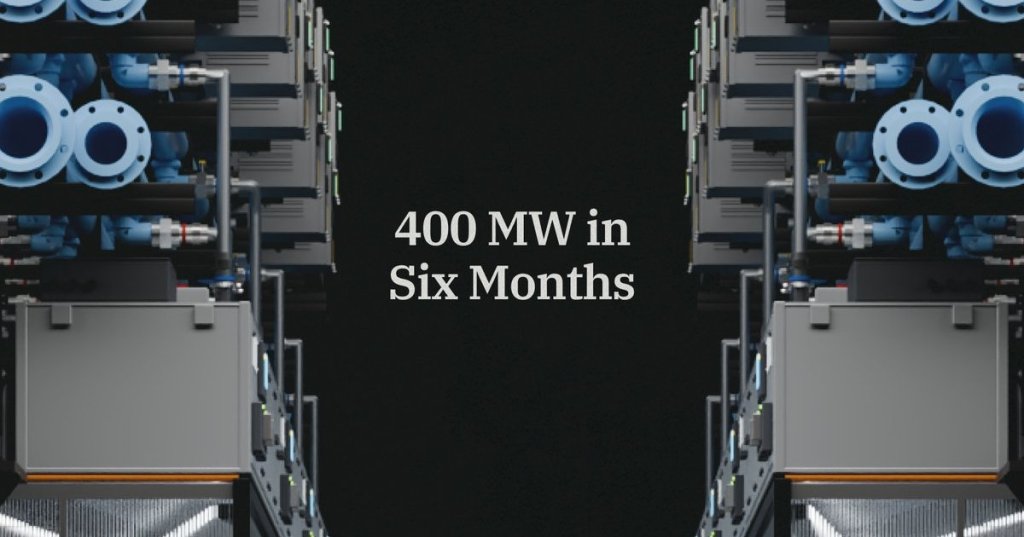
Fluidstack introduced Blackbird on November 24, 2026, offering a standardized modular data center design intended to reach 400 MW within six months of groundbreaking. The company’s official launch announcement compares the target with its stated conventional construction benchmark of 18 to 24 months. Achieving the proposed schedule would reduce elapsed construction time by approximately 67% to 75%. The target is not yet evidence of a completed 400 MW Blackbird deployment.
The manufacturer announced two complementary products: an overhead Compute Module and a prefabricated Electrical Skid. Together, the products move substantial integration work away from the construction site and into a controlled manufacturing environment. View Fluidstack’s original launch post and its interactive product presentation for the company’s illustrations.
A factory-built data hall
Fluidstack says its Luke Field manufacturing operation in Glendale, Arizona, is already operating. The two buildings occupy more than 1.1 million square feet, with 1,250 permanent manufacturing and skilled-trades jobs anticipated. Repeated assembly and pre-shipment testing could reduce the amount of electrical and mechanical integration required at each customer campus.
According to its Compute Module specifications, overhead steel assemblies support cooling pipes, busways, network cable trays and hot-air containment. The manufacturer targets installation in one day per module, subject to site readiness. A module can extend to 53 feet in length; the specified row capacity reaches 4 MW depending on configuration. UL listing is pending.
Power distribution and cooling
The Electrical Skid combines medium-voltage switching, a 3.6 MVA transformer and low-voltage switchgear. A nominal 35 kV-class incoming supply can be converted to either 415 V or 480 V three-phase power for the computing rows. The MVA transformer rating measures apparent power; actual MW delivery depends on power factor and operating limits.
Each overhead assembly distributes coolant toward processor cold plates and rear-rack fan coils. The latter extract heat from rack exhaust air, while direct-to-chip cooling removes heat closer to the silicon. Network pathways remain overhead, keeping the floor available for equipment and access.
Capacity versus resilience
The Blackbird product specification lists two example electrical arrangements. A nonredundant N configuration targets 14 MW per zone and 95% availability. A 4-makes-3 configuration targets 10.5 MW and 99.9% availability. The second arrangement sacrifices 25% of nominal zone capacity in exchange for a higher availability target. Neither percentage represents measured field uptime.
Fluidstack also offers optional coolant distribution units and uninterruptible power supplies, but recommends omitting both from compute rows when speed is the priority. Customers must assess whether the resulting reliability, maintenance and thermal architecture suits their workloads.
The remaining bottlenecks
Factory fabrication can overlap with civil construction, but it cannot remove the need for permits, utility interconnection, site preparation, equipment deliveries or integrated system commissioning. The six-month clock starts at groundbreaking rather than initial site selection. At full continuous 400 MW demand, a hypothetical installation would use 9,600 MWh per day, excluding any additional facility overhead if 400 MW refers to IT capacity.
Related BitcoinVersus.Tech coverage includes Dell’s AI server backlog, Applied Digital’s 25 MW commissioning milestone, Vertiv’s 800 VDC power architecture and Cipher’s Barber Lake expansion. Blackbird’s strongest validation will come from independently documented commissioning schedules and measured performance at customer sites.
Featured image: Fluidstack’s official November 24 Blackbird launch artwork.
We volunteer daily to ensure the credibility of the information on this platform is Verifiably True. If you would like to support to help further secure the integrity of our research initiative, please scan the QR code below.



Leave a Reply