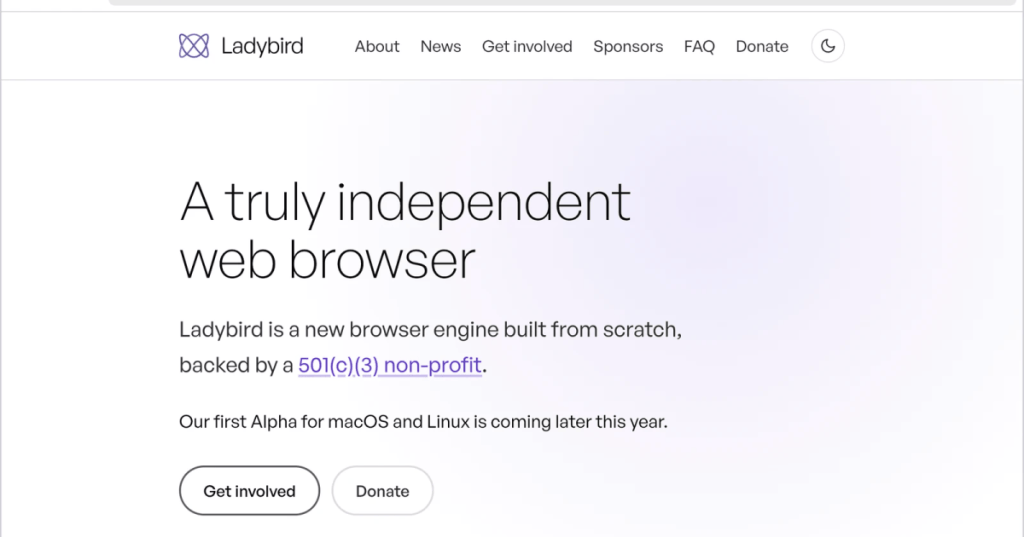
An independent web browser engine has reached a milestone that few new browser projects achieve: installable public releases. On November 23, 2026, the nonprofit Ladybird Browser Initiative announced its first alpha for Linux and macOS. Instead of building the application from source, interested developers can obtain packaged releases and receive updates through a rolling alpha channel.
Ladybird differs from browsers that package an existing rendering engine. Its developers are implementing their own core web platform components rather than maintaining a fork of Chromium or Firefox. The alpha is intended for testing, however, and the project explicitly warns of website incompatibilities, crashes and unresolved security risks. Featured image: the project’s official October pre-alpha browser interface screenshot.
Official Ladybird development update from August 2026, showing earlier engineering progress rather than the November alpha.
What an independent browser engine does
A browser engine interprets HTML, applies CSS rules, computes element dimensions and positions, records drawing operations and constructs the displayed page. JavaScript execution, event handling and networking coordinate with rendering. Implementing those subsystems independently requires years of work because modern websites depend on thousands of interacting platform behaviors.
Ladybird’s October engineering report describes moving style and layout computation away from the JavaScript main thread, with paint recording assigned another thread. The arrangement allows selected visual updates to proceed while script execution occupies its own thread. When scripts request layout-dependent information, synchronization remains necessary to return consistent results.
The team also introduced just-in-time compilation for its JavaScript engine on x86-64 and AArch64. A JIT can translate frequently executed operations into optimized native instructions, using observed runtime behavior to inform optimization. Incorrect assumptions require a fallback to less specialized execution. Browser responsiveness and JavaScript throughput are related but distinct performance characteristics.
Measuring progress without overstating compatibility
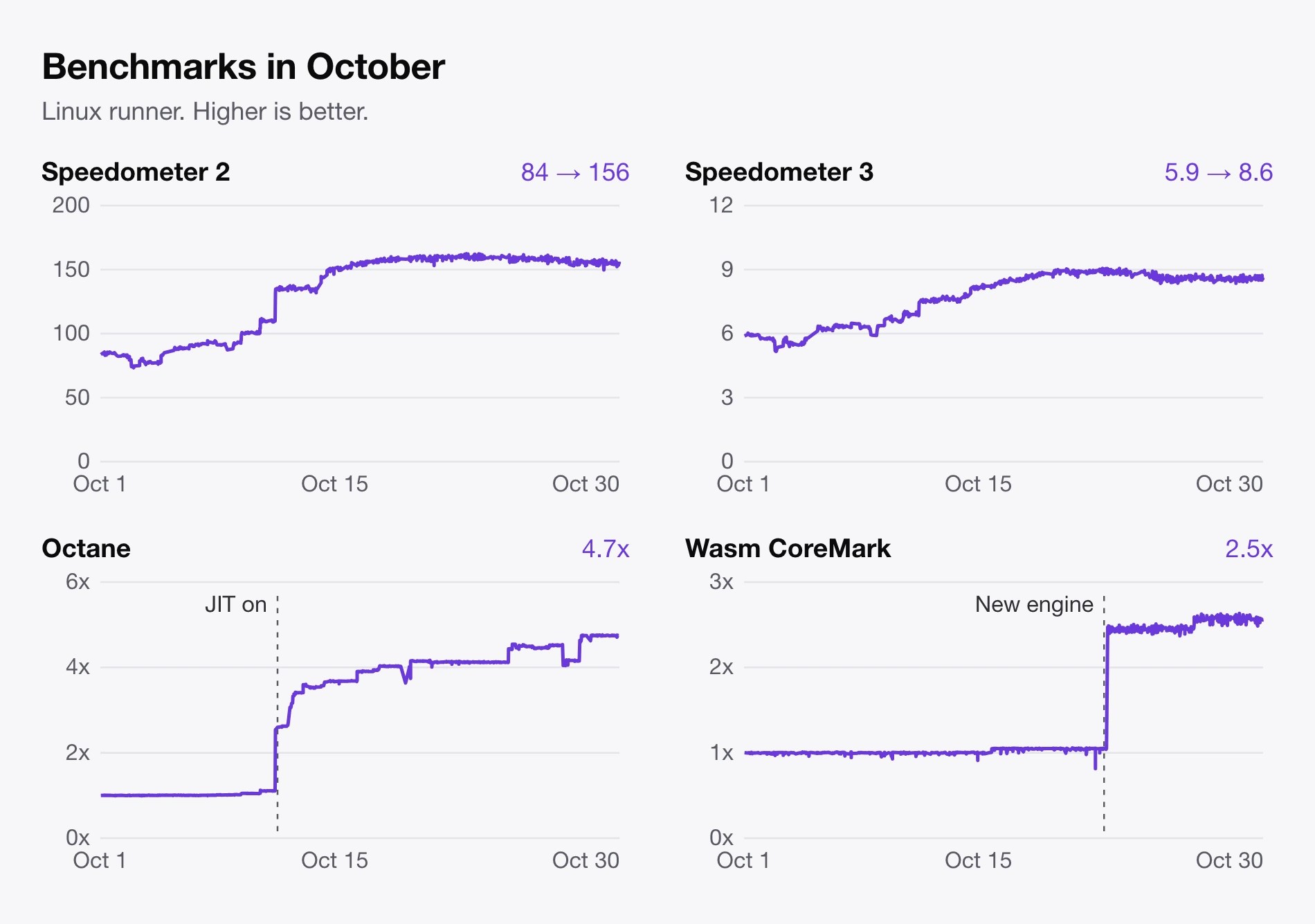
The project’s October benchmark chart shows Speedometer 2 increasing from 84 to 156, approximately 85.7%, and Speedometer 3 increasing from 5.9 to 8.6, about 45.8%. Those are comparisons within Ladybird’s own benchmark series, not independent measurements establishing superiority over competing browsers. The team also replaced its WebAssembly engine and reported gains on selected workloads.
Browser testing must extend beyond synthetic performance. The developers reported passing 2,184,722 Web Platform Tests subtests by October’s end, an increase of 75,650 during the month. Subtest counts measure particular test outcomes rather than percentages of websites supported. Passing more tests cannot demonstrate complete security or compatibility with complex commercial applications.
Earlier interview with Ladybird’s founder discussing the engineering challenge of building a new browser.
A new target for web developers
The alpha supports WebDriver automation, allowing developers to incorporate another engine into compatibility testing. Its engineering direction complements developments covered in our stories on Rust compiler parallelism, browser fingerprinting research, open-source software release testing and lightweight open-source Bitcoin infrastructure.
Developers can visit the official download page to experiment. Production work, banking and sensitive accounts remain better suited to established browsers with mature security processes. The release is an important step toward engine diversity, not a declaration that Ladybird is ready to replace existing browsers.
We volunteer daily to ensure the credibility of the information on this platform is Verifiably True. If you would like to support to help further secure the integrity of our research initiative, please scan the QR code below.



Leave a Reply