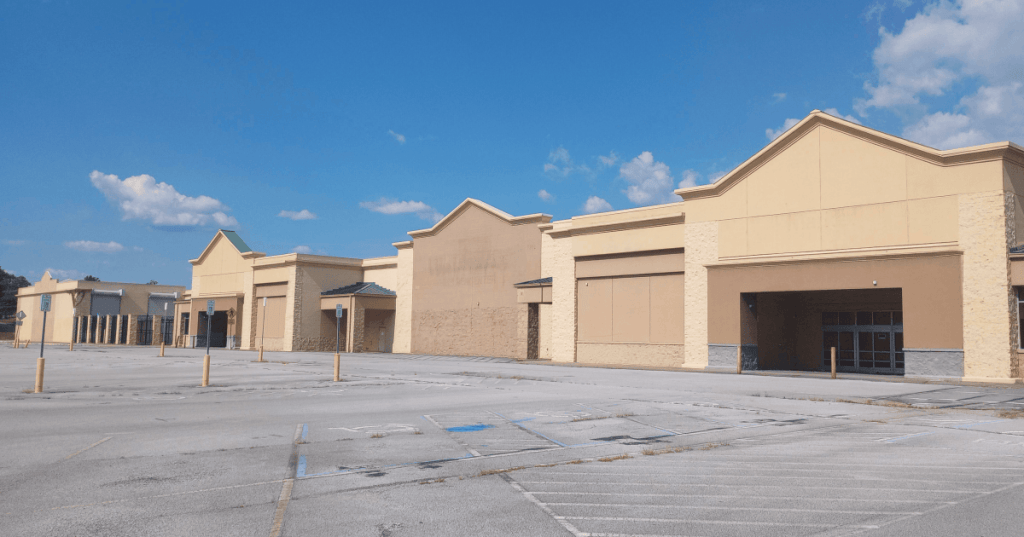
A vacant Walmart Supercenter in Fairfield, Alabama, could become a computing hub for artificial intelligence and high-performance computing. Infrastructure developer Patmos announced on November 12 that it had acquired the former retail property and intends to establish a technology campus there. The proposed data center would begin with a 20 MW capacity, with utility service potentially reaching 50 MW. Initial operations are targeted for May 2027.
The acquisition is a completed property transaction; the computing capacity and opening date remain development targets. The existing building offers approximately 205,000 square feet, or 19,045 square meters, and has stood vacant since 2016.
Why a retail building can become a data center
Large-format retail buildings offer substantial interior floor area, vehicle access and existing connections to local infrastructure. Adaptive reuse can preserve structural materials and avoid some of the earthwork associated with developing undeveloped land. However, a former supermarket or department store is not automatically suitable for high-density computing.
Engineers must evaluate slab loading, roof strength, electrical distribution, cable pathways, fire protection and cooling requirements. Server racks concentrate power consumption and heat in relatively small spaces. High-density GPU installations may require direct-to-chip liquid cooling, dedicated coolant distribution units and heat rejection equipment. Retaining the original building shell does not eliminate the need for specialized mechanical and electrical systems.
Understanding the 20 MW and 50 MW figures
The initial 20 MW figure and potential 50 MW utility capacity represent different development milestones. Patmos has not specified in its announcement whether the initial figure refers to critical IT load or total facility power. As a result, the two numbers should not be treated as equivalent measures of installed computing capacity.
For perspective, a facility drawing 20 MW continuously would consume 480 MWh over 24 hours, or 175.2 GWh over a 365-day year. At an illustrative power usage effectiveness of 1.25, a 20 MW facility could support 16 MW of IT demand, with the remaining 4 MW allocated to cooling, electrical losses and other overhead. Neither calculation is a forecast of Fairfield’s actual consumption.
Power agreements and local concerns
Patmos says it has agreed on electrical service terms with Alabama Power and will bear the cost of serving its energy requirements. Planned improvements include electrical distribution and reliability infrastructure. The company expects approximately 50 jobs associated with the project, rather than employment at the scale of a large retail store.
Local reaction is mixed. WBRC reported that residents raised questions about noise, water and electricity demand, while Fairfield’s mayor welcomed the prospect of redevelopment. Detailed equipment selections, measured efficiency and operating noise levels have not been established by the acquisition announcement.
The Fairfield proposal follows a similar Patmos redevelopment in Kansas City, where a former printing facility became a computing campus. Comparable infrastructure transitions covered by BitcoinVersus.Tech include Québec’s Bitcoin mine conversion, Applied Digital’s commissioned 25 MW hall, the Qatar 20 MW groundbreaking and Google’s proposed Ohio transmission upgrade.
The next important measures of progress will be permits, utility energization, equipment installation and customer acceptance. Fairfield demonstrates how existing commercial real estate may offer a route to new computing infrastructure, provided its electrical and mechanical systems can meet the requirements of modern workloads.
Featured photograph: Patmos, November 12, 2026 project announcement. The image depicts the existing property before redevelopment.
We volunteer daily to ensure the credibility of the information on this platform is Verifiably True. If you would like to support to help further secure the integrity of our research initiative, please scan the QR code below.



Leave a Reply