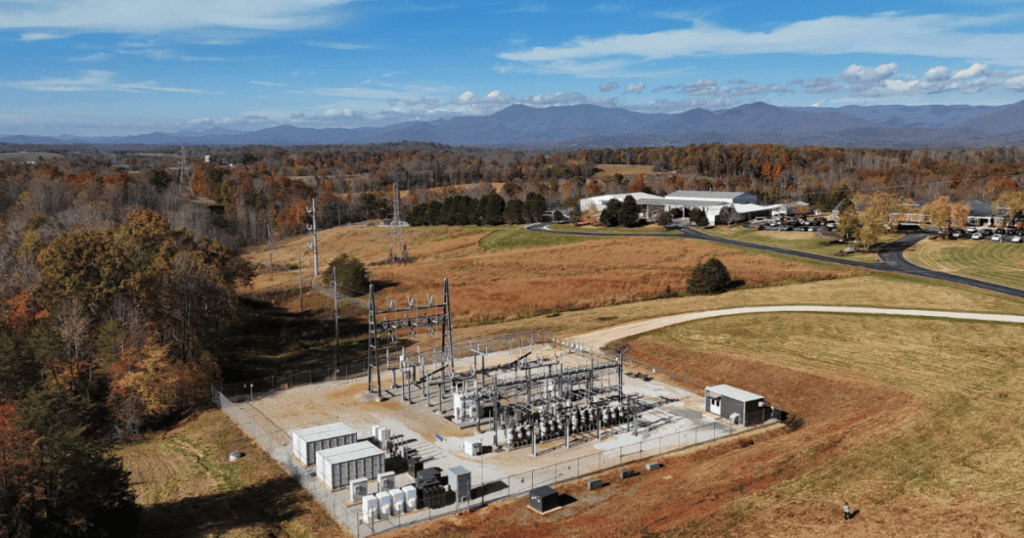
Central Virginia Electric Cooperative (CVEC) and Lightshift Energy marked the completion of a distribution-connected battery storage installation in Arrington, Virginia, on November 12, 2026. The Colleen VA BESS 1 project is notable for its automatic management of electrical substation loading, allowing the storage system to respond to local infrastructure constraints as well as wider electricity demand.
The cooperative’s project announcement specifies 4 MW of power and 20 MWh of energy storage. The completed installation sits beside an existing substation and occupies less than one tenth of an acre, according to CVEC. Featured aerial photograph: CVEC.
Five hours of nominal discharge
Power describes the rate at which energy moves, while energy describes the accumulated amount delivered. Dividing the announcement’s 20 MWh energy rating by its 4 MW power rating gives a nominal five-hour discharge duration at rated power. Actual usable duration depends on operating limits, state of charge, battery temperature and the boundary at which energy capacity is measured.
If a cooperative anticipates a brief demand peak, its battery can supply part of the local load. During quieter periods, the system can recharge. Round-trip losses mean the energy returned is smaller than the energy consumed during charging. Economic benefits therefore depend on the timing and value of electricity and avoided capacity charges, not merely the quantity of stored energy.
A separate Lightshift project portfolio lists Colleen at 5 MW, conflicting with the completion announcement. The five-hour calculation uses the 4 MW rating stated in the dated CVEC release, rather than combining inconsistent specifications.
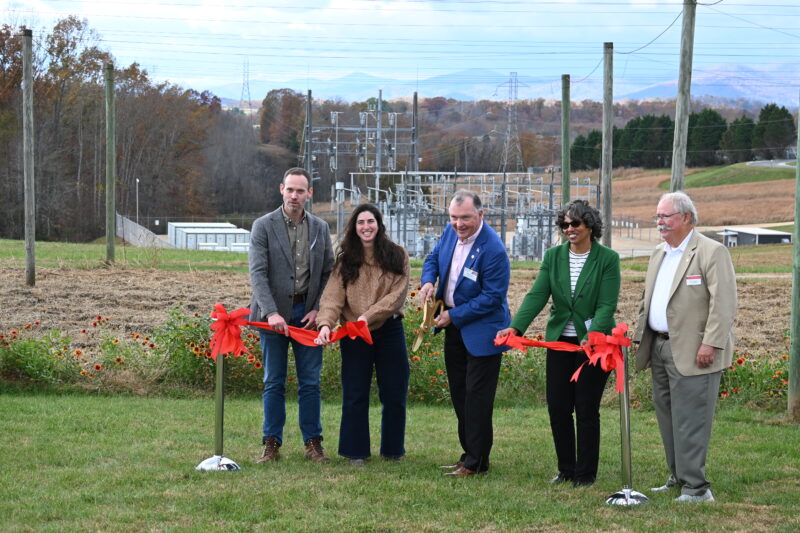
A battery that responds to substation loading
Distribution transformers and associated equipment have operating limits. A battery programmed solely to follow electricity market prices could increase demand at a time when its local connection is already heavily loaded. The project’s control system instead measures substation demand and adjusts battery operation to respect the available capacity.
The American Public Power Association reports that Colleen and the nearby Piney River project are Lightshift’s first batteries to directly manage utility substation loading in an automated manner. Such controls could defer certain infrastructure upgrades, although their effectiveness depends on the timing of demand, battery availability and the actual equipment constraints.
Why distribution storage matters
The Colleen battery belongs to a five-project partnership involving Lightshift and the Blue Ridge Power Agency. CVEC expects reduced exposure to peak-related capacity and transmission charges, but the announcement does not quantify realized annual savings or measured reliability improvements. Nor does the release establish that the installation can supply customers during a grid outage without suitable islanding and protection arrangements.
Related BitcoinVersus.Tech reporting includes Germany’s Dahlem battery, open-source grid management tools, geothermal transmission infrastructure and battery materials research. Together, they illustrate the distinct roles of generation, storage, electrical networks and control software.
Colleen demonstrates a practical approach to integrating storage with existing distribution equipment. Future operating reports should reveal how often the battery reduces peaks, how much energy it delivers and whether actual savings justify the investment.
We volunteer daily to ensure the credibility of the information on this platform is Verifiably True. If you would like to support to help further secure the integrity of our research initiative, please scan the QR code below.



Leave a Reply