
Power Efficiency Theory evaluates modeled value progression by combining computational performance and energy efficiency. The original algebraic equation provides the foundation, while the expanded four-year expression makes the measurement dates and physical-price minimum explicit. Both equations describe the same compounded relationship when their inputs are aligned.
The foundational equation
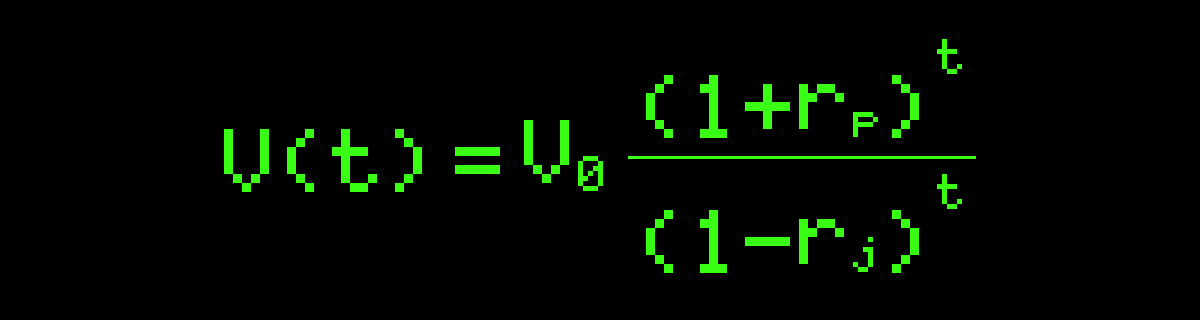
The equation begins with physical price, then compounds annual computational performance growth and the reduction in energy required per unit of computation. Greater throughput increases the numerator, while a reduction in energy cost decreases the denominator. Together, those changes determine the modeled relative price.
| Variable | Definition |
|---|---|
| V(t) | Modeled relative price after t elapsed years. |
| V₀ | Physical price: the minimum observed market price within a declared, complete 48-month selection window. |
| rₚ | Annual proportional computational throughput growth rate, expressed as a decimal. |
| rⱼ | Annual proportional reduction in energy required per unit of computation, expressed as a decimal. |
| t | Elapsed years from the selected physical-price date; set t = 4 for PEI-4. |
For example, with both annual rates at 20%, the annual multiplier is 1.20 ÷ 0.80 = 1.50. Under the four-year standard, the compounded multiplier is 1.50⁴ = 5.0625. Both annual factors must be positive. The formula assumes constant rates or equivalent compound annual rates derived from matching endpoints.
The expanded four-year equation
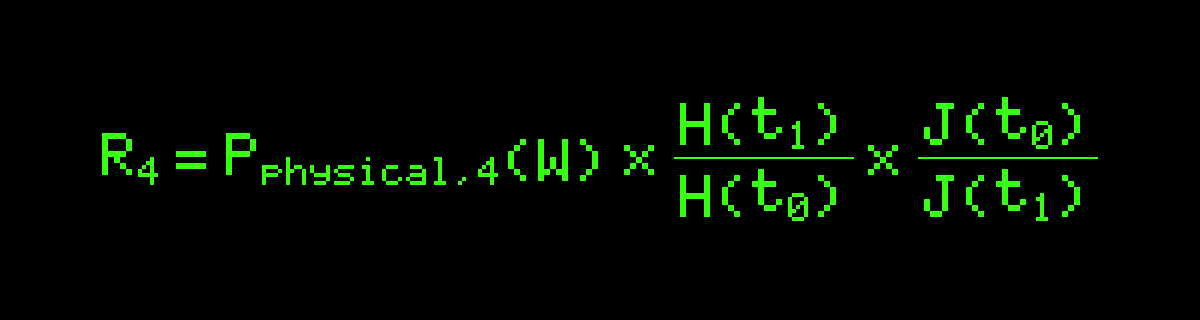
The expanded expression replaces the annual rates with directly comparable endpoint measurements. Physical price is selected from a complete 48-month market-price window. The date of that minimum anchors the initial computational and efficiency measurements; the standardized final observation occurs exactly 48 calendar months later. Neither date must coincide with a Bitcoin halving.
| Variable | Name | Definition |
|---|---|---|
| R₄ | Four-Year Relative Price | Model-implied price after four years of compounded computational and energy-efficiency progression; currency per coin. |
Pphysical,4 | Physical Price | Minimum observed market price within the designated complete 48-month window. |
| W | Observation Window | Any declared complete four-year interval used to establish physical price. |
| H | Computational Throughput Function | Output per second at a specified date; Bitcoin hashrate, in consistent units such as EH/s. |
| J | Energy Cost Function | Energy required per unit of computation at a specified date; Bitcoin J/TH. |
| t₀ | Initial Observation Date | Date of the selected minimum market-price observation. |
| t₁ | Final Observation Date | Date 48 calendar months after t₀, using the published leap-day convention. |
| H(t₀) | Initial Hashrate | Network hashrate at t₀. |
| H(t₁) | Final Hashrate | Network hashrate at t₁. |
| J(t₀) | Initial Energy Cost | Energy required per terahash at t₀. |
| J(t₁) | Final Energy Cost | Energy required per terahash at t₁. |
Physical Price Function

The physical-price function selects the lowest observed market price in a declared complete 48-month window. A one-year low alone does not qualify. A consistent price series, venue, currency and observation convention must be specified before selection.
| Term | Definition |
|---|---|
| P(t) | Observed market price at time t. |
| t | An observation time within the designated window. |
| min | Operation selecting the lowest observed value. |
| ∈ | Symbol meaning belongs to. |
| W | Complete 48-month observation window. |
| 4 | Four-year measurement designation. |
The Observation Window
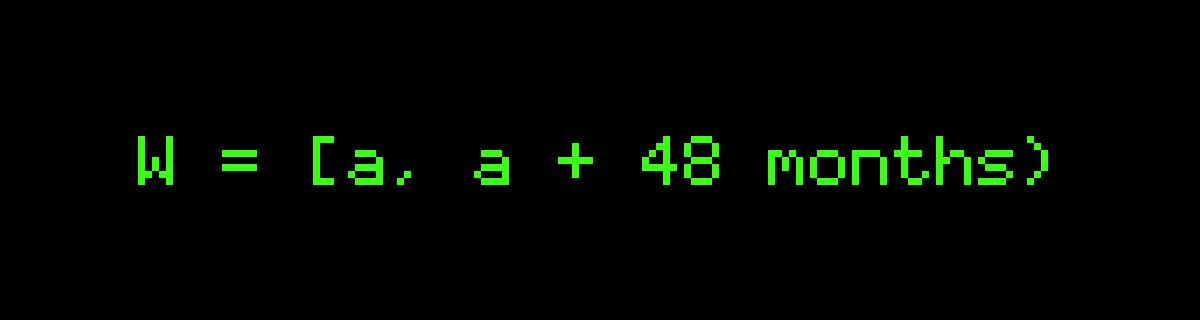
The variable a denotes the beginning of the declared selection window. The square bracket includes the starting boundary; the parenthesis excludes the ending boundary. A complete window contains all observations defined by the chosen market-price convention over 48 calendar months. It may begin in any year or month.
Computational Power Progression

C₄ is the dimensionless four-year computational throughput multiplier. A value greater than 1 means throughput increased; a value equal to 1 means throughput remained unchanged; a value less than 1 means throughput declined. H(t₀) and H(t₁) must use comparable units and measurement methods.
Energy-Efficiency Progression

E₄ is the dimensionless four-year efficiency multiplier. Initial energy cost is divided by final energy cost because a decline in energy required per unit of computation represents improved efficiency. A value greater than 1 indicates improvement, 1 indicates no change, and less than 1 indicates deterioration. J(t₀) and J(t₁) must use the same measurement convention.
Compounded Power Efficiency Index

PEI₄ is the product of C₄, the computational progression multiplier, and E₄, the energy-efficiency progression multiplier. Both are dimensionless. Multiplying the physical price by PEI₄ gives the four-year relative price R₄. The measured changes compound rather than add.
Four-Year Interval Standard
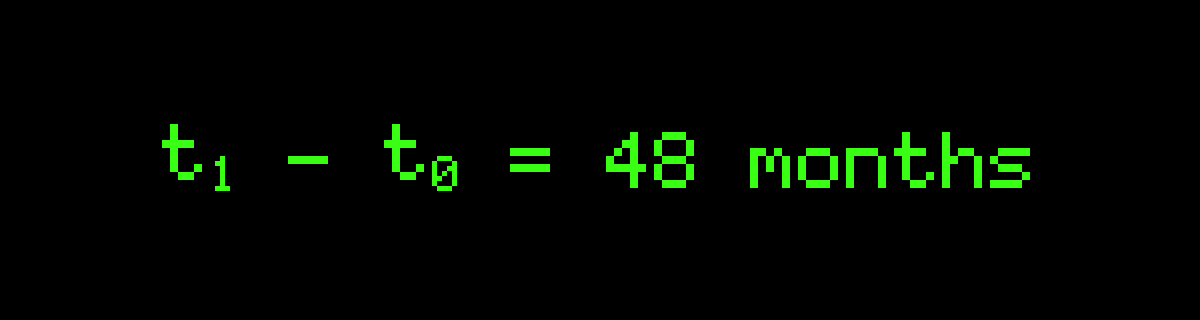
The standardized progression measurement spans exactly 48 calendar months from the selected physical-price date t₀ to the final observation date t₁. Neither date needs to coincide with a Bitcoin halving. The 48-month price-selection window and the 48-month progression interval need not share endpoints. If the final observation has not occurred, the reading is supplementary rather than a completed PEI-4 measurement.
Actual Price and Valuation Divergence
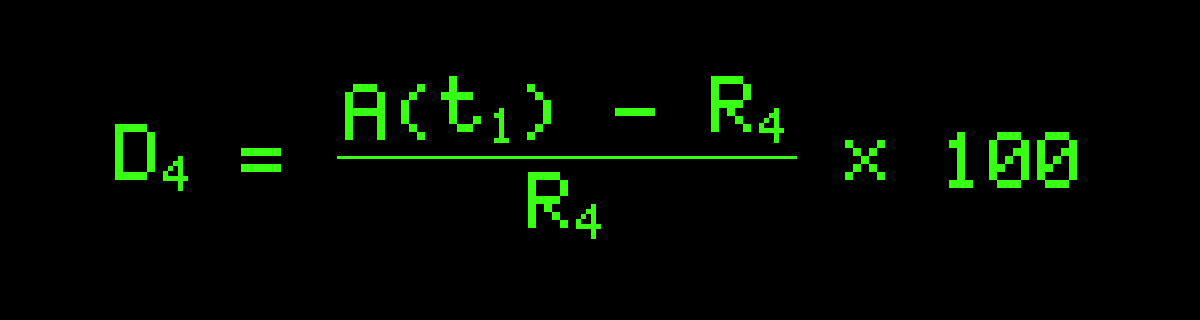
Valuation divergence measures the observed market price against the model-derived relative price. Negative divergence indicates actual price below the model; positive divergence indicates actual price above it. Zero indicates parity. The calculation requires a positive relative price.
| Term | Definition |
|---|---|
| D₄ | Four-year valuation divergence, expressed as a percentage. |
| A(t₁) | Actual observed market price at the final observation date. |
| R₄ | Four-year relative price calculated through PEI. |
| 100 | Conversion factor from a proportional difference to a percentage. |
Simplified Interpretation
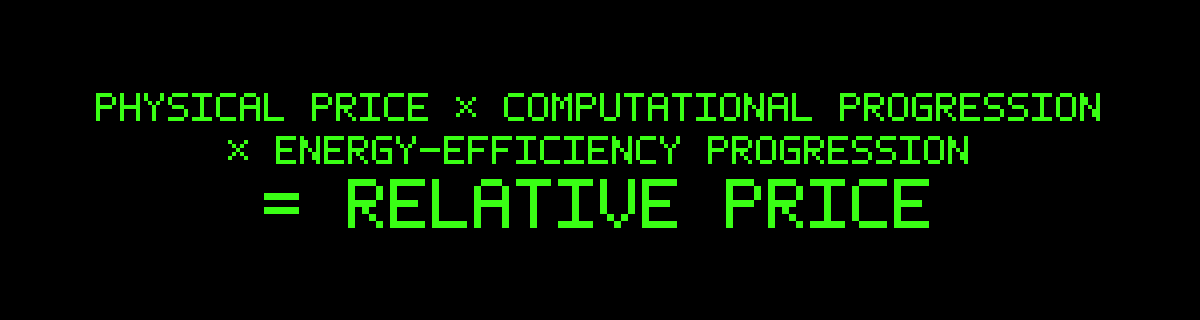
Physical price multiplied by computational power progression and energy-efficiency progression equals relative price. The standardized progression duration is 48 months. Every variable and function is defined without requiring calculus. The mathematics is reproducible; the economic valuation interpretation remains experimental.
The price-selection window and the progression interval are distinct. Researchers must declare the market-price source, observation convention, hashrate estimator and efficiency metric. See the complete foundational equation story, Four-Year Interval Standard, physical-price minimum and relative-price explanation. The mathematics is verifiable; the valuation interpretation is experimental.
We volunteer daily to ensure the credibility of the information on this platform is Verifiably True. If you would like to support to help further secure the integrity of our research initiative, please scan the QR code below.



Leave a Reply