A vacant corporate office property northwest of Chicago is moving closer to becoming a major computing campus. On November 24, the Rolling Meadows City Council approved zoning measures and backed a property-tax incentive for Digital Realty’s redevelopment at 3800 Golf Road, ABC7 Chicago reported. Plans call for 156 megawatts of computing capacity and a dedicated ComEd substation rated at approximately 240 MW. Final site design and building permits remain separate steps.
Watch the local television report on the council decision and public opposition.
From empty offices to critical infrastructure
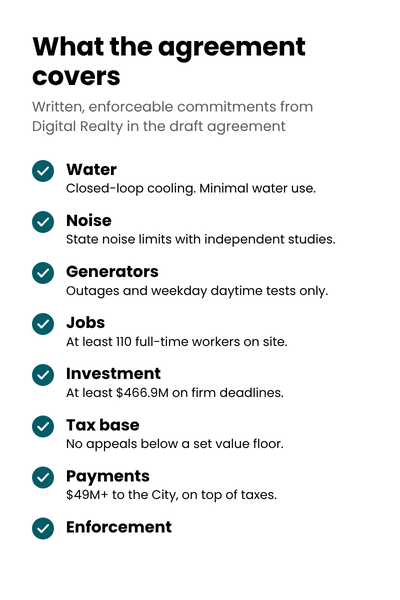
The site covers roughly 40 acres. Digital Realty acquired it for $81.5 million in September, according to Data Center Dynamics. The proposed redevelopment replaces an approximately 485,000-square-foot office complex with two data center buildings totaling about 975,000 square feet. The municipal agreement calls for at least $466.9 million of building and site investment, excluding computing equipment.
156 MW of IT capacity versus a 240 MW substation
The distinction between the two power figures matters. Critical IT capacity represents electrical demand available to computing and networking equipment, while utility infrastructure must also support cooling, electrical conversion losses and other facility loads. Dividing the planned 156 MW of IT capacity by 240 MW gives 65%. The remaining nominal 84 MW difference cannot automatically be classified as cooling consumption or spare usable power. Substation equipment ratings, redundancy and utility operating restrictions determine actual available capacity.
At continuous full IT utilization, 156 MW would consume approximately 1.37 terawatt-hours annually (156 × 8,760 = 1,366,560 MWh), before facility overhead. Actual energy use will depend on occupancy, equipment utilization and operating conditions. Comparable capacity distinctions appear in our coverage of Skanska’s Georgia data center contract and NTT’s proposed Thailand campus.
Cooling, generators and community concerns
The municipal FAQ describes a requirement for closed-loop cooling without evaporative towers. Rejecting heat to ambient air rather than consuming water through evaporation changes the water and electrical design trade-offs. It does not eliminate all facility water use. The agreement also limits generator operation to emergencies and testing and provides for independent noise assessments. Residents nevertheless raised concerns about nearby homes and the Busse Woods natural area. State wildlife review and final design assessment are still pending.
Related engineering coverage: Ohio’s Project Flyer reclaimed-water proposal and Fluidstack’s modular data center design.
The development agreement and public revenue
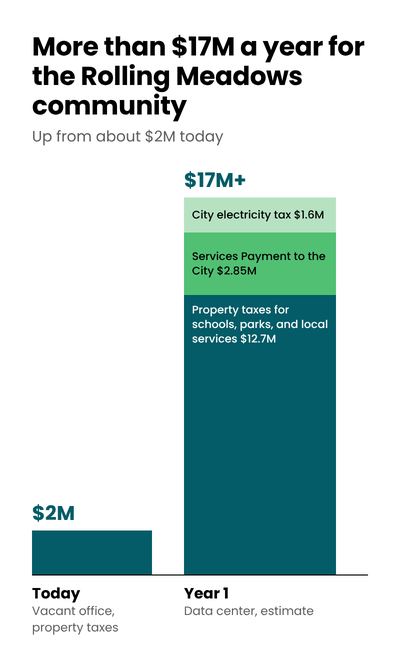
Municipal projections exceed $240 million in combined local-government revenue through 2041, subject to assumptions about assessments, tax rates and completion. The agreement calls for at least 110 full-time workers on site by the end of 2031 and sets June 1, 2031 as the outer construction completion deadline. Those commitments do not establish that construction has begun or that the full electrical capacity has been energized. The project’s next milestones are final design review, permitting, utility construction and commissioning.
Featured illustration: City of Rolling Meadows official development-agreement summary.
We volunteer daily to ensure the credibility of the information on this platform is Verifiably True. If you would like to support to help further secure the integrity of our research initiative, please scan the QR code below.



Leave a Reply