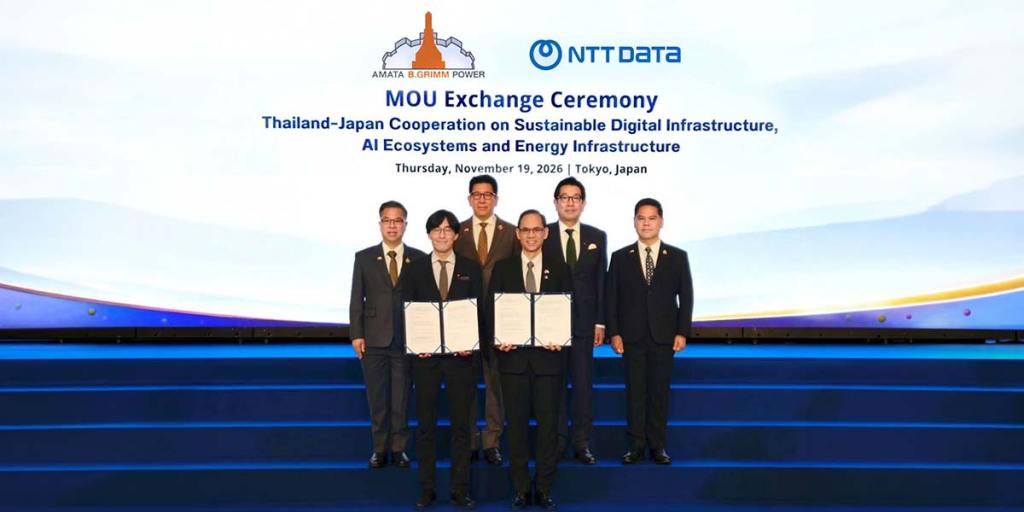
Japan’s NTT Global Data Centers and Thailand’s Amata B.Grimm Power are evaluating a 400 MW hyperscale data center campus within the Amata City Chonburi Industrial Estate. The companies signed a memorandum of understanding on November 19, 2026, at an investment dialogue in Tokyo. Kaohoon International reported on November 24 that estimated investment exceeds 113 billion Thai baht, approximately $3.3 billion, with projected employment exceeding 2,500 positions. The development remains a feasibility study rather than an approved construction program.
The partnership brings together two complementary disciplines: electrical utility development and large-scale computing infrastructure. Amata B.Grimm Power would address energy and utility requirements, while NTT would contribute its experience designing, constructing and operating data centers. Data Center Dynamics reported that further project specifications were not disclosed.
Why an industrial estate matters
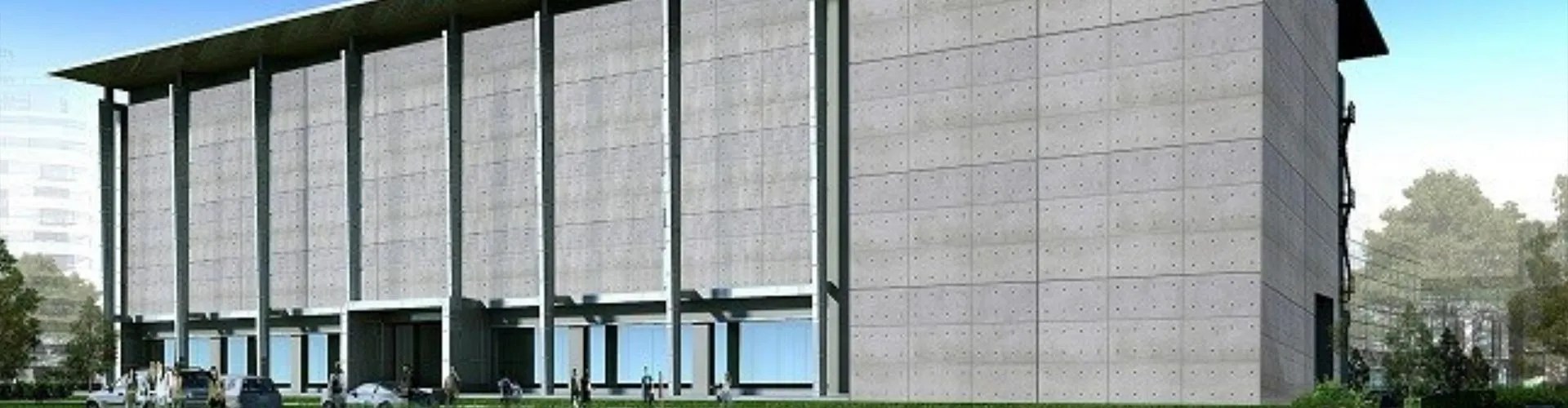
The proposed site is part of an established industrial region where electricity distribution, transportation and manufacturing services already support commercial activity. Locating computing facilities near industrial utilities may reduce some development barriers, but available land and existing electrical equipment do not guarantee enough capacity for hundreds of megawatts of continuous demand.
NTT already operates facilities in the region. Its Bangkok 2 specifications list 5 MW of critical IT load, redundant electrical systems and water-cooled chillers. DCD separately reports 3.6 MW for Bangkok 2; the discrepancy is not resolved by the available reporting. Earlier in 2026, NTT signed a separate 100 MW power purchase agreement for its Bangkok 4 development, with energization expected in the second quarter of 2027. The relationship between that agreement and the proposed 400 MW campus has not been established; the figures should not be added together.
What 400 MW means for electricity supply
A constant 400 MW load would consume 9,600 MWh of electricity per day, or 3.504 TWh over 365 days. That is an illustrative calculation, not a forecast of the campus’s actual consumption. Public reporting does not clearly identify whether 400 MW describes critical IT capacity or the entire facility’s electrical demand.
Power usage effectiveness (PUE) divides total facility energy by IT equipment energy. If 400 MW represented IT capacity and the site achieved a hypothetical PUE of 1.25, full-load facility demand would be approximately 500 MW. If 400 MW instead represented total facility demand, the same PUE would imply 320 MW available for IT equipment. Neither scenario represents a disclosed design specification.
Engineering beyond the server racks
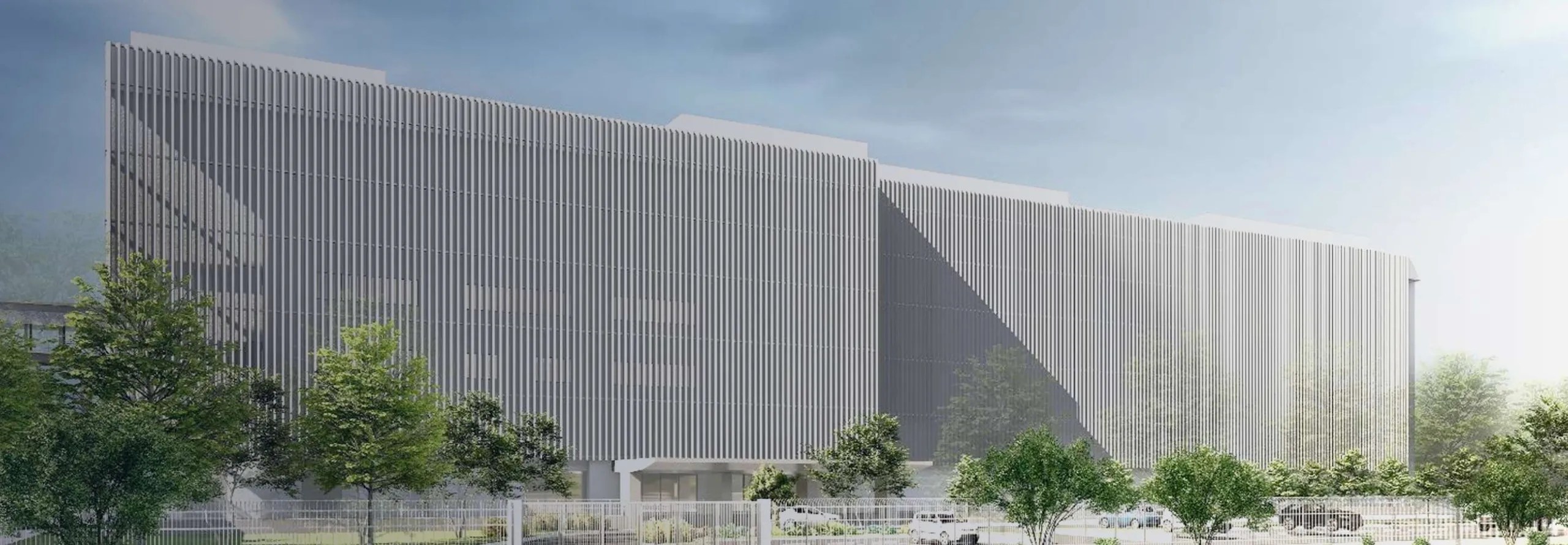
A campus of such scale requires substations, transformers, distribution switchgear, cooling equipment, backup-power systems and redundant fiber connections. High-density AI accelerators may also require liquid cooling, depending on rack power and server design. The developers have not disclosed GPU models, rack densities, a final cooling architecture or customer commitments.
Comparable infrastructure challenges appear in BitcoinVersus.Tech’s coverage of NTT’s 900 MW fuel-cell power agreement, Fluidstack’s modular 400 MW design, EdgeCore’s phased Reno development and Samsung’s expandable AI campus. Each project illustrates a different approach to coordinating electricity supply, construction and computing demand.
For Chonburi, the next milestones are a completed feasibility assessment, clearly defined power boundaries, verified utility capacity, financing, permits and a construction schedule. The November agreement indicates serious commercial interest, but operational capacity remains unproven.
Featured photograph: NTT and Amata B.Grimm Power memorandum signing in Tokyo, November 19, 2026. Source: B.Grimm Power via Kaohoon International.
Editor’s Note: The power and energy scenarios are illustrative calculations. Project capacity, investment and employment figures are attributed to the reported memorandum of understanding.
We volunteer daily to ensure the credibility of the information on this platform is Verifiably True. If you would like to support to help further secure the integrity of our research initiative, please scan the QR code below.

BitcoinVersus.tech is not a financial advisor. This media platform reports on financial subjects purely for informational purposes.


Leave a Reply