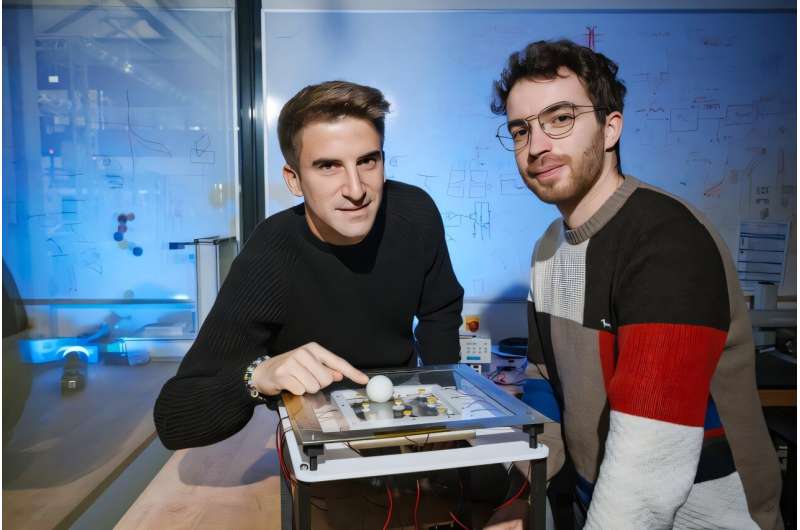
A sheet of silicone can become a conveyor without a conventional belt, rotating rollers or cameras. On November 25, 2026, Saarland University announced a laboratory demonstration in which nine electrically driven polymer actuators detected and moved a table-tennis ball. The research, led by Gianluca Rizzello’s group, combines motion and sensing within the same flexible components. The underlying Advanced Functional Materials paper first appeared online on August 17, 2026.

When a capacitor becomes a muscle
A dielectric elastomer actuator consists of an elastic insulating film between deformable conductive electrodes. An electric field attracts the electrodes, compressing the film through its thickness and expanding it sideways. Mechanical structures convert that deformation into useful movement perpendicular to the surface.
Capacitance also depends on electrode area and separation. For a simplified parallel-plate capacitor, capacitance equals permittivity multiplied by area and divided by separation. If the separation decreases while the area remains fixed, capacitance increases. An elastic membrane can change both dimensions simultaneously, giving its controller an electrical indication of deformation. Real materials require calibration because their mechanical and electrical responses may be nonlinear.

Nine actuators cooperate beneath one surface
The experimental array uses nine independently addressable regions on a shared elastomer membrane. Mechanical coupling allows deformation in one region to influence its neighbors. Simultaneously driving nearby elements can reduce opposing tension and increase their movement, whereas alternating excitation can produce the opposite effect.
In the published static tests, actuator travel ranged from 2.5 to 4.2 millimeters, with cooperative operation increasing displacement by approximately 4% to 17%, depending on the element. At higher frequencies, the researchers recorded smaller movements, including approximately 0.4 millimeters at 100 Hz. The different operating regimes suggest potential for both manipulation and tactile feedback rather than one universal displacement specification.

A surface that detects its own load
The conveyor test placed a 2.72-gram ball on a 20-by-20-centimeter silicone skin linked to the active array. Changes in capacitance revealed which regions were loaded. A control routine then activated selected elements to transfer the ball toward another quadrant. The paper supplies supporting experimental media, including video files.
The demonstration used laboratory drive electronics and high-voltage actuation, not a self-powered or consumer-ready surface. Scaling the concept would require reliable insulation, manufacturing consistency, durable materials and measurements of payload, transport speed and energy consumption. The prototype also exhibits different responses depending on each element’s position in the array.
Related BitcoinVersus.Tech coverage includes inflatable fabric actuators, optical touch sensing, haptic trackpad acoustics and embedded robot motor control. Each illustrates a different way to combine physical movement, feedback and computation.
The engineering opportunity is to distribute both movement and sensing through a material rather than attach a separate sensor to every mechanical joint. Potential applications include adaptive handling surfaces, tactile interfaces and flexible robotics, but the ball demonstration does not establish industrial readiness. Independent coverage likewise distinguishes the prototype from proposed applications.
Featured photograph: Oliver Dietze / Saarland University, via Tech Xplore. The linked video thumbnails provide historical technical context; in-page playback was not independently verified.
We volunteer daily to ensure the credibility of the information on this platform is Verifiably True. If you would like to support to help further secure the integrity of our research initiative, please scan the QR code below.



Leave a Reply