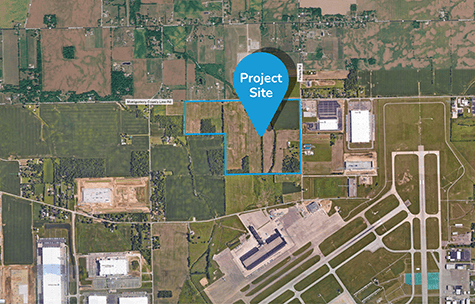
Panattoni Data Centers presented Project Flyer to Union City Council in Ohio on November 23, 2026, proposing a phased computing campus with approximately 300 megawatts of electrical capacity near Dayton International Airport. The developer’s project page describes four data center buildings and an administrative building on roughly 201 acres. The proposal remains in planning rather than construction.
The city’s November 23 council presentation outlines a potentially important feature: new infrastructure to deliver treated wastewater to the campus rather than relying on potable water for relevant operations. The municipal proposal places an estimated $11.8 million value on the water improvements.
How much electricity would 300 MW require?
At a hypothetical constant 300 MW draw, the campus would consume 7,200 MWh every 24 hours, or 2.628 TWh over a 365-day year. At 70% average utilization of the stated electrical capacity, the annual figure would be approximately 1.84 TWh. Neither calculation is a forecast of actual consumption; the buildings would be commissioned in stages, and the developer has not established a measured operating profile.
The distinction between campus electrical capacity and critical IT capacity matters. Transformers, pumps, fans, power conversion equipment and other facility systems consume electricity alongside servers. If 300 MW were the total facility input and power usage effectiveness were 1.2, the corresponding IT load would be 250 MW. That is an illustrative engineering scenario, not a disclosed Project Flyer design specification. The tenant, processor configurations and final cooling architecture remain unspecified.
Turning wastewater into a cooling resource
Union’s proposed water system would add ultraviolet disinfection and media filtration, upgrade pumping equipment and install a dedicated pressurized pipeline from its treatment facility. Reclaimed water can serve as makeup water for certain heat rejection systems, reducing demand for drinking-quality water. Treatment requirements depend on water chemistry, equipment materials and the cooling system selected.
Water recycling does not automatically eliminate consumption. Evaporative heat rejection can still lose water to the atmosphere, and dissolved minerals can accumulate as water recirculates. Engineers must balance treatment, discharge, seasonal availability and electricity used for pumping. Panattoni’s project FAQ confirms that final water demand has not yet been determined and that reclaimed-water use remains subject to feasibility.
Infrastructure and community commitments
The municipal presentation estimates $16.5 million for roadway and utility improvements, bringing the combined proposed infrastructure investment to $28.3 million. It also outlines a proposed $12 million annual municipal incentive over 15 years. Those figures describe anticipated arrangements, not revenue already collected.
Panattoni says it intends to fund project-required electrical infrastructure. Whether local ratepayers are fully protected will depend on enforceable utility contracts, regulatory treatment and actual allocation of costs. The developer anticipates construction beginning in the first quarter of 2027, subject to approvals and infrastructure readiness. Its FAQ projects approximately 1,900 construction jobs at peak activity; permanent employment estimates remain unconfirmed.
Residents can review the municipal project information ahead of an open house scheduled for November 30. Local reporting by the Tippecanoe Gazette documents the council discussion and the proposed campus layout. A local television news clip provides additional coverage.
Related infrastructure reporting includes Google’s proposed Ohio grid upgrade, Empire AI’s heat-reuse project, Fluidstack’s modular campus design and the conversion of a former Alabama Walmart into a data center. Project Flyer’s next meaningful milestones are site-plan review, binding utility commitments and construction authorization.
Featured image: official Project Flyer aerial site location map, Panattoni Data Centers. It depicts the proposed location, not a completed facility.
We volunteer daily to ensure the credibility of the information on this platform is Verifiably True. If you would like to support to help further secure the integrity of our research initiative, please scan the QR code below.



Leave a Reply