Swedish construction company Skanska announced on November 26, 2026, that an existing customer awarded it an additional $275 million contract for a data center in Georgia. The company says construction started during November and is scheduled to finish in October 2028. The official announcement describes a facility rated at 48 MW with approximately 244,730 square feet of floor area. The customer and exact municipality remain undisclosed.
The award covers building construction and the installation of interior infrastructure for technical, administrative and support functions. A separate water-treatment building measuring 860 square feet is also included. The $275 million award is a construction contract, not necessarily the complete investment required to deliver an operating computing facility.
A contract is not the same as a second facility
In September, Skanska announced an $84 million Georgia data center contract with precisely the same stated floor area and electrical capacity. The earlier release described five colocation halls and a third-quarter 2028 completion target. The November announcement does not explicitly confirm whether both awards concern the same facility. Consequently, adding their capacities to report 96 MW, or combining the contract values into a confirmed project budget, would be premature.
How a 48 MW facility consumes energy
Operating continuously at 48 MW would require 1,152 MWh per day or 420.48 GWh across a 365-day year. Actual consumption will vary with occupancy, equipment utilization, maintenance and cooling requirements. Skanska does not specify whether its 48 MW capacity refers to critical IT equipment or total facility demand. If the facility drew 48 MW at a hypothetical power usage effectiveness (PUE) of 1.20, IT demand would be 40 MW; if IT capacity were 48 MW, total power demand would instead be 57.6 MW. Neither scenario is a disclosed operating specification.

The construction sequence
Data center delivery involves substantially more than erecting an industrial building. Electrical distribution, mechanical cooling, controls, fire detection, security and fiber pathways must be coordinated with structural work. Commissioning then evaluates system performance, protective responses and resilience under specified conditions. Equipment installation does not establish readiness for customer workloads until the appropriate acceptance tests are complete.
The contract also specifies a water-treatment building, but gives no treatment throughput, source-water arrangement or cooling system specifications. Its presence alone does not establish the facility’s water consumption. Georgia’s climate, equipment density and cooling architecture can influence the design, and the precise environmental requirements will depend on the eventual site.
Related infrastructure coverage includes CleanSpark’s proposed Georgia expansion, Fluidstack’s modular construction concept, EdgeCore’s phased Nevada campus and Applied Digital’s first 25 MW hall at Polaris Forge 2. Each illustrates why contracted capacity and capacity available for service must be tracked separately.
The next meaningful milestones for the Georgia facility are disclosure of its electrical design boundary, construction progress and commissioning results. The November award establishes a substantial construction commitment, not an operating 48 MW compute resource.
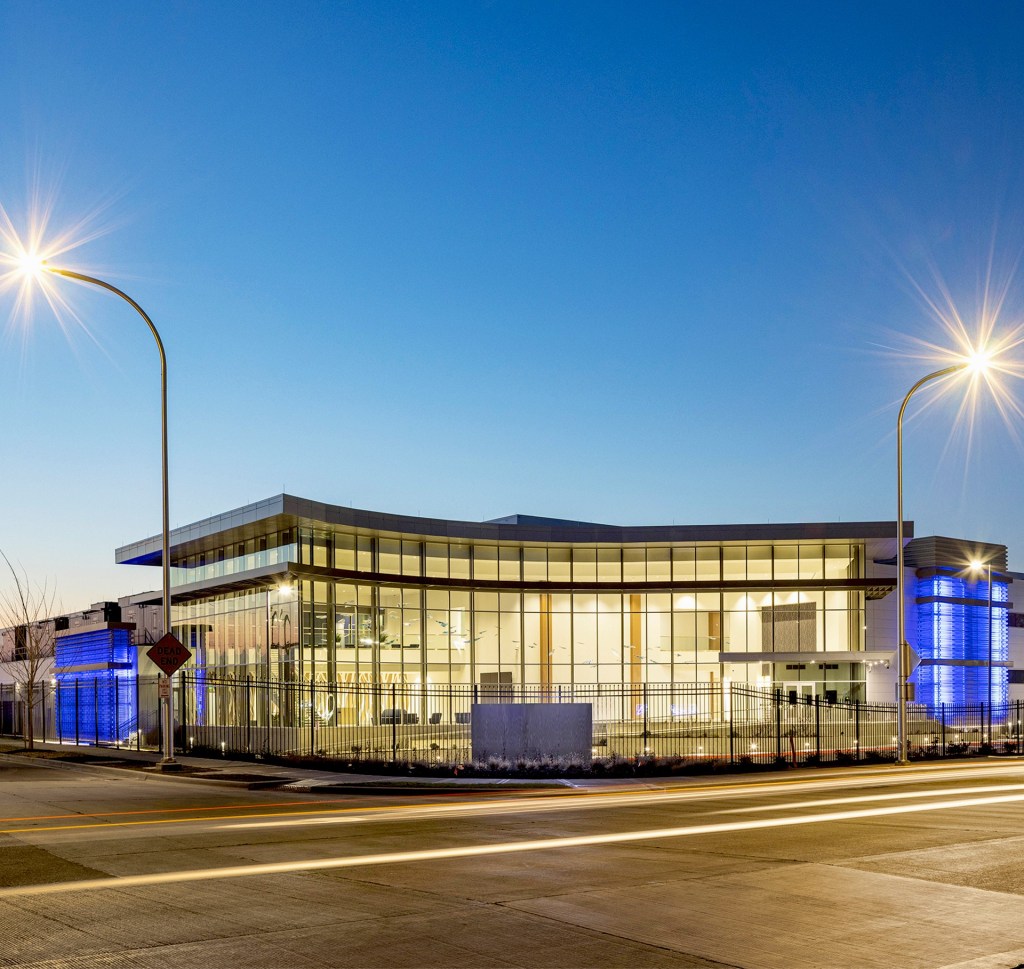
Featured photograph: Skanska’s previously completed Hillsboro, Oregon data center, a separate reference project. Source: Skanska USA. No project-specific Georgia photographs were available in the announcement.
Editor’s Note: Energy calculations assume continuous operation at the stated power. PUE examples are hypothetical.
We volunteer daily to ensure the credibility of the information on this platform is Verifiably True. If you would like to support to help further secure the integrity of our research initiative, please scan the QR code below.

BitcoinVersus.tech is not a financial advisor. This media platform reports on financial subjects purely for informational purposes.


Leave a Reply