
Research provenance and editorial commentary by BitcoinVersus.Tech. A documented earlier publication, professional contact and a subsequent industry presentation raise a question about the influence of Power Efficiency Theory.
In January 2026, BitcoinVersus.Tech published an explanation of ASIC mining performance through an automotive analogy. Months later, BITMAIN released a presentation promoting its latest hydro-cooled Bitcoin mining machine. Matthan Burton, the author of Power Efficiency Theory, observed what he considers a striking resemblance: an older vehicle evolving into a more advanced vehicle, illustrating technological progression. Burton believes his research may have influenced the way the manufacturer communicates efficiency. The chronology deserves examination without conflating resemblance with proof of copying.
The original automotive analogy
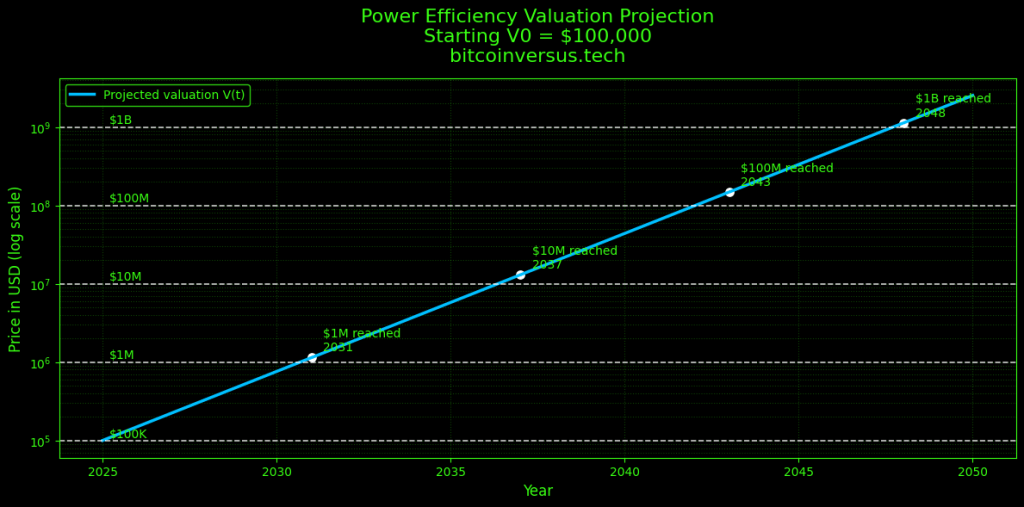
On January 17, 2026, Power Efficiency Theory: A Simplified Analytical Analogy proposed a hypothetical vehicle that improved from 60 mph to 600 mph and from 25 miles per gallon to 250 miles per gallon. Each metric increased tenfold. Multiplying the two ratios yielded a 100-fold combined capability multiplier. Applying the same multiplier to a hypothetical $50,000 baseline produced a $5 million model valuation, conditional on markets pricing the improved capability proportionally. The example was not a forecast of actual automobile prices.
In ASIC mining, the corresponding variables are computational throughput in TH/s and energy consumed per terahash in J/TH. Lower J/TH means more hashes per joule. The original research drew on the Bitcoin Mining Singularity and subsequently developed an upgraded valuation equation.
Professional discussions and publication chronology
According to Burton’s firsthand recollection, interviews with BITMAIN took place during January and February 2026. Discussions included ASIC chip energy efficiency. Burton does not recall specifically communicating the automotive analogy during those interviews. Exact interview dates, contemporaneous correspondence and a transcript have not been independently verified. The public article predates the August video regardless of the precise interview dates.
| Date | Documented event or attributed recollection |
|---|---|
| May 21, 2025 | Bitcoin Mining Singularity research published. |
| January–February 2026 | Burton recalls BITMAIN interviews discussing ASIC chip energy efficiency. |
| January 17, 2026 | Automotive speed, fuel efficiency and valuation analogy published. |
| January 24–27, 2026 | Physical security-cost research and upgraded valuation model published. |
| August 28, 2026 | S23 XP Hyd. launch at WDMS Global Hong Kong, as reported by JGM Learn. |
| August 31, 2026 | BITMAIN product video published on YouTube. |
| November 26, 2026 | Research-provenance comparison documented by BitcoinVersus.Tech. |
Why BITMAIN’s presentation matters
The 2025 Cambridge Digital Mining Industry Report, drawing on 49 mining companies, identifies a highly concentrated ASIC hardware market. BITMAIN accounted for 82% of surveyed market share as of June 2024. The figure describes the report’s historical measurement, not a verified November 2026 share. The manufacturer’s product presentation therefore offers an important example of how a dominant hardware supplier communicates engineering advances.
BITMAIN rates its S23 XP Hyd. at 600 TH/s and 8.9 J/TH. Multiplying those specifications implies approximately 5,340 W at rated operating conditions. The distinction between computational output and energy cost per unit of computation is central to both mining economics and Power Efficiency Theory. Burton’s March methodology clarification explains why individual ASIC measurements are useful research inputs.
For a concrete generational comparison, BITMAIN’s 2022 S19 XP specification lists 141 TH/s and 21.5 J/TH. Compared with the S23 XP Hyd. ratings, throughput is approximately 4.26 times higher, energy per terahash is 58.6% lower, and hashes per joule are approximately 2.42 times higher. Multiplying the throughput and inverse-energy ratios produces a 10.28-fold combined capability score under Burton’s analogy. The comparison concerns different machine designs and cooling conditions; it is not a measured fleet result, a chip-only efficiency comparison, or a prediction of the equipment’s market price. BITMAIN publicly documented energy efficiency before the January 2026 interviews. The question raised by the author concerns the later presentation’s communication of progression, not the invention of energy-efficiency metrics or the engineering of the miner.
Influence is a hypothesis, not a finding
The earlier article establishes public precedence for Burton’s particular mathematical vehicle analogy. The interviews establish a potential avenue of contact, according to the author. Neither establishes that BITMAIN personnel read the article, adopted its framework or derived the video sequence from it. Automotive metaphors are common in engineering communication, and independent development remains possible. No claim is made that BITMAIN invented or copied the Power Efficiency Equation or PEI.
The appropriate next step is to preserve dated publications, original interview records and video timestamps, compare earlier BITMAIN promotional materials, and invite the company to clarify the origin of the creative concept. The broader research synthesis documents how the proposed theory developed independently through the published record. If evidence of influence emerges, the record can be updated accordingly.
Evidence disclosure: Interview details and the visual observation are attributed to Burton. The video date and manufacturer specifications are publicly documented; its individual frames and production history were not independently inspected. BITMAIN has not been contacted for comment for the present account.
We volunteer daily to ensure the credibility of the information on this platform is Verifiably True. If you would like to support to help further secure the integrity of our research initiative, please scan the QR code below.



Leave a Reply