
Bitcoin’s mining network is exhibiting two apparently contradictory trends. On November 24, blockchain analytics firm Glassnode reported an 8% year-over-year reduction in estimated network hashrate, the first annual contraction since China’s 2021 mining ban. Yet Luxor’s November 23 Hashrate Index report recorded a 7.8% weekly rebound in its seven-day moving average. The difference reveals how industrial computing responds to electricity markets, difficulty adjustments and falling revenue per unit of computation.
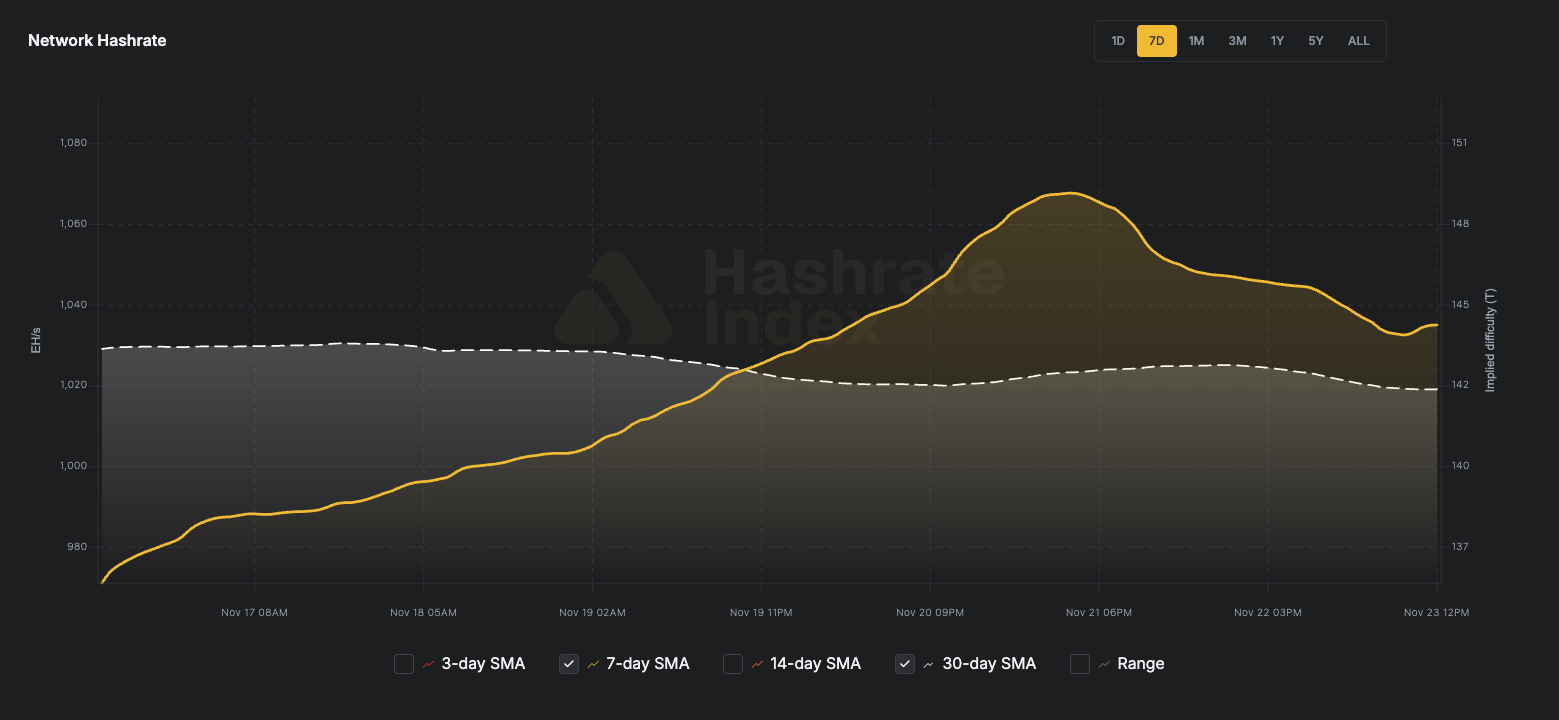
The seven-day estimate increased from 959 to 1,033 exahashes per second (EH/s), while the 30-day estimate stood at 1,019 EH/s. Glassnode’s annual comparison uses a different observation window; a short recovery does not necessarily reverse a longer contraction. Independent reporting on November 24 corroborated the annual figure and linked to Glassnode’s original statement.
Why the network can recover while miners struggle
Bitcoin adjusts its mining difficulty every 2,016 blocks to maintain an average block interval near ten minutes. When substantial computing capacity goes offline, blocks tend to arrive more slowly until the protocol recalibrates. The adjustment on November 14 lowered difficulty by approximately 9.13%, as previously reported by BitcoinVersus.Tech. Lower difficulty increases the expected share of rewards earned by a machine operating at a fixed hashrate.
A separate November 17 Luxor investigation attributed much of the early-November contraction to costly electricity in West Texas. When wholesale rates eased, computing capacity returned despite a weaker Bitcoin price. Our earlier analysis of Texas wind generation explains the regional power-market mechanism. Neither report identifies every machine responsible for the global change.
The economics of another difficulty increase
Luxor estimated a 9.5% upcoming difficulty increase on November 23. A later November 25 estimate placed the increase near 9%. Both were projections, not completed adjustments. If difficulty rises 9.5%, expected output per fixed unit of hashrate falls by 1 − 1/1.095, or about 8.68%, assuming the same average block reward and uptime.
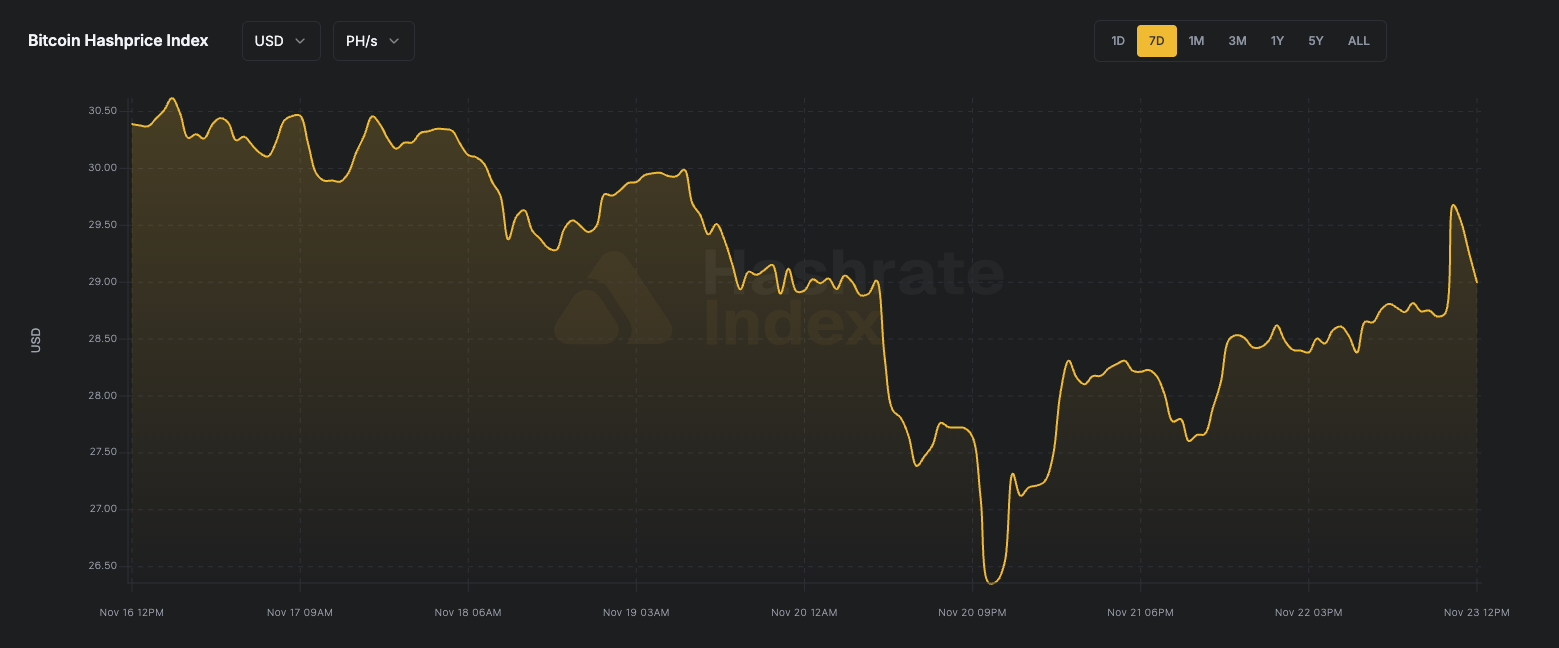
Holding Bitcoin’s dollar price and transaction fees constant, a $29.36 per PH/s per day hashprice would become approximately $26.81. A 200 TH/s ASIC would therefore generate about $5.36 daily, compared with $5.87 before the hypothetical reset. These figures illustrate sensitivity rather than forecast realized revenue.
A 200 TH/s machine rated at 15 J/TH draws 3 kW, consuming 72 kWh during 24 hours of operation. Its electricity-only break-even tariff would decline from approximately 8.16 cents to 7.45 cents per kWh under the scenario. Cooling overhead, pool fees, downtime, maintenance and financing would reduce the actual margin. See our earlier hashprice and electricity-cost analysis for the underlying conversion.
A changing industrial landscape
Mining operators increasingly face competition for electrical infrastructure from other computing workloads. Our recent analysis of contracted AI infrastructure distinguishes announced capacity from revenue-generating deployments. A temporary decline in Bitcoin hashrate alone cannot establish how much equipment has been permanently retired, relocated or switched off in response to power prices.
The central lesson is that physical computing capacity and profitability are related but different measurements. Faster block production can signal recovering network computation while rising difficulty erodes the economics of individual operators. Monitoring revenue per megawatt-hour alongside network hashrate makes that distinction visible.
BitcoinVersus.tech is not a financial advisor. All difficulty and revenue scenarios are conditional estimates, not live market quotations.
We volunteer daily to ensure the credibility of the information on this platform is Verifiably True. If you would like to support to help further secure the integrity of our research initiative, please scan the QR code below.



Leave a Reply