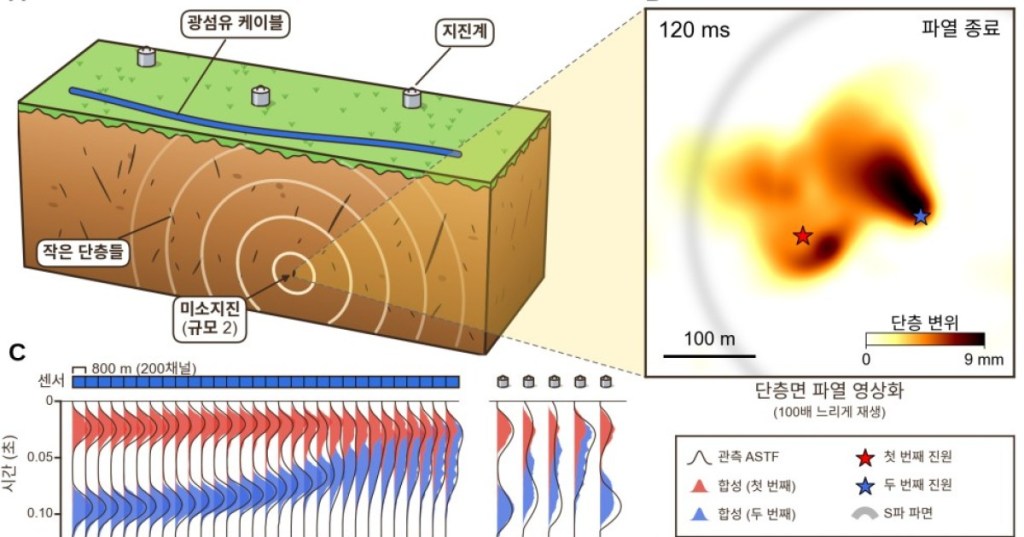
Underground telecommunications fiber has enabled researchers to reconstruct the failure of an earthquake fault on a millisecond timescale. A study published in Science on November 26, 2026 examined a magnitude-2 earthquake in California’s Brawley Seismic Zone. Instead of a single expanding rupture, the analysis identified two distinct episodes separated by 42 milliseconds. The findings challenge a simplified representation of small earthquakes and demonstrate how optical infrastructure can support geophysical research.
Turning a fiber cable into thousands of measurement channels
The international research team used distributed acoustic sensing (DAS) along 28 kilometers of underground optical fiber. According to a November 27 report from Korea.net, the instrument recorded deformation at approximately 7,000 positions spaced four meters apart. The channel count follows from dividing the monitored length of 28,000 meters by the sampling interval. Channel spacing, however, is not necessarily the same as the instrument’s effective spatial resolution.
A DAS interrogator sends optical pulses into a fiber and analyzes light scattered back toward the source. Mechanical deformation changes the optical phase measured between positions along the cable. By examining those changes over time, researchers can estimate variations in axial strain or strain rate. The delay of returning light helps determine where a signal originated along the fiber. Unlike ordinary network traffic, the measurement uses the cable itself as a sensing medium.
Related optical engineering techniques include swept-laser reflectometry and research into magnetically influenced optical signals. Each relies on interpreting changes in light, although the instruments and physical quantities differ.
A fault that stops and starts again
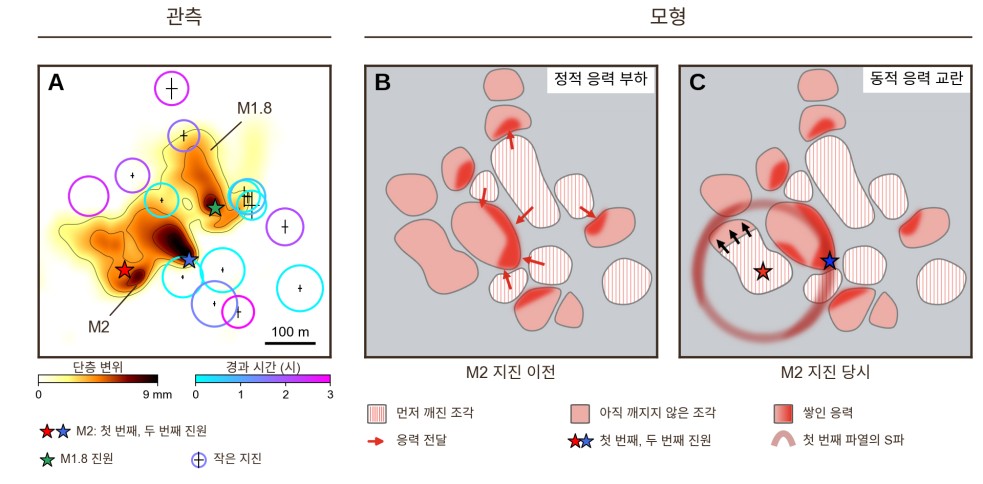
Researchers combined optical measurements, conventional seismic records and computational modeling to estimate the timing and distribution of fault motion. The reconstructed magnitude-2 event involved an initial rupture that stopped, followed by renewed failure on a neighboring fault segment. The authors also examined successive events within a three-hour earthquake swarm. Their interpretation suggests that stress interactions between adjacent fault patches can influence how rupture develops.

The Rice University research announcement emphasizes the value of observing small, frequently occurring earthquakes to investigate mechanisms relevant to larger events. The measurements do not establish that every microearthquake behaves similarly. Nor do they demonstrate an ability to predict the timing or magnitude of a future earthquake.
Infrastructure beyond telecommunications
Existing fiber routes may offer opportunities to expand environmental monitoring without installing a separate electronic sensor at every measurement point. Projects involving programmable dark fiber and international subsea cables illustrate the broader scale of optical infrastructure. Seismic sensing nevertheless requires suitable interrogators, access to fiber, adequate coupling to the ground and careful calibration. Cable orientation also affects sensitivity to deformation. The research demonstrates a method for examining fault mechanics at finer scales, rather than a replacement for conventional earthquake-monitoring networks.
Cover diagram: Optical sensing and reconstructed fault rupture. Credit: Republic of Korea Ministry of Science and ICT, via Korea.net.
We volunteer daily to ensure the credibility of the information on this platform is Verifiably True. If you would like to support to help further secure the integrity of our research initiative, please scan the QR code below.

BitcoinVersus.tech is not a financial advisor. This media platform reports on financial subjects purely for informational purposes.


Leave a Reply