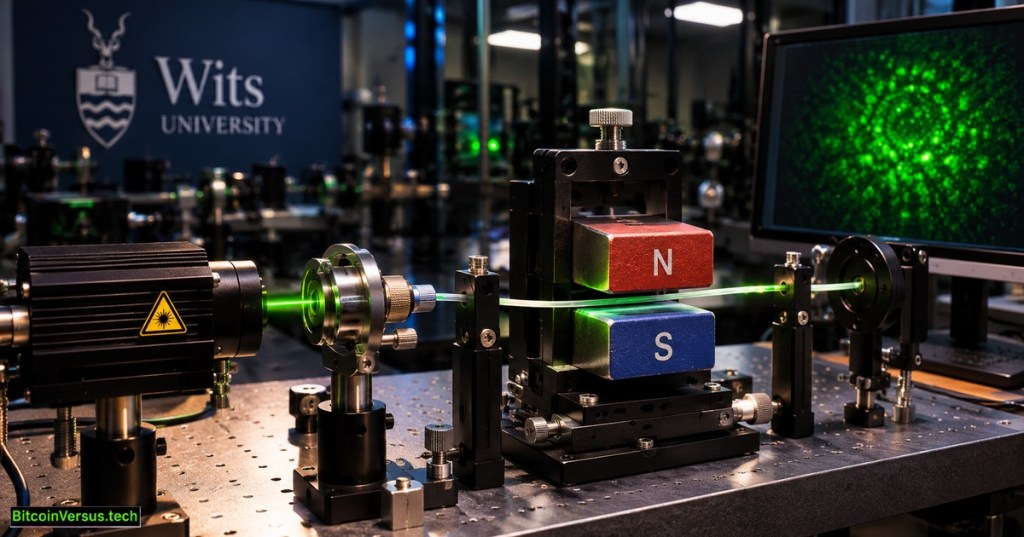
Engineers in South Africa have demonstrated an electromagnetic interaction that a widely used optical-fiber approximation largely concealed for decades. In research published in Optics Letters on September 28, 2026, Mohammed R. Sharif and Mitchell A. Cox of the University of the Witwatersrand showed that a magnetic field directed across a multimode glass fiber can measurably alter its output light pattern. The university highlighted the finding on November 11. The result builds on Michael Faraday’s nineteenth-century discovery connecting magnetism and polarized light, but involves a different field geometry. Wits University’s research report and the peer-reviewed abstract document the experiment.
Video context: University of Pennsylvania physics demonstrators show conventional Faraday rotation with a magnetic field aligned along a light beam. The 2022 demonstration is not footage of the newly observed sideways effect. Open the original university video on YouTube.
Why the field direction matters
Light comprises coupled oscillating electric and magnetic fields. In established Faraday rotation, a magnetic field along the direction of propagation changes how the material transmits different polarization states. Engineers commonly model weakly guiding fibers by treating the light’s electric field as almost entirely transverse to the direction of travel. A smaller longitudinal component is neglected, making many fiber calculations manageable.
Sharif and Cox retained the longitudinal electric-field component in step-index multimode fibers. At boundaries with a sufficiently large refractive-index step, the neglected component matters. A magnetic field placed sideways can couple a transverse electric-field component into the longitudinal one, subtly changing reflection and interference between guided light modes. The finding does not invalidate ordinary fiber engineering calculations; it identifies an interaction that simplified equations can omit under particular conditions.
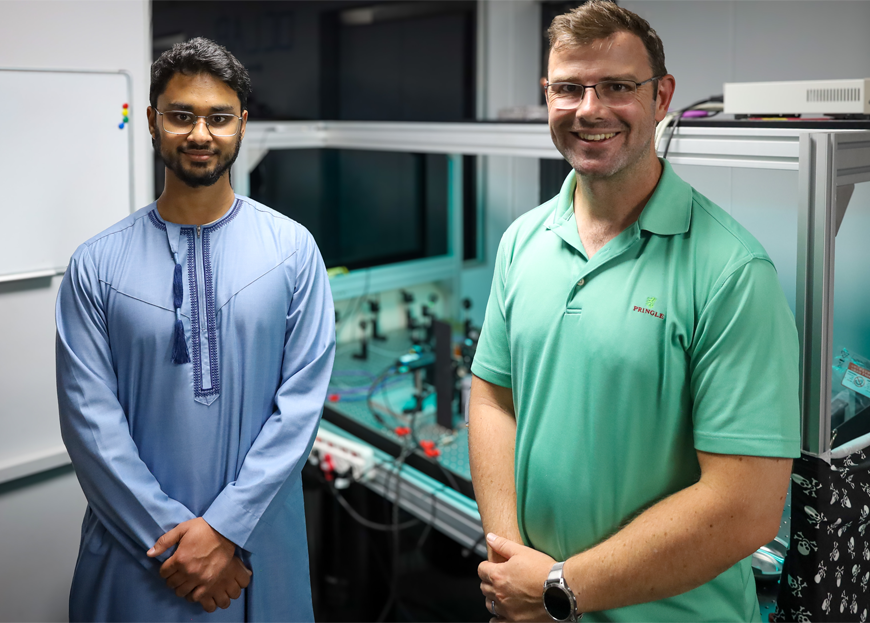
What the 0.24-tesla experiment actually measured
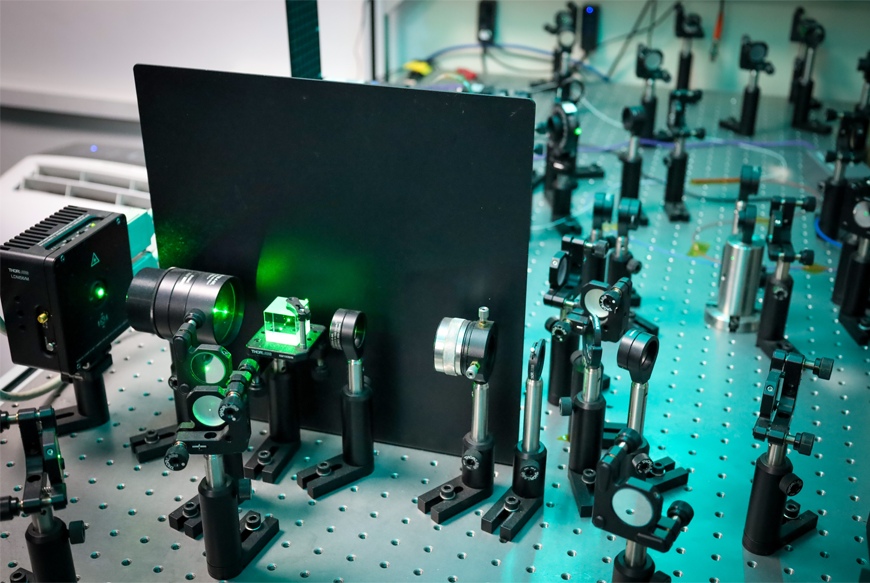
In a controlled bench experiment, researchers positioned magnets beside a stationary fiber and tracked the bright-and-dark speckle pattern formed as many optical paths interfere at the output. With a 0.24 T transverse field, equivalent to 240 millitesla, one tested input polarization produced a measured speckle decorrelation of about 0.16. The remaining similarity was approximately 0.84, or 84%. The parallel polarization showed no corresponding signal in the reported test.
Crucially, a 16% change in pattern correlation does not mean 16% of the optical power was lost. The measured quantity describes redistribution of spatial interference, not fiber-link attenuation or a commercial data-rate gain. The team also separated a response proportional to magnetic field from the conventional Cotton–Mouton contribution, whose leading dependence is quadratic in field strength.
Could magnets become fiber sensors or optical switches?
A practical transverse sensor might eventually sit beside a current-carrying cable rather than loop around it. The challenge is sensitivity: 0.24 T is much stronger than fields beside many real-world cables, and the researchers have not demonstrated an operational power-line instrument. Related battery-free power-line monitoring and electric-motor cable engineering show why measuring electromagnetic environments can matter.
Electrically adjustable magnets could also offer a way to control the spatial modes used in optical signal processing. Such ideas connect to new silicon-photonic transmitters and optical interconnects serving GPU clusters, but no energy saving, faster networking system or deployed optical-computing chip was established by the Wits study. The experiment concerns a measurable physical mechanism, not a finished product.
Evidence, limits and next steps
The paper verified predicted dependence on fiber refractive-index contrast, launch angle, polarization and wavelength. Reproducibility across fiber types, operation at realistic ambient magnetic fields and stable readout under temperature or vibration changes remain engineering questions. The journal reports that underlying datasets are not publicly posted, although authors may provide them upon reasonable request. Further instrument-level tests, not extrapolated publicity figures, will establish whether the effect has practical value.
Primary sources: Sharif and Cox, Optics Letters 51, 5526–5529 (2026), DOI 10.1364/OL.611078; University of the Witwatersrand research release, November 11, 2026. Media disclosure: The featured cover is original conceptual editorial photography-style artwork, not a documentary photograph. The small BitcoinVersus.tech watermark was copied from an existing site image. Both inline still photographs are supplied by Wits University. The embedded university lecture demonstrates the earlier, axial Faraday effect.
We volunteer daily to ensure the credibility of the information on this platform is Verifiably True. If you would like to support to help further secure the integrity of our research initiative, please scan the QR code below.



Leave a Reply