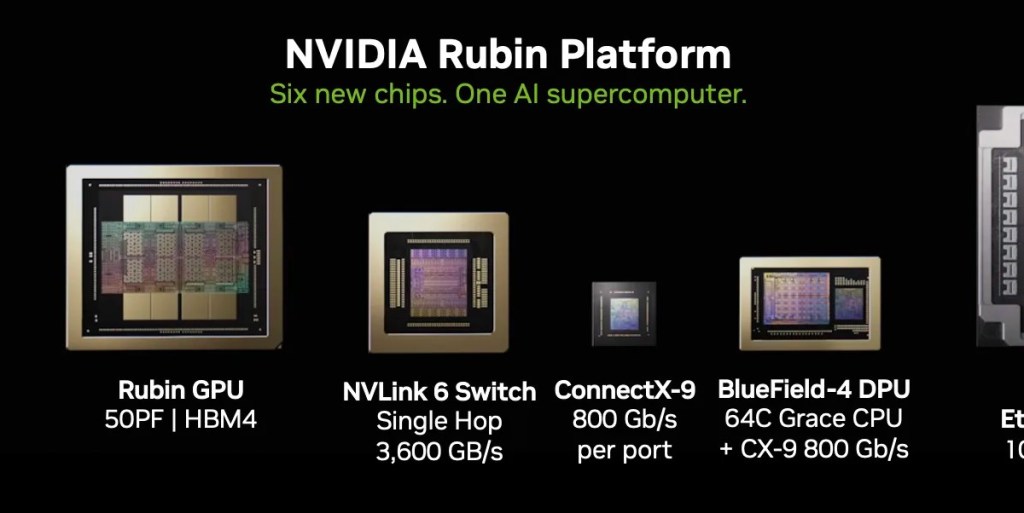
Apollo and Goldman Sachs announced November 20 that they had priced approximately $44 billion in senior and subordinated notes to finance graphics processors and associated equipment for SpaceX. The transaction follows a roughly $40 billion financing commitment announced by SpaceX on October 26. The November release identifies NVIDIA Vera Rubin hardware for terrestrial computing infrastructure.
Featured graphic: NVIDIA’s January 2026 Vera Rubin chip lineup; credit NVIDIA. It does not depict delivered SpaceX equipment.
Compute hardware as a financing asset
Accelerator deployments require significant capital before a facility delivers useful computing services. Financing structures can spread hardware costs across an expected operating period instead of requiring all expenditure to be paid upfront. Senior and subordinated debt occupy different contractual positions, which influence the risks borne by lenders and the returns they seek.
The new amount exceeds the earlier announced commitment by approximately $4 billion, or 10 percent relative to the $40 billion baseline. The transaction participants attributed the increase to investor demand. The comparison describes two announced financing milestones rather than a verified increase in installed GPU capacity.
Equipment is only one part of the system
A functioning accelerator cluster requires power conversion, cooling, network fabrics, storage, system software and suitable buildings. Without contractual prices and detailed configurations, the amount of financing cannot establish the number of accelerators or the electrical capacity of the resulting installation. Cost per accelerator also depends on whether the denominator includes ancillary systems.
Economic performance depends on deployment timing, utilization, workload demand, operating expenditure and hardware depreciation. Improvements in successive processor generations can reduce the relative economic value of older equipment. Conversely, older systems can remain useful for workloads suited to their capabilities.
Delivery is the next milestone
Apollo expects leases to commence as GPUs and related equipment are delivered in the first half of 2027. Pricing the notes does not establish equipment delivery, operational data halls or sustained utilization. The announcement illustrates the increasing intersection of capital markets and physical computing infrastructure, but does not establish the profitability of any individual AI service.
Apollo announcement | October SpaceX commitment | Reuters
GPU spot markets | Accelerator comparisons | Vera Rubin systems | AI financing
The hardware’s physical location also matters. Terrestrial facilities have different cooling, power distribution, maintenance and networking constraints from orbital systems. The November financing announcement explicitly identifies terrestrial compute. It should not be conflated with speculative plans for space-based computing. Financing terms are also distinct from the commercial contracts that may generate revenue once the accelerators are deployed.
For lenders, an important issue is the relationship between equipment collateral and its future value. The useful life of a GPU depends on workload performance, software compatibility and maintenance. Evaluating the transaction would require information about repayment schedules, guarantees, residual-value assumptions and contractual risk allocation. The published headline financing amount cannot establish those details.
We volunteer daily to ensure the credibility of the information on this platform is Verifiably True. If you would like to support to help further secure the integrity of our research initiative, please scan the QR code below.

For mobile scanning, open the article on another display and scan the QR code with a Bitcoin wallet. The voluntary donation amount is 5,000 sats. Verify the receiving address 3C9o19EH5HSiwEPyCTmEKzxhNCbo2X6TTb before sending.
BitcoinVersus.tech is not a financial advisor. This media platform reports on financial subjects purely for informational purposes.


Leave a Reply