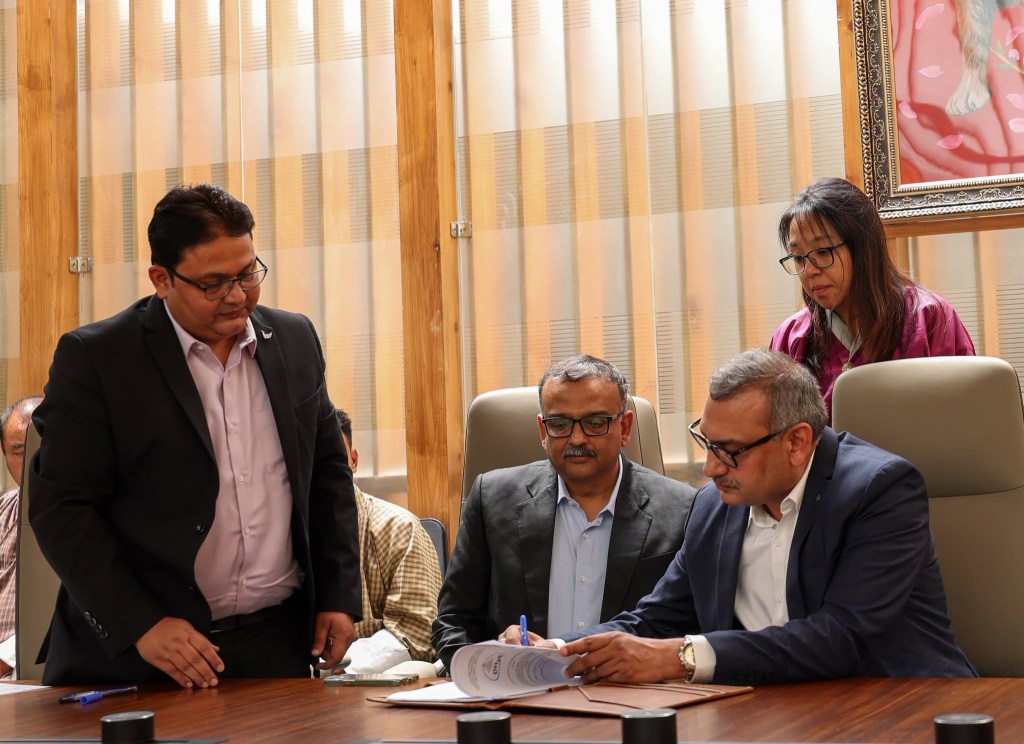
Bhutan is expanding its hydropower fleet with the 90 MW Jomori project in Samdrup Jongkhar, a southeastern district. In an October 16, 2026 announcement, Voith Hydro identified two vertical Pelton turbine generating units rated at 45 MW apiece. Druk Hydro Energy Limited awarded the electromechanical equipment package to Voith. The manufacturer will supply turbine and generator systems and participate in their installation, testing and commissioning.
The underlying contract was signed September 5, according to an October 5 statement from Druk Green Power Corporation. The equipment contract is valued at 2.289 billion Bhutanese ngultrum or Indian rupees and is supported by concessional financing from Japan International Cooperation Agency. The project owner reports that construction of major civil structures, including the dam, water conveyance tunnel and powerhouse, has begun. The generator rating is therefore planned installed capacity, not measured electricity output.
Turning hydraulic head into electrical power
Pelton machines are impulse turbines. Pressurized water passes through nozzles and strikes curved buckets arranged around a rotating wheel. The buckets change the direction of the jets, converting the water’s momentum into shaft torque. Pelton designs are particularly suited to substantial hydraulic head and comparatively moderate flow rates. The generator converts mechanical rotation into electricity through electromagnetic induction.
For an illustrative engineering calculation, a 45 MW unit at an assumed 90% combined conversion efficiency and 500 meters of net head would require approximately 10.2 cubic meters of water per second. The relationship is power equals water density multiplied by gravitational acceleration, volumetric flow, net head and efficiency. Neither the assumed head nor efficiency is a published Jomori specification. Site-specific hydraulic data are required to calculate its actual water demand.
Capacity versus dependable generation
Continuous operation at 90 MW would yield 788.4 GWh in a non-leap year. An illustrative 50% capacity factor would instead yield 394.2 GWh. Seasonal river discharge, maintenance and dispatch determine actual production. Reliable electricity depends not only on turbine capacity but also on water management and the transmission system. The distinction matters for energy-intensive applications such as Paraguay’s hydropower-backed computing infrastructure and Sweden’s hydropower-oriented AI factory.
A hydropower project can support the electricity needs of many industries, but Jomori’s equipment announcement does not identify a Bitcoin mining or AI tenant. Contrasting energy procurement arrangements include Uruguay’s solar-backed data center proposal and New Zealand geothermal procurement. The next milestones are completion of civil structures, delivery and installation of electromechanical equipment, grid synchronization and measured generation. Equipment awards provide evidence of progress without demonstrating that the plant is already producing power.
We volunteer daily to ensure the credibility of the information on this platform is Verifiably True. If you would like to support to help further secure the integrity of our research initiative, please scan the QR code below.

For mobile scanning, open the article on another display and scan the QR code with a Bitcoin wallet. The voluntary donation amount is 5,000 sats. Verify the receiving address 3C9o19EH5HSiwEPyCTmEKzxhNCbo2X6TTb before sending.
BitcoinVersus.tech is not a financial advisor. This media platform reports on financial subjects purely for informational purposes.


Leave a Reply