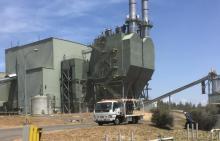
Sierra Pacific Industries (SPI) announced on November 17, 2026 that it acquired the generating assets of Burney Forest Products in Northern California. The company plans to refurbish the wood-fueled cogeneration facility and resume operations in 2027. SPI describes a generating capacity of up to 30 MW and expects approximately 20 permanent jobs to be added to its existing Burney workforce. Acquisition does not establish that the plant has resumed generating electricity.
The acquisition brings the company’s stated biomass cogeneration portfolio to nine facilities with a combined rating of up to 211 MW. The historical Olympus Power facility profile describes Burney as a 31 MW gross-capacity plant that entered commercial service in 1989. The difference between the two published ratings should not be interpreted as evidence of an equipment upgrade or downgrade without a consistent gross-versus-net measurement boundary.
Extracting useful heat and electricity from wood
Sawmill residues contain chemical energy that can be recovered by controlled combustion. Fuel handling equipment feeds appropriately sized material into boilers, where the released heat converts treated water into high-pressure steam. A turbine expands the steam, driving an electrical generator. A cogeneration configuration can also direct useful heat toward lumber drying instead of rejecting all remaining heat to the environment. SPI describes its approach on its cogeneration operations page.
Fuel moisture matters because evaporation consumes energy before useful heat reaches the steam circuit. Different wood mixtures also affect ash production and boiler behavior. Refurbishment may require inspection of pressure vessels, combustion systems, generator insulation, turbine condition, emissions equipment and electrical protection. SPI has not published a detailed refurbishment scope in its acquisition announcement.
The energy output depends on operating hours
At the announced maximum of 30 MW, continuous full-load operation would produce 262.8 GWh over a non-leap year. An assumed 80% capacity factor would yield 210.24 GWh. The calculation is illustrative, not a production forecast. Wood supply, boiler outages, electricity agreements and heat demand will affect annual output.
Biomass generation differs from Texas wind procurement because a suitable fuel inventory can support dispatchable electricity. Its environmental value nevertheless depends on the origin and alternative fate of the wood, transportation, combustion emissions and forest management. Renewable classification does not establish zero emissions. The U.S. Department of Energy’s biopower overview explains the available conversion pathways.
Other energy infrastructure approaches include California’s proposed biomass-powered AI factory, Saskatchewan’s proposed off-grid gas mine and New Zealand geothermal procurement. Burney’s announcement does not name a computing customer. Its immediate purpose is integration into SPI’s industrial operations. Verified return-to-service dates, net electricity exports, useful process heat and emissions measurements will establish the practical value of the restart.
We volunteer daily to ensure the credibility of the information on this platform is Verifiably True. If you would like to support to help further secure the integrity of our research initiative, please scan the QR code below.

For mobile scanning, open the article on another display and scan the QR code with a Bitcoin wallet. The voluntary donation amount is 5,000 sats. Verify the receiving address 3C9o19EH5HSiwEPyCTmEKzxhNCbo2X6TTb before sending.
BitcoinVersus.tech is not a financial advisor. This media platform reports on financial subjects purely for informational purposes.


Leave a Reply