Digital distribution has become the largest channel for collecting royalties on creative works. In its 2026 Global Collections Report, released November 4, the International Confederation of Societies of Authors and Composers (CISAC) reported €15.5 billion in worldwide collections for 2025. Digital uses contributed €6.57 billion, up 27.9% from the preceding year and representing 42.4% of all collections. Live and background uses grew 7.7%, while television and radio collections declined 2.6%, according to the November 4 release. The figures cover CISAC’s network of 228 societies in 111 countries and territories, rather than every transaction in the creative economy.
Separating real growth from expanded reporting
The headline increase of 11.3% does not describe a fully comparable year-over-year sample. The newly included U.S. Mechanical Licensing Collective (MLC) contributed approximately 52% of the annual increase. Without its figures, overall growth was 5.3%, according to CISAC. The distinction matters whenever a dataset gains new reporting participants: an increase in recorded activity can reflect broader coverage as well as an increase in economic activity.
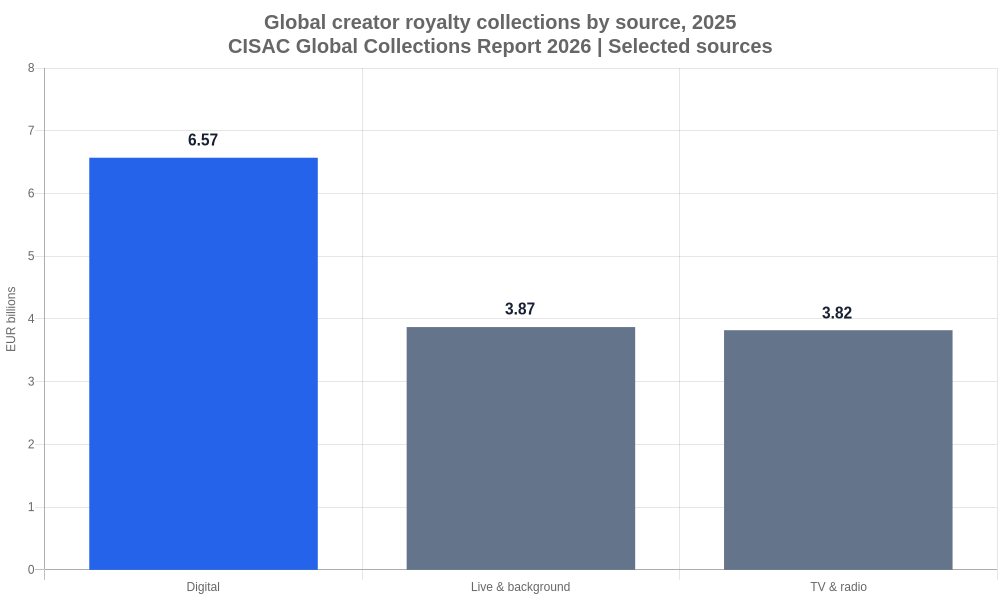
For the three largest collection channels, digital led live and background uses by €2.70 billion, and exceeded broadcast collections by €2.75 billion. The gap between live and background and broadcast was only €50 million at the reported precision. Music collections alone amounted to €14.06 billion. As Music Business Worldwide explains, digital music collections reached €6.41 billion, while their growth excluding the MLC was 11.2%. These collections should not be confused with record label revenue or the net earnings of individual musicians.
The engineering of royalty attribution
A streaming platform may record the recording identifier, territory, playback event and account or subscription category. To compensate the composition’s owners, a royalty system must associate the recorded performance with the underlying musical work and its rights shares. An International Standard Recording Code (ISRC) identifies a recording, while an International Standard Musical Work Code (ISWC) identifies a composition. The former uses 12 alphanumeric characters and the latter uses 11 characters. Several recordings can correspond to one composition, and each composition can have multiple entitled parties.
A missing identifier, conflicting ownership claim or incomplete metadata can prevent a clean match. For example, two different recordings of one song must not be interpreted as two distinct compositions simply because the recording identifiers differ. Reliable payment infrastructure consequently depends on validation, reconciliation and audit trails, not just a count of plays. A royalty report aggregates collections; it cannot independently establish how equitably those amounts are distributed among creators.
Artificial intelligence and the next measurement problem
Generative music tools complicate attribution when recordings, compositions and synthetic performances are difficult to distinguish. Related developments include Spotify’s artist profile protection, AI music publishing through SoundCloud, Deezer’s AI music filtering and YouTube Music’s AI labels. Identification systems, licensing policies and payment infrastructure address related but different challenges.
The next meaningful benchmark is whether collections continue growing on a comparable reporting basis and whether improved identification and reconciliation reduce unresolved claims. A larger digital royalty market creates incentives to build more reliable rights databases, but the 2025 figures alone cannot establish the effectiveness of any particular AI detection system.
Featured image: official CISAC report promotional artwork.
We volunteer daily to ensure the credibility of the information on this platform is Verifiably True. If you would like to support to help further secure the integrity of our research initiative, please scan the QR code below.

For mobile scanning, open the article on another display and scan the QR code with a Bitcoin wallet. The voluntary donation amount is 5,000 sats. Verify the receiving address 3C9o19EH5HSiwEPyCTmEKzxhNCbo2X6TTb before sending.
BitcoinVersus.tech is not a financial advisor. This media platform reports on financial subjects purely for informational purposes.


Leave a Reply