A benchmark with two different winners
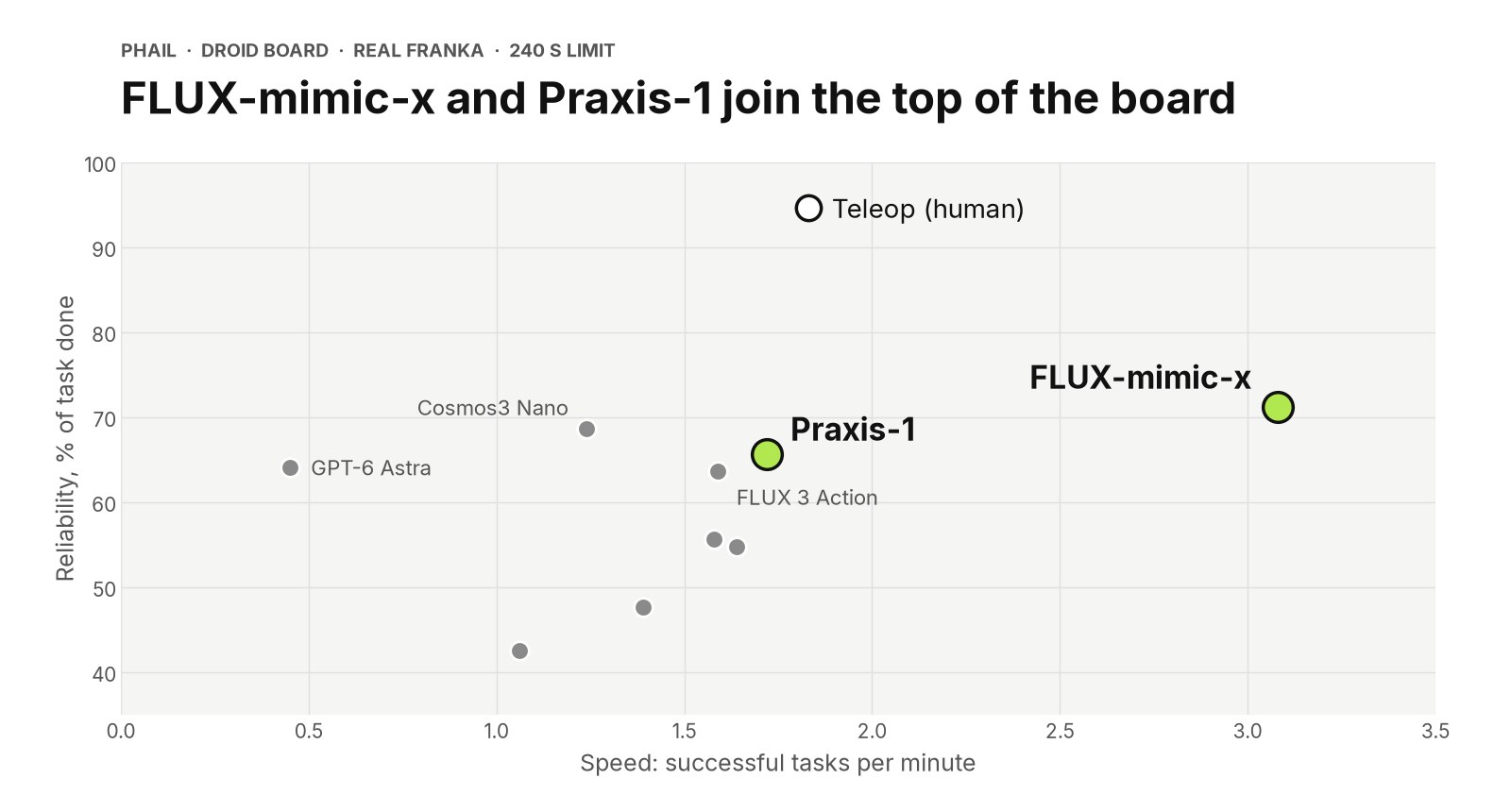
Positronic Robotics published a real-arm benchmark update on November 25 comparing FLUX-mimic-x against other physical AI systems and a human teleoperator. On shared tasks that succeeded, the model finished in a median of 11 seconds versus 27 seconds for the human. However, the operator scored 94.7 on the benchmark’s reliability metric against 71.2 for FLUX-mimic-x. The results indicate faster execution on successful trials, not overall superiority at robotic manipulation.
Featured cover: conceptual editorial artwork, not a documentary photograph of the named product or event.
Watch the video directly on YouTube if the embedded player is unavailable.
What the benchmark measures
PhAIL evaluates physical AI in simulated environments and on a Franka robot arm. Its real-arm DROID tasks allow up to 240 seconds per episode. The organizers define reliability as the percentage of the task completed within the permitted period, while speed represents successful tasks per minute. A system can be fast when it succeeds while still performing poorly on tasks that require precision, recovery or adaptation. Reporting speed without reliability would obscure a major deployment constraint.
Learning movement from video
FLUX-mimic-x uses a video-action architecture derived from a pretrained video model. Rather than treating images solely as static observations, video-based learning can expose models to how objects change position over time. An action model must translate predicted changes into commands suitable for a particular robot. The evaluation team reports that its next commands were typically prepared before the previous commands finished, helping maintain continuous arm movement. The training approach and resulting behavior require additional testing across different hardware and environments.
A numerical comparison
Dividing 27 seconds by 11 gives a successful-task time ratio of approximately 2.45. The AI’s median successful completion was about 59% shorter. Meanwhile, the reliability scores differed by 23.5 percentage points in the human’s favor. Neither calculation establishes the productivity of a factory line. A factory must account for failed attempts, reset procedures, intervention, equipment availability and the cost of damaged items. A robot that requires frequent recovery may perform worse over an entire shift despite completing individual successful tasks quickly.
Engineering toward dependable automation
The most useful future evaluation would measure repeated performance across changing object positions, lighting, payloads and tooling. Safety mechanisms must independently limit harmful movements, and a supervisory system needs ways to detect unsuccessful operations. Recovery behavior deserves special attention because production equipment cannot assume that every grasp or placement will work. A benchmark provides a controlled comparison, while a commercial deployment needs evidence of long-duration reliability and predictable behavior. The speed result is promising, but the gap in task completion shows why human performance remains a valuable comparison standard.
The benchmark is especially valuable because the human and model operate the same physical arm, rather than being compared across different machinery. Even so, the teleoperation interface adds its own constraints. Evaluating additional operators and task distributions would help establish how broadly the observed advantage applies.
Sources and related coverage
Report or primary announcement | Additional documentation
Robotic rope manipulation research | AI loader control | Arm Cortex-M42 | Modular Linux laptop
We volunteer daily to ensure the credibility of the information on this platform is Verifiably True. If you would like to support to help further secure the integrity of our research initiative, please scan the QR code below.

For mobile scanning, open the article on another display and scan the QR code with a Bitcoin wallet. The voluntary donation amount is 5,000 sats. Verify the receiving address 3C9o19EH5HSiwEPyCTmEKzxhNCbo2X6TTb before sending.
BitcoinVersus.tech is not a financial advisor. This media platform reports on financial subjects purely for informational purposes.


Leave a Reply