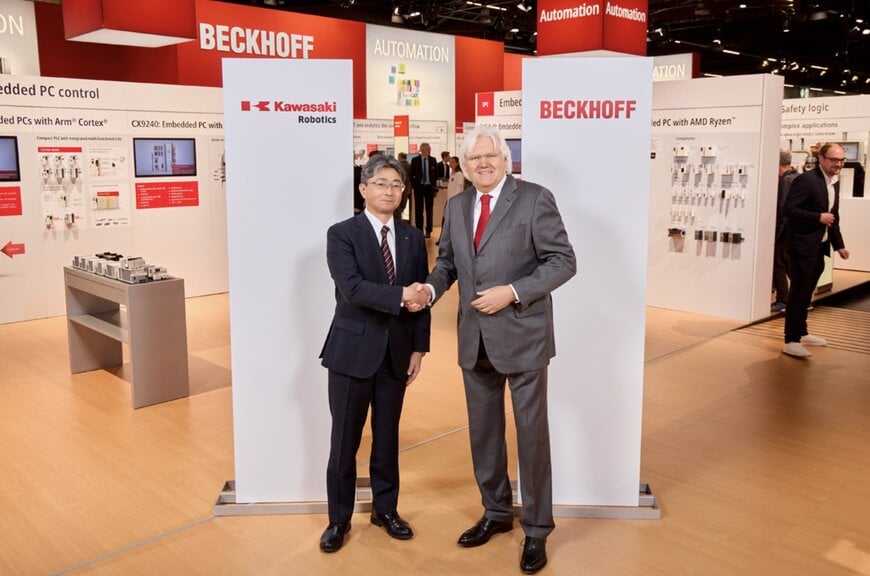
Kawasaki Heavy Industries and Beckhoff Automation signed a memorandum of understanding at SPS Smart Production Solutions in Nuremberg, Germany, on November 26, 2026. The joint announcement outlines an effort to investigate open industrial robot control architectures built around EtherCAT networking and TwinCAT automation software. The agreement follows Kawasaki’s open-control concept exhibited at iREX in 2025. It addresses the integration challenge also demonstrated by the FPGA-controlled robotic hand developed by Inova, Lattice and DLR.
Why the control architecture matters
An industrial robot cell consists of more than a manipulator. A production line may combine programmable logic controllers, servo drives, encoders, machine vision, safety equipment and material-handling mechanisms. Each device exchanges information with the machinery responsible for coordinating the sequence of operations. Interfaces between incompatible systems increase engineering effort and complicate fault diagnosis.
EtherCAT transports process data using Ethernet frames that compatible devices process as they pass through the network. Distributed clocks can synchronize operations across devices. TwinCAT supplies software for logic, motion and other automation functions on industrial computing hardware. Integrating the technologies could reduce the number of separate interfaces needed between a robot and the surrounding production equipment. GigaDevice’s industrial microcontroller with EtherCAT connectivity illustrates how the same communication technology can extend to embedded components.
Three areas of collaboration
The agreement establishes a framework for engineering support and training with system integrators, EtherCAT connectivity in Kawasaki’s industrial robots, and evaluation of PC-based control using TwinCAT. A memorandum is not a commercial product release, and the companies have not supplied a delivery date, measured control-loop performance, pricing or a list of supported robot models.
A programmable controller can coordinate a production sequence while specialized motion functions calculate trajectories and regulate motor movement. Machine vision may provide target coordinates, but its inference latency can vary. Designers must keep the timing requirements of servo control separate from computationally intensive perception workloads. Robot positioning accuracy and repeatability remain distinct performance characteristics regardless of the controller architecture.
What manufacturers should measure
A successful implementation would need to demonstrate deterministic communication under load, acceptable control-cycle jitter, positioning accuracy and repeatability, recovery after device or network faults, and validated functional safety. Greater interoperability does not automatically guarantee that any compatible device can be substituted without commissioning, calibration or safety assessment.
Industrial cybersecurity also becomes important as more components share a control environment. Kawasaki separately announced its F Series Controller S-type on November 5, with enhanced security functions. That existing product should not be confused with the prospective joint architecture. Network segmentation, authenticated access, controlled software updates and safe fallback behavior remain essential engineering considerations.
The broader industry is moving toward coordinated machines rather than isolated automation islands, as Bigwave’s integration of a humanoid with an automotive production line demonstrates. Kawasaki and Beckhoff have established a direction for development, but the commercial value of their agreement will depend on validated implementations, maintainability and support across real production environments.
Additional reporting: Drives & Controls, November 26. Featured photograph: Beckhoff press image via Automation International.
We volunteer daily to ensure the credibility of the information on this platform is Verifiably True. If you would like to support to help further secure the integrity of our research initiative, please scan the QR code below.



Leave a Reply