
The South Sea Bubble of 1720 grew around a real financial operation: exchanging British government debt for company shares. The share-price collapse exposed a crucial distinction between a state’s payment obligations and the market value of a company holding those obligations. Following the Bank of England’s founding, the episode shows how reorganizing public credit can change who bears investment risk.
Elementary overview
Imagine exchanging a promise to receive payments for a small ownership stake in a company. The company now receives the payments, while the investor owns shares whose resale price can rise or fall. A popular company can attract buyers without generating enough additional income to justify every price increase. Changing the wrapper around a financial claim does not automatically create more underlying wealth.
Learning objectives and prerequisites
After studying the lesson, learners should be able to trace the debt-for-equity exchange; distinguish debt principal, share price and dividend income; calculate how a conversion price changes shares received; and evaluate historical evidence without treating satire or famous anecdotes as complete economic records. Prerequisites are percentage arithmetic and basic familiarity with ownership and borrowing. Use paper or a spreadsheet for the exercise; no purchase, account opening or financial transaction is required.
A company with two connected businesses
Founded in 1711, the South Sea Company combined government-debt management with overseas commercial ambitions. The Bank of England’s historical timeline records the company’s competition for public debt and the dramatic 1720 share boom and crash. An investor therefore needed to assess both the government’s payments and the company’s management, expenses and prospective commercial income. Earlier sovereign-credit failures help explain why a reorganized claim could attract creditors even before speculation intensified.
The commercial story also involved enslavement. After the 1713 Treaty of Utrecht, the company operated the contract to supply enslaved Africans to Spanish America. The Bank of England Museum’s research identifies forced transportation as central to its business, recording more than 15,900 enslaved people transported on company ships between 1711 and 1720. Describing the venture only as imaginary maritime trade erases documented human exploitation.
How the debt conversion worked
A creditor surrendered an eligible government claim in return for South Sea shares under the conversion terms. The company acquired the claim on the government; the former creditor acquired equity in the company. Government payments could support company distributions, alongside other income and costs. The Federal Reserve Bank of New York’s account explains the 1720 competition to acquire debt and the company’s share-backed lending.
Three quantities must remain separate. Debt principal is the contractual amount owed. Share price is the price at which equity changes hands. Dividend income is a distribution to shareholders. Government payments to the company did not guarantee a particular resale price for its shares. As in early banking and ledger money, identify the issuer and holder of each claim before comparing balances.
Worked example: conversion price and shares received
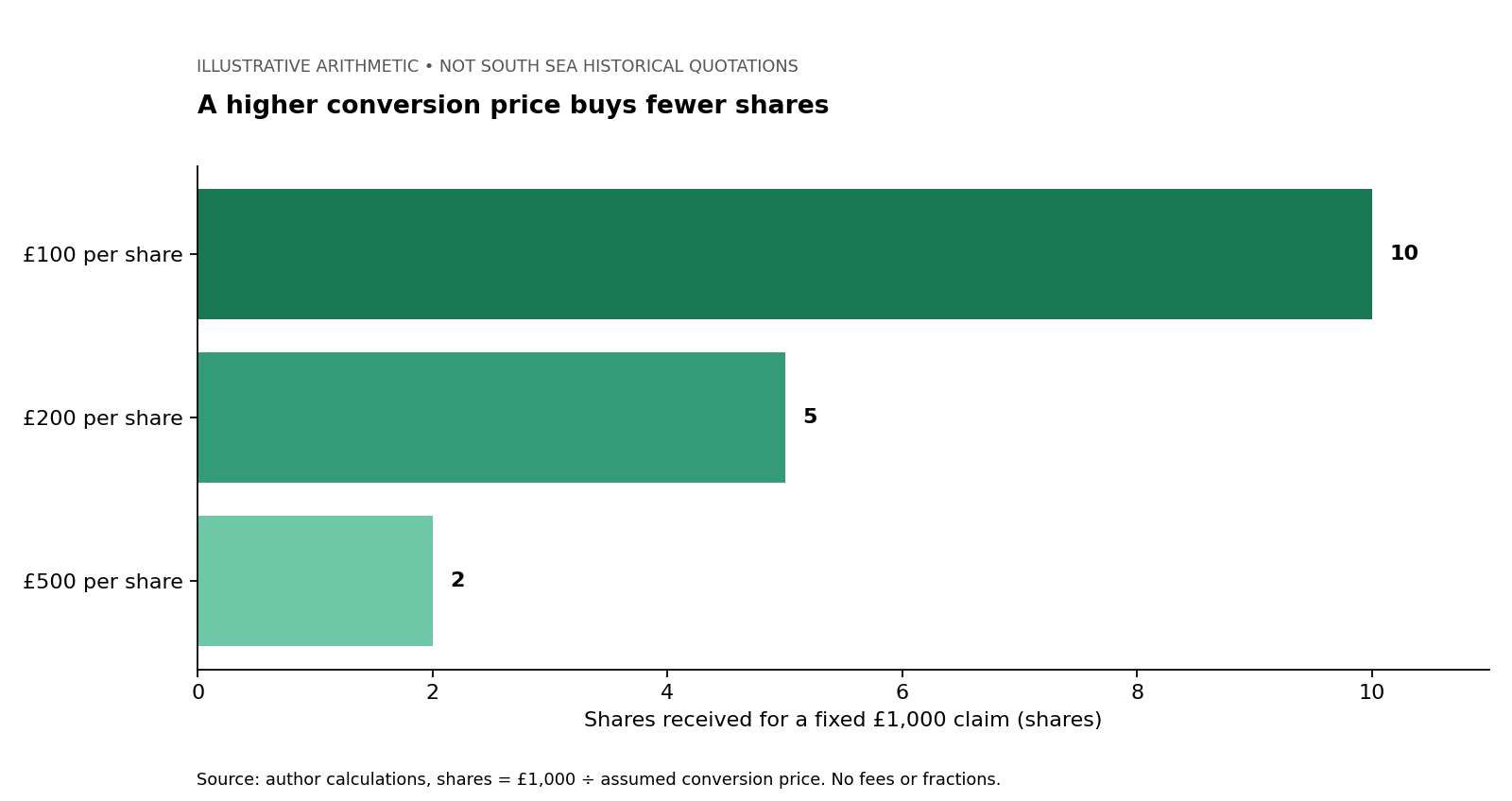
The following deliberately simplified example uses invented prices, not historical South Sea quotations. Assume a £1,000 claim is accepted at face value, with no fees and conversion at a stated price per whole share. Shares received equal accepted claim value divided by conversion price. At £100 per share, £1,000 ÷ £100 gives 10 shares. At £200, the result is 5 shares; at £500, it is 2 shares. Higher conversion prices leave the creditor with fewer shares for the same surrendered claim.
Suppose the hypothetical £500 conversion produces two shares, and their subsequent market price falls to £100 each. The holding is worth £200, an £800 decline, or 80% of its £1,000 conversion valuation, excluding dividends. That arithmetic measures the assumed investor’s equity loss. It does not establish that the government’s debt principal fell by 80%. Actual historical conversions involved different tranches and terms; the example isolates one mechanism.
Why rising collateral prices amplified exposure
If an investor borrows against shares, rising market prices can support more credit and purchases. Falling prices reverse the relationship: collateral provides less protection while the loan remains payable. In a separate hypothetical example, an investor buys £1,000 of shares with £500 cash and £500 borrowed. A fall to £600 leaves £100 after repaying principal, before interest and costs. The shares lost 40%, but the investor’s initial cash lost 80%. Borrowing magnifies exposure without improving the underlying company’s income.
Reading the crash critically
Shareholders suffered losses, and parliamentary investigations documented misconduct. Yet a severe securities crash does not by itself measure the duration or size of a national economic contraction. Helen Paul’s lecture transcript challenges accounts that reduce the episode to universal gambling or prolonged national devastation. Her interpretation should be read alongside the underlying evidence. Compare the same distinction between surviving contracts and popular retellings in the tulip-mania lesson.
François Velde’s research on Britain’s 1717–1722 restructuring examines how the conversion and subsequent parliamentary decisions redistributed gains and losses among creditors and taxpayers. It is a research working paper, not an official institutional verdict. Its focus helps explain why a share collapse and continuing government obligations can coexist. The company survived the crash rather than immediately disappearing.
Practical exercise and knowledge check
Using the illustrative assumptions, exchange a £1,200 claim at £300 per share, then value the shares at £180. Record shares received, subsequent value and percentage decline. Next, write three separate ledger entries identifying the government’s obligation, the company’s asset and the investor’s equity. Finally, explain why a satirical picture cannot independently establish either aggregate losses or the exact finances of everyone it depicts.
Answer key
The conversion produces 4 shares. Their later value is 4 × £180 = £720. The decline is £480 ÷ £1,200 = 40%, before distributions or costs. The government owes the underlying obligation; the company holds the acquired claim; the investor holds company equity. Satire provides evidence of attitudes and representation, but aggregate financial conclusions require contracts, account records and defensible measurement. A government payment stream and a shareholder’s resale outcome remain different quantities.
Elementary conclusion
The South Sea operation moved government claims into a company and gave creditors ownership stakes. The bubble made those stakes expensive, and the crash reduced their market value. Understanding the event requires following each promise, its payments and its risks. The principles connect to liquidity and bank runs: an asset’s quoted price, its eventual income and the ability to turn it into spendable funds answer different questions.
Cover: original AI-generated historical illustration; papers and objects are conceptual, not reproductions of surviving South Sea documents.
We volunteer daily to ensure the credibility of the information on this platform is Verifiably True. If you would like to support to help further secure the integrity of our research initiative, please scan the QR code below.



Leave a Reply