
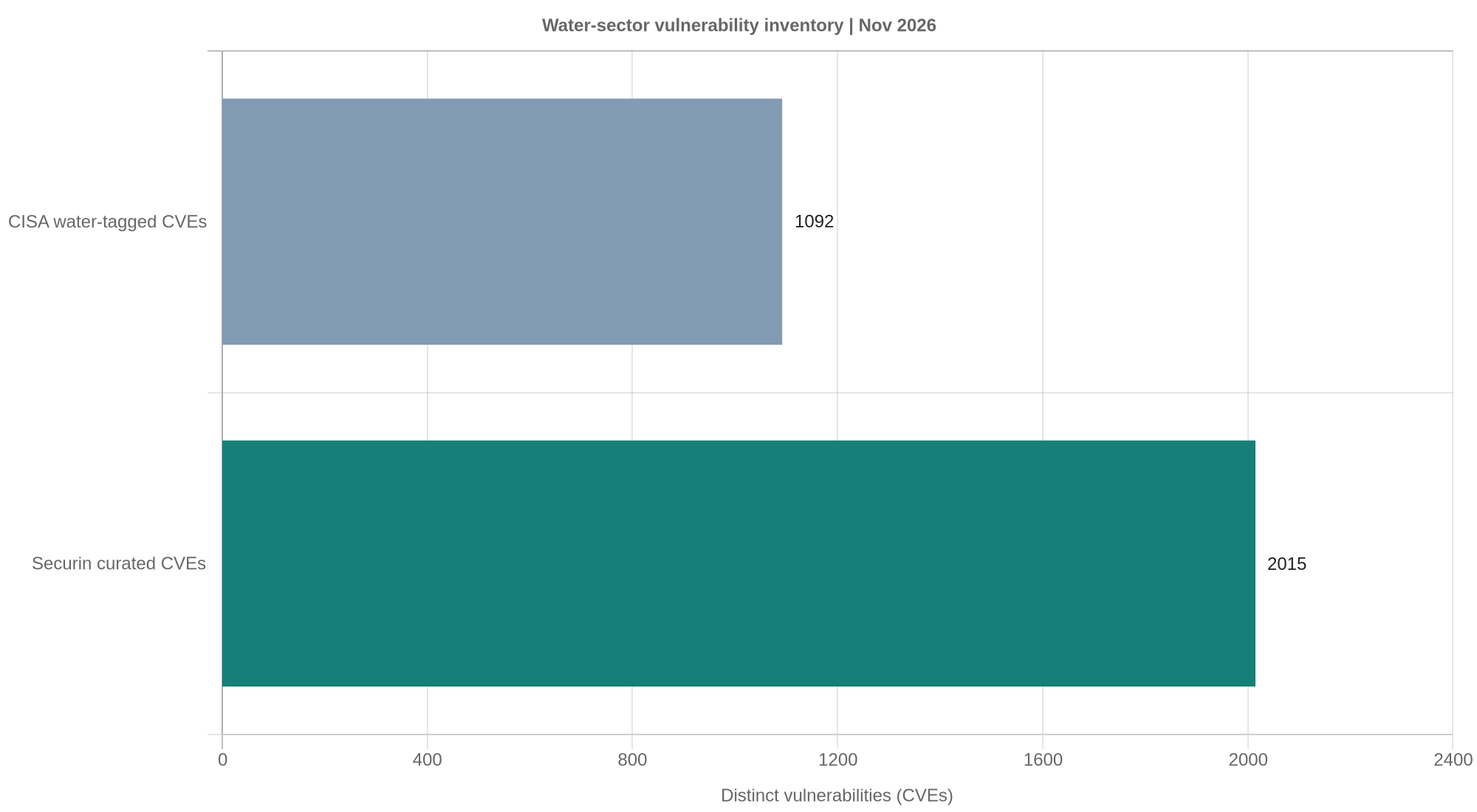
A November 2026 study of the technology supply chain behind American drinking water and wastewater infrastructure identifies a substantial gap between federal vulnerability disclosures and a broader product-level inventory. The Water Supply Chain Watch from Securin examined 236 vendors and identified 2,015 relevant vulnerabilities, compared with 1,092 in federal advisories explicitly tagged for water. The findings reinforce the importance of isolating industrial equipment from unrestricted internet access and maintaining an accurate inventory of connected assets.
Measuring the disclosure gap
Securin analyzed Cybersecurity and Infrastructure Security Agency (CISA) industrial advisories through November 20 and its exploited-vulnerability catalog through November 23. The researchers also mapped products to water-sector applications. Their curated inventory contains the publicly tagged vulnerabilities plus 923 additional entries, an increase of approximately 84.5% relative to the tagged inventory. The two counts overlap and must not be added together. A vulnerability count is neither an incident count nor a measurement of how many utilities have installed affected equipment.
The study also identifies 99 indexed vendors without a corresponding CISA advisory. That absence does not establish that their products are secure or insecure. A vendor may have no known vulnerabilities, may disclose them through another channel, or may supply components without being named in a sector-specific advisory. The index is a research sample, not a census of American utilities. The Register reported on the findings November 25.
Why asset identity matters
Water systems depend on operational technology, including instruments, pumps, valves, programmable controllers and supervisory control systems. The controller architecture determines how commands become physical actions, while the human-machine interface and SCADA layer provide operators with visibility and supervisory control. A conventional enterprise software inventory may overlook equipment purchased through integrators or embedded software bundled with industrial products.
An effective inventory associates hardware models and firmware revisions with owners, maintenance responsibilities and approved network connections. It also records software dependencies when suppliers make them available. Vulnerability management can then distinguish affected installed equipment from products that merely appear in an advisory.
Security controls must preserve water service
Unlike ordinary office systems, industrial control environments must prioritize safe operation and service continuity. Patches may require compatibility testing, scheduled maintenance and vendor approval. Operators should employ network separation, authenticated remote access, tested recovery procedures and configuration backups while evaluating changes with plant engineers. Our previous coverage of AI security testing in SCADA environments illustrates the importance of validating safeguards before introducing new software into operational networks.
The National Rural Water Association’s cybersecurity center provides resources for smaller utilities and describes its partnership with DEF CON Franklin on the Water Watch Center. Shared expertise can help facilities with limited security staffing. The central lesson from the November study is that advisory feeds alone cannot establish the security of an installed system. Maintaining asset records, verifying supplier disclosures and coordinating safe remediation with operators remain necessary even when no new vulnerability is announced.
Featured photograph: Duane Lempke, Blue Plains wastewater treatment plant, 2022, CC0. Illustrative sector photograph; no incident at the pictured facility is implied.
We volunteer daily to ensure the credibility of the information on this platform is Verifiably True. If you would like to support to help further secure the integrity of our research initiative, please scan the QR code below.

For mobile scanning, open the article on another display and scan the QR code with a Bitcoin wallet. The voluntary donation amount is 5,000 sats. Verify the receiving address 3C9o19EH5HSiwEPyCTmEKzxhNCbo2X6TTb before sending.
BitcoinVersus.tech is not a financial advisor. This media platform reports on financial subjects purely for informational purposes.


Leave a Reply