Hex.pm, the package registry serving the Elixir, Erlang and Gleam programming ecosystems, disclosed a security incident on November 24, 2026, after an unauthorized party executed commands on six production web servers the previous day. According to the maintainers’ incident report, the registry received 69 malicious requests before deploying a patched service. Investigators found no evidence of unauthorized package modifications, although possible access to account information remains unresolved. The incident follows other developer infrastructure compromises, including the 1Password backend security incident.
A critical flaw at the registry boundary
The vulnerability, CVE-2026-129514, received a maximum CVSS v4.0 severity score of 10.0. The Erlang Ecosystem Foundation advisory identifies an unsafe deserialization weakness in the registry’s server application. Deserialization converts transmitted data into objects an application can process. Allowing untrusted data to influence application behavior beyond its intended schema can undermine the security boundary between a network request and the server’s execution environment. The affected server software is distinct from the Hex package-management client. Self-hosted registries using affected code require the server-side correction documented in the official GitHub advisory.
The first 33 minutes of incident response
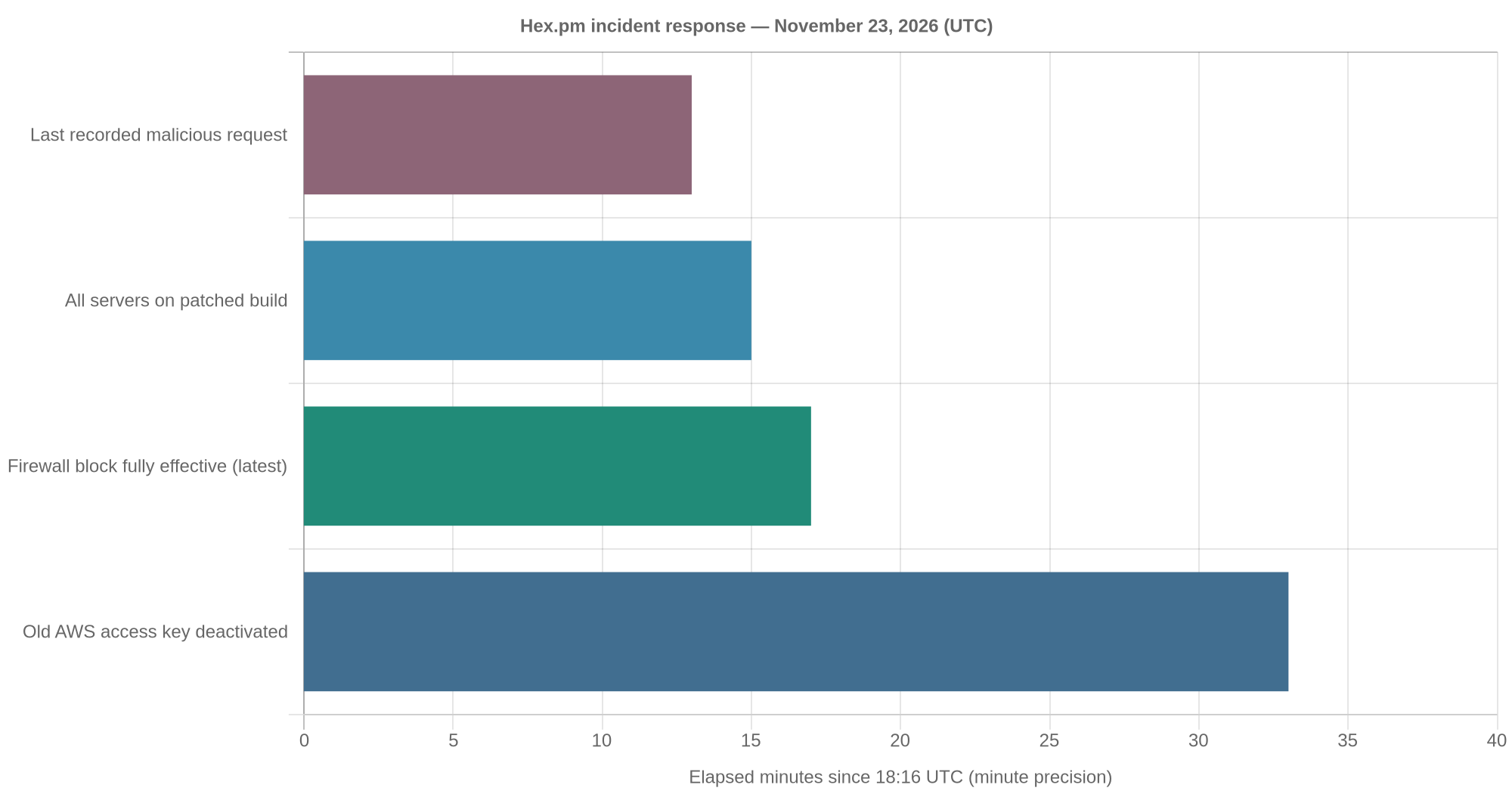
The reported times establish a 13-minute interval between the first and last recorded malicious requests. All servers were running patched builds by minute 15, the firewall restriction was fully effective by minute 17 at the latest, and the previous AWS access key was disabled by minute 33. These milestones measure containment actions, not the complete duration of remediation. Rapid emergency updates also featured in the recently reported Drupal security incident.
Why package integrity and account confidentiality differ
Registry maintainers checked package-storage writes against database records and found no unexpected changes. However, database-read activity was not logged, limiting their ability to establish whether an intruder viewed account records. Password hashes, multifactor authentication secrets, API credential hashes and session information could have been accessed. Lack of evidence of unauthorized modification does not establish confidentiality. The distinction between recorded events and unobserved activity also matters when interpreting the security findings in our AI data-retention investigation.
Protecting the software supply chain
A package registry connects published software to downstream build systems. Cryptographic signatures help clients verify authenticity, but the signing keys themselves require protection and a credible replacement procedure. Hex reported that it was developing registry signing infrastructure with key-rotation support. Users should consult the current incident guidance and obtain packages from the official repository while the transition proceeds. Our earlier cryptographic vendor-readiness coverage explains why organizations should evaluate whether cryptographic dependencies can be replaced when necessary.
Hex advises account holders to replace passwords and multifactor authentication enrollment, secure their new recovery codes, and follow official client-update instructions. Development teams should independently review dependency provenance, credential exposure and build integrity. As SecurityWeek reported on November 27, the incident also prompted attention to security defects in related libraries. The most consequential lesson is that containment, trustworthy distribution and demonstrated confidentiality are separate engineering objectives; evidence for one cannot substitute for evidence of another.
We volunteer daily to ensure the credibility of the information on this platform is Verifiably True. If you would like to support to help further secure the integrity of our research initiative, please scan the QR code below.

For mobile scanning, open the article on another display and scan the QR code with a Bitcoin wallet. The voluntary donation amount is 5,000 sats. Verify the receiving address 3C9o19EH5HSiwEPyCTmEKzxhNCbo2X6TTb before sending.
BitcoinVersus.tech is not a financial advisor. This media platform reports on financial subjects purely for informational purposes.


Leave a Reply