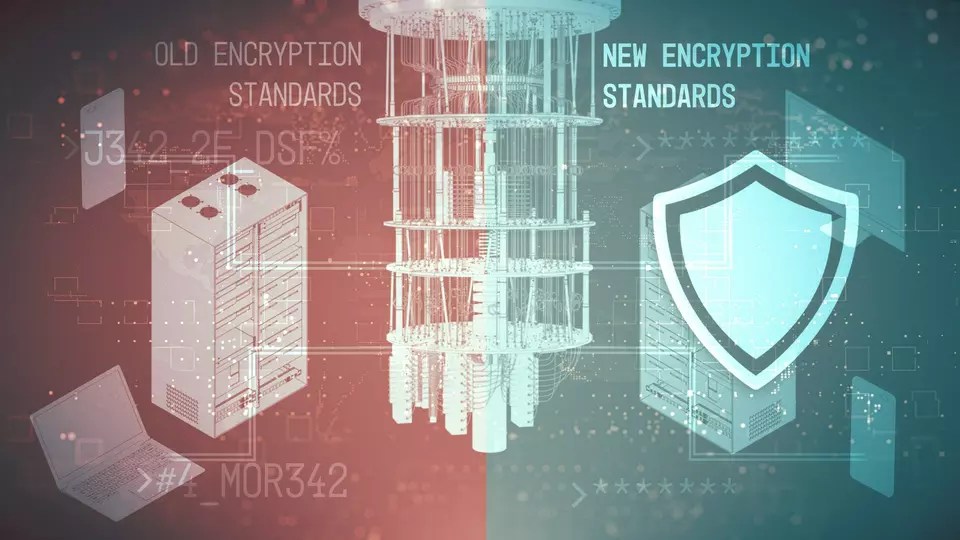
The United States and Australia have updated their guidance for evaluating technology suppliers ahead of the migration to post-quantum cryptography (PQC). The National Security Agency announced the joint publication with CISA and the Australian Signals Directorate on November 4, 2026. Australia published its accompanying update on November 5. The agencies want buyers to examine how suppliers will replace vulnerable cryptography before signing or renewing contracts.
The NSA announcement emphasizes a problem that extends beyond selecting an encryption algorithm: an organization may depend on security mechanisms controlled by manufacturers, cloud operators or managed service providers. A migration plan cannot succeed if critical components cannot be upgraded. Featured illustration credit: J. Wang/NIST and Shutterstock.
Where cryptography hides inside infrastructure
A network switch may use public-key cryptography to establish administrative connections, verify firmware signatures and authenticate management services. A storage appliance may use separate mechanisms to protect backups and communicate with its controllers. Hardware security modules and certificates create additional dependencies. Replacing a library in an application does not necessarily change the algorithms used by embedded firmware or external services.
The revised vendor questionnaire asks suppliers to identify their cryptographic components, including inherited libraries and hardware-bound operations. A cryptographic bill of materials can document algorithms, protocols, parameter choices and implementation locations. Procurement teams can then identify products that require firmware upgrades, component replacement or new vendor commitments.
From inventory to controlled migration
The agencies organize their recommendations around discovery, assessment, prioritization, implementation and stakeholder communication. Buyers should ask when standards-based algorithms will become available, how vendors validate implementations and whether certificates or key-management processes will change. A supplier that cannot yet provide a complete answer may still have a credible plan, provided its limitations and milestones are explicit.
For example, a data center operator purchasing equipment expected to remain in service for ten years can ask whether its secure-boot trust anchors can accept updated signature algorithms without replacing the motherboard. The answer affects maintenance budgets, deployment schedules and the risk of prematurely retiring otherwise functional hardware.
Why the timeline matters
NIST’s October 27 migration announcement describes accelerated United States federal deadlines for high-value and high-impact systems: 2030 for key establishment and 2031 for digital signatures. The broader federal migration target is 2035. Those milestones are not a universal legal deadline for every private company. Organizations must assess the requirements applicable to their own jurisdictions and contracts.
Sensitive information intercepted today may remain valuable for decades. A future sufficiently capable quantum computer could threaten conventional public-key protection of previously collected communications. The guidance addresses that risk through preparation; it does not establish that such a computer already exists or predict when one will become available.
Related reporting includes Cloudflare’s quantum-resistant key management, financial-sector quantum readiness, OpenSSL’s post-quantum implementation improvements and hardware roots of trust.
The practical measure of readiness is evidence: supported algorithms, documented dependencies, credible delivery dates, interoperability tests and an approved rollout plan. Cryptographic modernization is a supply-chain engineering project, not merely a change to an encryption setting.
We volunteer daily to ensure the credibility of the information on this platform is Verifiably True. If you would like to support to help further secure the integrity of our research initiative, please scan the QR code below.



Leave a Reply