
Elementary Overview
OSHistory.018 explains the trading excitement around rare tulips in the Dutch Republic during 1636 and early 1637. People wanted valuable flower bulbs, and some agreed to buy or sell bulbs that were still growing underground. Prices quoted for certain varieties rose sharply. When buyers became reluctant to make new deals in February 1637, the trade in speculative contracts stalled.
A story often told today says almost everyone in Holland gambled on bulbs, ruined their families, and brought down the national economy. Surviving contracts, estate documents, court records and modern scholarship support a narrower account. The market disruption was real, yet its participants formed a relatively limited commercial network. Oxford’s historical review reports little evidence of widespread bankruptcy or major damage to the broader Dutch economy.
The lesson follows OSHistory.017 on the 1619–1623 Kipper und Wipper monetary crisis. One crisis involved debased circulating coins; the other involved speculative contracts on a scarce luxury commodity. Neither should be treated as interchangeable with general inflation in household prices.
Learning goals: distinguish bulb sales from contracts for future delivery, explain why rare varieties carried premiums, identify the February 1637 break in trading, separate offers from completed payments, examine disputed settlement rules, and evaluate how later storytelling transformed a narrow market event into a familiar economic parable.
The Getty, Tulipmania: Money, Honor, and Knowledge in the 17th-Century Netherlands, historian Anne Goldgar. An original institutional lecture correcting exaggerated versions of the story. Getty event and video source. The video is modern historical interpretation, not contemporary footage.
Why seventeenth-century tulips commanded high prices
Tulips entered European horticulture through exchange with the Ottoman world. Dutch collectors cultivated distinctive varieties, including blooms with striking red-and-white or purple-and-white patterns. Named bulbs could be rare, slow to multiply and expensive to obtain. A fashionable collector might pay a premium for a recognized cultivar, just as collectors do for other scarce plants, artworks or manuscripts.
The striped appearance of many prized historical tulips was associated with viral infection, often called tulip breaking, which could weaken the plant and complicate propagation. However, the exact health of an individual specimen cannot be diagnosed merely from a historical painting. Rare appearance, limited supply and social status help explain genuine collector demand, even when later price quotations became speculative.
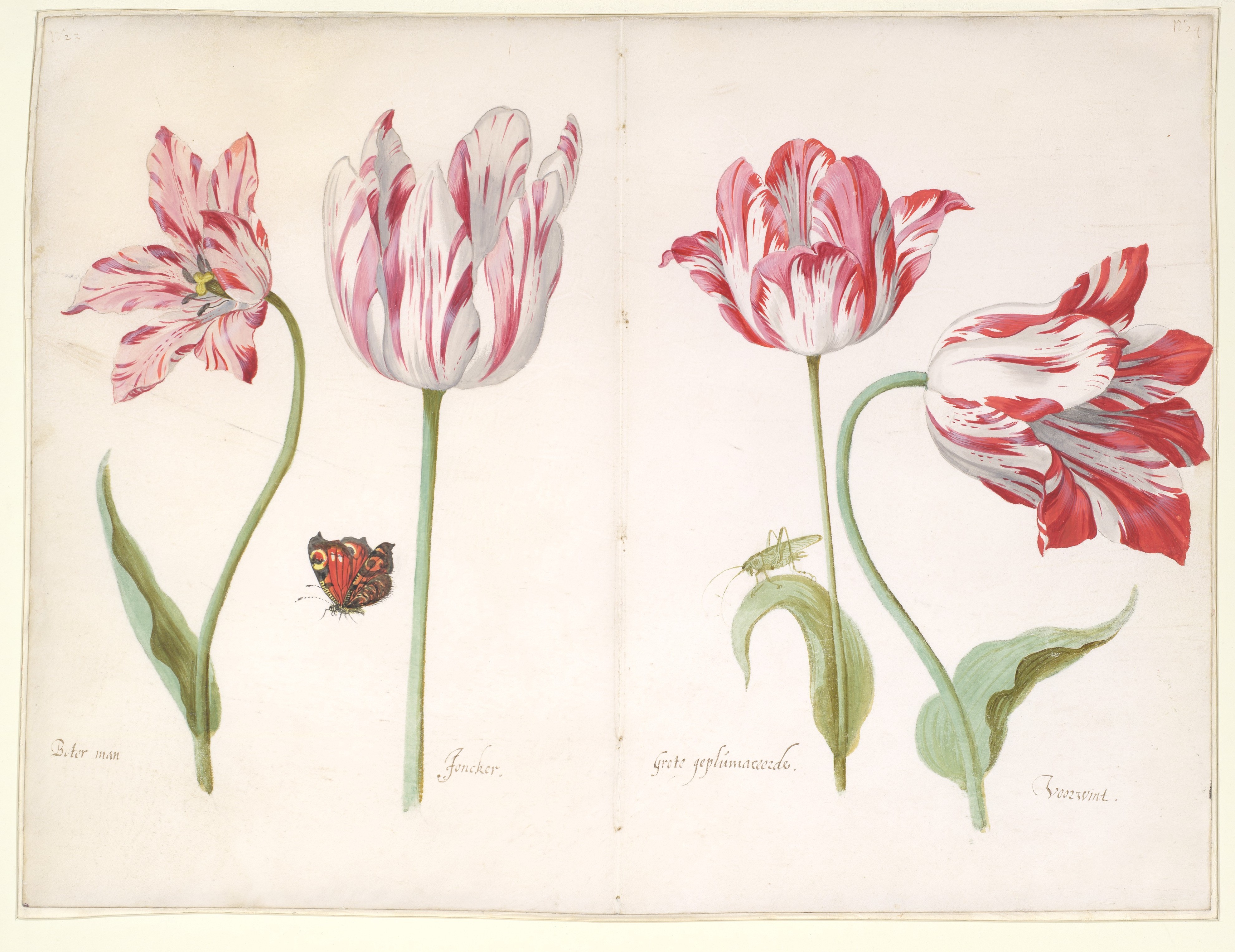
An original Rijksmuseum press release about the Six Collection tulip book describes an album containing 104 floral drawings and two historic price lists. Those surviving records are more dependable evidence of how tulips were catalogued and valued than colorful stories invented generations later. They also show why comparing every quoted price with an ordinary annual wage, without checking the cultivar or the transaction status, can mislead.
The winter contracts and the February 1637 breakdown
Tulip bulbs grow in the ground during winter. Because the bulbs could not simply be inspected and delivered as flowering plants on demand, buyers and sellers used agreements anticipating future delivery. Commercial participants sometimes traded the promise of a bulb rather than immediately moving a physical bulb. These arrangements resembled forward transactions, but the legal setting and enforcement were different from modern exchange-cleared futures markets.
Trading intensified during late 1636 and the opening weeks of 1637, including meetings in taverns associated with the bulb trade. Some prices recorded for particular varieties rose severalfold. The precise path is difficult to reconstruct because surviving quotations mix bulb sizes, cultivar names, asking prices, contract prices and completed settlements. A consolidated exchange-wide daily index did not exist.
The trade faltered in the first week of February 1637, with Haarlem central to several accounts. A scholarly article in Financial History Review evaluates one explanation: investors had poor information about how many bulbs were developing underground, and emerging growth could have changed expectations about future supply. That interpretation is a research hypothesis, not a universally established cause. Historians also consider changing confidence, contract practice and social relationships.
An eye-catching price does not establish a completed sale
The Rijksmuseum’s catalogue entry for Tulip Fever: Myth and Reality describes a highest quoted bid of 4,200 guilders for a Viceroy bulb in February 1637, but warns that the offer was probably never paid because trading was collapsing. A quoted bid, an agreed contract and money actually received are different events.
Likewise, a famous assertion that a single bulb was routinely exchanged for an Amsterdam canal house is not a reliable description of normal trading. Historian Anne Goldgar’s archival research found substantial exaggeration in the later accounts of suicide, bankruptcy and universal participation. Genuine losses and damaged trust do not require a collapse of the entire Dutch economy.
How disputed contracts were settled
With buyers reluctant to pay the original high contract prices, growers, traders and municipal authorities argued about enforceability and compensation. Proposed and locally applied resolutions differed. Studies describe cancellation or compensation arrangements sometimes around 3.5% to 10% of a nominal contract price. The final treatment depended on jurisdiction, date and the agreement involved. No single percentage should be presented as an automatic rule applied across the whole Dutch Republic.
Illustrative arithmetic: suppose a hypothetical contract stated a bulb price of 1,000 guilders. A 3.5% compensation payment would be 35 guilders, while 10% would equal 100 guilders. The remaining 965 or 900 guilders would not represent a measured loss automatically owed to the seller. Such a calculation only illustrates the difference between a large nominal contract and a much smaller possible settlement. It is not proof of actual payment or a statement about any identified historical contract.
The distinction echoes material in OSHistory.014 on bills of exchange, where trust, promises and enforceability shaped the movement of money. A financial promise can circulate at an eye-catching value while creating a far smaller cash transfer when finally disputed or settled.
Satire and the origin of the popular legend
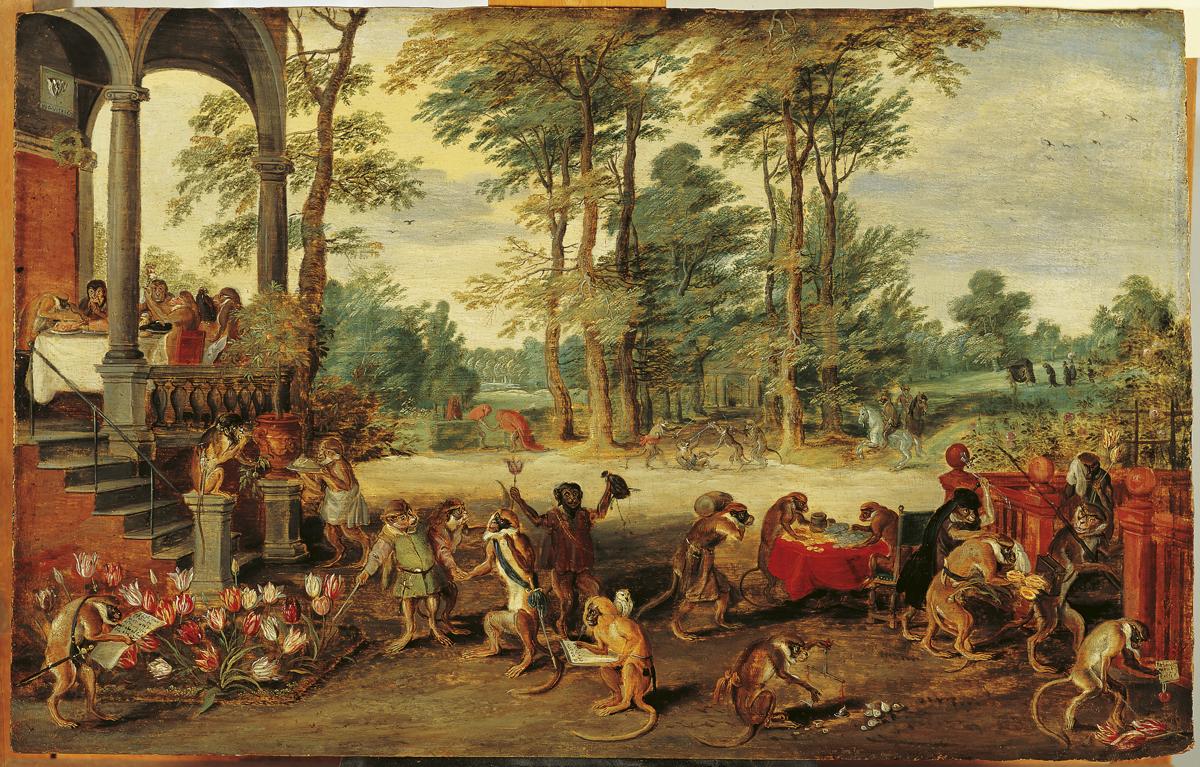
Contemporary pamphlets and paintings mocked bulb traders, sometimes depicting foolish animals or spectacular reversals of fortune. Satire is valuable evidence of public moral judgment, yet cannot be counted as literal proof that every depicted misfortune occurred. Later writers repeated dramatic material without consistently checking notarial contracts and court records. Goldgar’s published source analysis traces how nineteenth-century retellings relied on older polemical narratives.
The Oxford history essay describes a limited network of participants and no clear evidence of a wave of bankruptcies. The speculative peak, the abrupt failure of confidence in some contracts and the legal aftermath are historical subjects; claims of nationwide economic destruction are not well supported.
What the episode teaches about money and markets
Tulip mania demonstrates the importance of distinguishing ownership of a scarce object from a promise to deliver the object later. It also illustrates how prices can be shaped by incomplete supply information, reputation, contract enforcement and expectations of resale. Prices are evidence of market behavior only when their units, dates and transaction status are understood.
A market involving perishable bulbs in the 1630s differs fundamentally from modern securities or commodity money. An analogy to gold convertibility or Bitcoin must identify the specific shared mechanism, such as speculative leverage or uncertain settlement, without equating a plant, redeemable note and digital asset.
Knowledge check
Question: Does a 4,200-guilder quoted bid prove that the buyer paid 4,200 guilders? Answer: No. The bid’s execution and settlement must be independently verified.
Question: What was traded during many winter gatherings? Answer: Agreements anticipating delivery of bulbs that were still growing, rather than only bulbs physically handed across a table.
Question: Did the February 1637 breakdown demonstrably ruin the entire Dutch Republic? Answer: No. Strong price and contract disruption affected a limited circle, while evidence for an economy-wide collapse is lacking.
References and further reading
- J. Paul Getty Museum: Anne Goldgar lecture, Tulipmania: Money, Honor, and Knowledge.
- University of Oxford: Tulipmania, A Garden Historian’s Perspective.
- University of Chicago Press: Anne Goldgar, Tulipmania: Money, Honor, and Knowledge in the Dutch Golden Age.
- Rijksmuseum: Historic tulip album and price lists.
- Rijksmuseum Library: Tulip Fever, Myth and Reality, exhibition catalogue.
- Financial History Review: The timing of the tulip boom and bust, a proposed explanation.
- The Metropolitan Museum of Art: Jacob Marrel, Four Tulips.
Elementary Conclusion
Some tulips became expensive because collectors admired rare flowers. People later made promises to buy bulbs before the flowers were ready. When confidence in those promises failed, arguments followed over who owed money. The event teaches why a price on paper is different from cash actually paid, and why dramatic stories should be checked against surviving historical evidence.
Editor’s Note: The 1636–1637 chronology and scholarly interpretations were checked against Oxford, Getty, Rijksmuseum, the University of Chicago Press, and research in Financial History Review. The 4,200-guilder example is a reported bid that was likely never paid. The 3.5% and 10% compensation arithmetic is a classroom illustration and is not presented as a universal settlement rule. The 1200×630 featured anime illustration is original fictional editorial artwork, not historical testimony; the two in-story artworks are genuine public-domain museum works with attribution. One original Getty scholarly video is embedded; live playback and independent mobile screenshot inspection remain unverified.

BitcoinVersus.Tech is volunteer-run and publishes independent technical and historical education. An optional 5,000-satoshi donation supports research. Scan the original QR from a second screen or import a saved QR image into a compatible Bitcoin wallet. Independently confirm recipient 3C9o19EH5HSiwEPyCTmEKzxhNCbo2X6TTb and amount; Bitcoin transactions are generally irreversible.
We volunteer daily to ensure the information on BitcoinVersus.Tech is Verifiably True. Educational history is not individualized investment advice, and historical analogies cannot predict future asset prices.


Leave a Reply