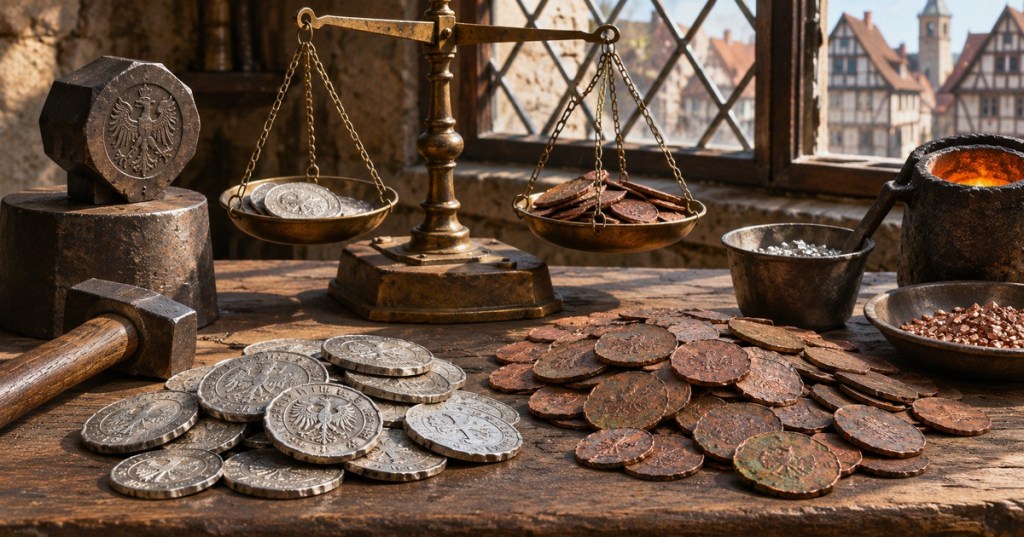
OSHistory.017 examines the Kipper und Wipper monetary crisis, a period of severe coin debasement and inflation across numerous territories of the Holy Roman Empire between roughly 1619 and 1623. Rival monetary authorities, merchants, and money changers sorted heavy silver coins, melted some of the superior coins, and issued new pieces containing less precious metal. Wartime finance intensified the practice, but fragmented mint regulation and incentives to export inferior money helped spread it beyond the original issuers.
The chapter follows OSHistory.016 on Philip II’s 1575 credit freeze. The earlier event concerned sovereign debt and merchant bankers. Kipper und Wipper was a coinage crisis: people were paid nominal amounts that increasingly diverged from the metallic value of the coins. Related groundwork includes OSHistory.003 on minting standards and OSHistory.009 on purchasing power.
Learning Objectives and Prerequisites
- Define debasement, fineness, coin denomination, seigniorage, exchange valuation, and purchasing-power loss.
- Identify the economic incentives behind clipping, sorting, melting and reminting higher-quality silver currency.
- Explain how fragmented issuing authorities and cross-border currency flows could amplify the crisis.
- Interpret an authenticated museum coin photograph without assuming its face value equals its metal value.
- Calculate a historically sourced exchange-valuation ratio, and distinguish that ratio from a modern consumer-price inflation measure.
- Describe the impact on wage earners, merchants, issuers, and trading partners without assuming uniform consequences across the Empire.
- Explain how withdrawals, legal revaluation and better-quality coinage contributed to monetary stabilization after the peak.
Prerequisites: basic percentages and ratios; familiarity with coinage and money; an understanding that early modern European territories issued multiple denominations with regional conventions. No special software is required. A calculator or spreadsheet is sufficient for the optional numerical exercise.
A Fragmented Monetary System Before the War
The Holy Roman Empire did not operate under a single centralized mint issuing identical currency in every territory. Territorial rulers and cities exercised minting rights subject to layers of imperial standards, local ordinances and practical enforcement. Lower-value subsidiary coins often circulated alongside larger pieces with more reliably assessed precious-metal contents. Coin weight, fineness, official tariff and location could all matter in a transaction.
The Deutsche Bundesbank’s free Money Museum teaches how monetary standards and state authority shaped the history of coinage. The Staatliche Museen zu Berlin’s Münzkabinett preserves coin specimens from the exact crisis period, including the Balan Collection. The Thirty Years’ War began in 1618, magnifying the financing pressure on many issuing authorities, but debasement’s structural incentives existed earlier.
Staatliche Museen zu Berlin, “Münzkabinett | National Museums in Berlin (DE/EN),” published April 6, 2011. Official museum introduction to the historical collection and coinage. The film is general numismatic background, not documentary footage from the seventeenth century.
How Kipper und Wipper Coinage Was Produced
The name is associated with tipping weighing scales and selecting better-quality coins. Higher-grade silver pieces could be separated from worn or inferior pieces and purchased, clipped or melted. Silver recovered from them was combined with less valuable metals, including copper, and struck into a greater nominal number of coins. That manufacturing sequence gave mints, their operators and cooperating merchants the opportunity to capture seigniorage or related exchange gains.
The practice exploited a difference between what a coin said it was worth and what its silver could purchase or fetch in another monetary market. The Federal Reserve Bank of New York’s historical analysis describes clipping and reminting as related mechanisms, with money moving between jurisdictions that did not all debase at the same time.
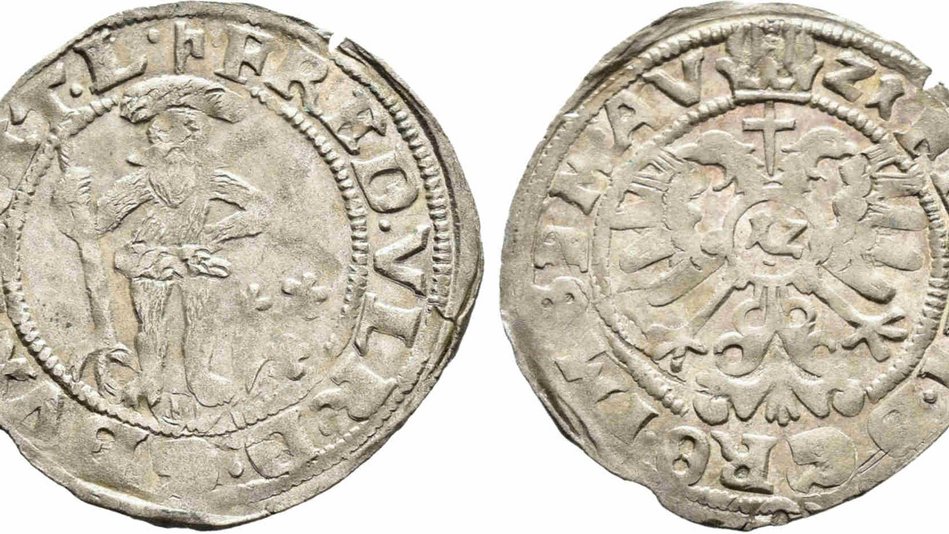
The Berlin museum reports more than 2,000 newly acquired Kipper-era coins from the Balan Collection, including examples produced in territories ruled by Friedrich Ulrich of Brunswick-Wolfenbüttel. Its curators describe more than 50 mints associated with his dominion and more than 220 identified coin types. Those counts describe a particular issuer and historical collection; they do not enumerate all coins or all mints in the Empire.
The Role of War and Competitive Debasement
The outbreak of the Thirty Years’ War raised demand for troops, provisions, transport and military equipment. Governments needed money quickly, while individual mint authorities had incentives to profit from exchanging new low-silver coins for older money. A neighboring territory that received an influx of debased currency might see its own better coinage disappear from circulation, creating pressure to copy the practice or impose controls.
Economists summarize one mechanism through Gresham’s law: under sufficiently rigid official exchange valuations, lower-quality money tends to remain in payments while higher-quality money is hoarded, exported or melted. The observation does not mean inferior coins literally replace superior coins in every free market; when different qualities trade at floating exchange rates, their prices can separate. New York Fed historians James Narron and David Skeie connect the contagion to the practical flow of coins between territorial monetary systems.
The crisis’s distributional consequences were substantial. Authorities and money handlers able to mint or exchange coins early could obtain revenue, but workers receiving nominal wages and people owed fixed sums faced declining command over goods. Merchants had to decide which coins were acceptable and at what premium. The Berlin Münzkabinett specifically reports diminished purchasing power for wage earners whose incomes did not keep pace with rapid price increases.
A Museum-Sourced Measure of Monetary Deterioration
Berlin’s Münzkabinett records one regional example: before the Thirty Years’ War, the relevant kreuzer was valued at approximately one ninetieth of a full-value Reichstaler. By the end of 1621, it had fallen to less than one three-hundred-ninetieth. Reversing those relationships gives approximately 90 small coins per good Reichstaler before the war, versus more than 390 by late 1621.
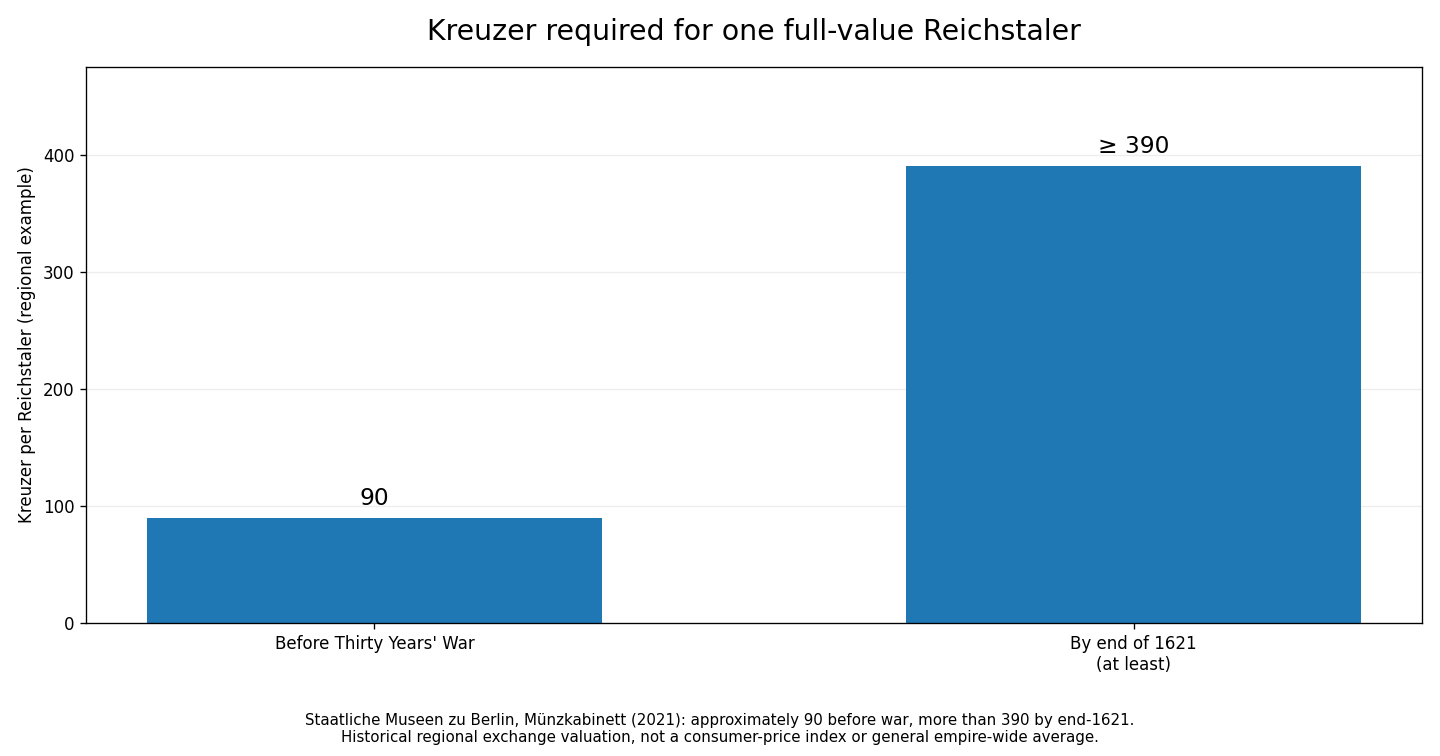
The minimum ratio is 390 ÷ 90 ≈ 4.33. Since the later historical amount is actually more than 390, the deterioration represented by the valuation exceeds 4.33 times. Inverting the coin’s value yields a maximum relative value of less than 90 ÷ 390 ≈ 23.1% of the earlier benchmark, using the same full-value reference. These are derived measures of exchange valuation, not measured price inflation for bread, grain or an entire consumer basket.
Never present a single regional exchange rate as a universal figure for all territories, dates or coin types. Different standards and tariffs produced different results. Nor should the label “hyperinflation” be confused with the modern Cagan threshold defined for monthly inflation in price-level series. Historical institutional accounts do describe the crisis using the term, but the present calculation alone cannot determine a modern monthly inflation classification.
Why Coin Images and Old Records Matter
The surviving coins tell researchers about minting authorities, denominations, iconography and metal composition. A coin’s date and inscription can help identify its issuer, while weight and fineness must be measured separately. Surface color alone does not establish exact silver content; corrosion, cleaning, lighting and alloy composition can alter appearance. Historians combine specimens with mint ordinances, price lists, account books and contemporary complaints to reconstruct the monetary crisis.
The University of Heidelberg’s NumiScience education project describes both actual Kipper coins and period broadsheets. Such contemporary printed satire provides evidence of public responses, while museum examination and written records support claims about metal content or exchange relationships. An illustration mocking money changers reflects its creator’s viewpoint; it is not a complete economic census.
Staatliche Museen zu Berlin, “Allein im Museum | Münzkabinett mit Bernhard Weisser,” published April 8, 2020. The museum director’s free gallery tour covers coinage from antiquity through the early modern period (early modern discussion begins around 08:20). Contextual education, not a film of the 1621 event.
From Crisis to Monetary Stabilization
By 1622–1623, many territories began restricting or recalling inferior money and reinstating higher-quality coinage. Policies included revised tariffs, new minting standards and invalidation of selected debased pieces. The Deutsche Bundesbank’s historical exhibit materials place the broad reform period around 1623–1624; the transition did not occur on one day throughout the Empire.
Recoinage imposed costs. Holders of inferior currency could suffer losses when coins were recalled or revalued. Governments might bear some fiscal burden, but households and merchants could still experience real transfers of wealth. Stabilization required more than printing a new coin legend: the issuing authorities needed a credible standard, workable redemption and enforcement, and sufficient public acceptance to resume trade.
Unlike the Medici Bank failure or the 1575 Spanish credit freeze, Kipper und Wipper was not primarily the insolvency of a single debtor. It was a multi-authority problem involving coin manufacture, monetary valuation, tax collection and cross-border circulation. All three episodes nevertheless show how financial trust can be undermined when nominal promises become disconnected from expected settlement value.
Practical Historical Analysis Exercise
- Specimen interpretation: Inspect the Berlin museum coin photograph. Identify the specimen’s 1621 date, denomination and issuing polity from its label. Distinguish visible features from metal-analysis claims that require additional laboratory evidence.
- Rate calculation: Compute the lower-bound increase in regional kreuzer required to buy one full-value Reichstaler: 390 / 90 ≈ 4.33. Explain why the museum’s “more than 390” means the true ratio exceeds the bar shown.
- Purchasing-power distinction: Explain why the 4.33 ratio is not the same as a 333% rise in the general consumer-price index, despite being a large monetary valuation change.
- Incentive mapping: Write a short narrative following an old silver coin from a money changer through melting, alloying, striking and circulation, noting who might profit at each stage.
- Source comparison: Compare the Berlin museum’s artifact-centered account with the New York Fed’s crisis narrative. Identify claims they corroborate and claims that require regional historical records.
- Modern analogy: Contrast metal debasement under fragmented territorial mints with an electronic bank-ledger balance. State two important institutional differences instead of asserting equivalence.
Knowledge Check and Answers
- What does debasement mean? Reducing a coin’s precious-metal content, mass or quality relative to an established nominal monetary standard.
- Who operated during the crisis? Multiple territorial mints and money handlers across the Holy Roman Empire; no single issuing authority controlled all of them.
- Why did high-quality silver coins disappear from ordinary circulation? Their melt, export or exchange value could exceed the value of spending them at an official rate.
- Was the cause only war? No. The war increased financing demands, while monetary fragmentation and pre-existing minting incentives helped produce the outcome.
- What museum example demonstrates the scale? A regional kreuzer was about 1/90 of a full Reichstaler before the war and below 1/390 by late 1621.
- How many times did the exchange valuation deteriorate at minimum? More than 390/90, or more than 4.33 times, under the cited regional comparison.
- Did every territory and coin reach the same valuation? No. Mint standards, local rates and reform timelines varied.
- What kind of media should students trust for an actual historical coin? A cataloged museum specimen with an attributed photograph, collection provenance and documented identification.
- What ended the crisis? Reforms, coin recalls, revaluations and renewed higher-quality minting across multiple authorities during 1623–1624 rather than one instantaneous Empire-wide action.
Primary Institutional and Educational References
Staatliche Museen zu Berlin, Münzkabinett — Kipper und Wipper Balan Collection (2021); Federal Reserve Bank of New York — Crisis Chronicles (2013); University of Heidelberg, NumiScience — Material Evidence of the Crisis; Deutsche Bundesbank — Money Museum; Berlin Bode-Museum — Coins and Medals Collection. Both videos are official educational productions of the State Museums in Berlin.
Conclusion
Kipper und Wipper shows how rapid expansion of nominal money can coexist with declining confidence in the money itself when issuers debase the underlying metal. Fragmented regulation, conflicting local incentives, wartime spending, exchange arbitrage and uneven adjustment among wage earners and merchants helped amplify the crisis. The surviving museum coins, contemporary documents and regional exchange valuations provide evidence for studying monetary credibility without pretending a modern inflation index existed four centuries ago.
Editor’s Note: OSHistory.017 follows the verified OSHistory.016 curriculum lesson. The 1200 × 630 cover is original AI-generated historical editorial art depicting a fictional object-only coinage workshop, not a contemporary historical artwork. The Berlin 1621 coin image is a credited genuine museum specimen. The rate comparison chart derives solely from Berlin Münzkabinett’s published regional estimate: roughly 90 kreuzer per full Reichstaler before the Thirty Years’ War and more than 390 by late 1621. Neither the picture nor the calculation implies an Empire-wide consumer-price index. The two museum videos provide historical coinage education and do not purport to document the seventeenth-century crisis on film. YouTube player presence and actual playback are audited separately.

For mobile donation, display the QR on a different screen or use a compatible wallet’s saved-image scanner. Verify the 5,000-sat payment amount and destination before sending.
We volunteer daily to ensure the information on this platform is Verifiably True. If you would like to support the research, please scan the QR code.
BitcoinVersus.Tech provides educational historical and financial information, not individualized financial advice.


Leave a Reply