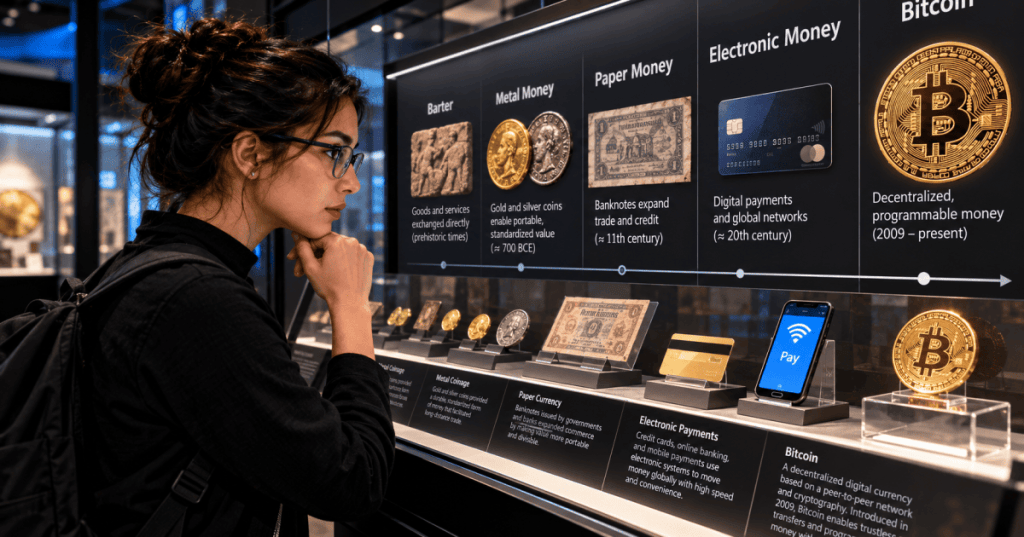
A bill of exchange is a written order directing one party to pay a specified amount to another party, either on demand or at an agreed future date. In the history of money, bills of exchange became important because merchants could transfer claims across commercial networks without physically transporting the full value in coins. The instrument did not eliminate debt or risk; it transformed how obligations could be documented, financed and settled. This lesson is OSHistory.014, following OSHistory.013 on medieval tally sticks and split receipts.
Trade, distance and the cost of moving coins
Medieval and early modern commerce faced practical constraints. Coins had weight, transportation costs and theft risk, while different cities and political authorities used different currencies and standards. A merchant selling cloth in one trading center might need to pay a supplier elsewhere weeks before the merchant’s own customers paid. Credit arrangements and transferable payment orders helped bridge these gaps.
The development of European bills of exchange is associated with medieval merchant banking, including networks connecting Italian commercial centers and major trading fairs. Their use and legal treatment evolved over centuries; no single surviving document or city explains the entire history. Encyclopaedia Britannica’s explanation of bills of exchange describes the instrument’s basic parties and function.
The parties to a bill of exchange
A conventional bill identifies a drawer, who issues the payment order; a drawee, who is instructed to pay; and a payee, who is entitled to receive payment. When the drawee formally accepts a time bill, the drawee becomes responsible for paying it under the relevant legal framework. The parties can be businesses, merchants or financial institutions. Historically, the precise terms and enforceability varied by jurisdiction and period.
The next existing editorial illustration depicts an early banking and ledger environment. It supplies historical context for the bookkeeping and merchant relationships on which payment instruments depended; it is not a reproduction of an authenticated medieval bill.
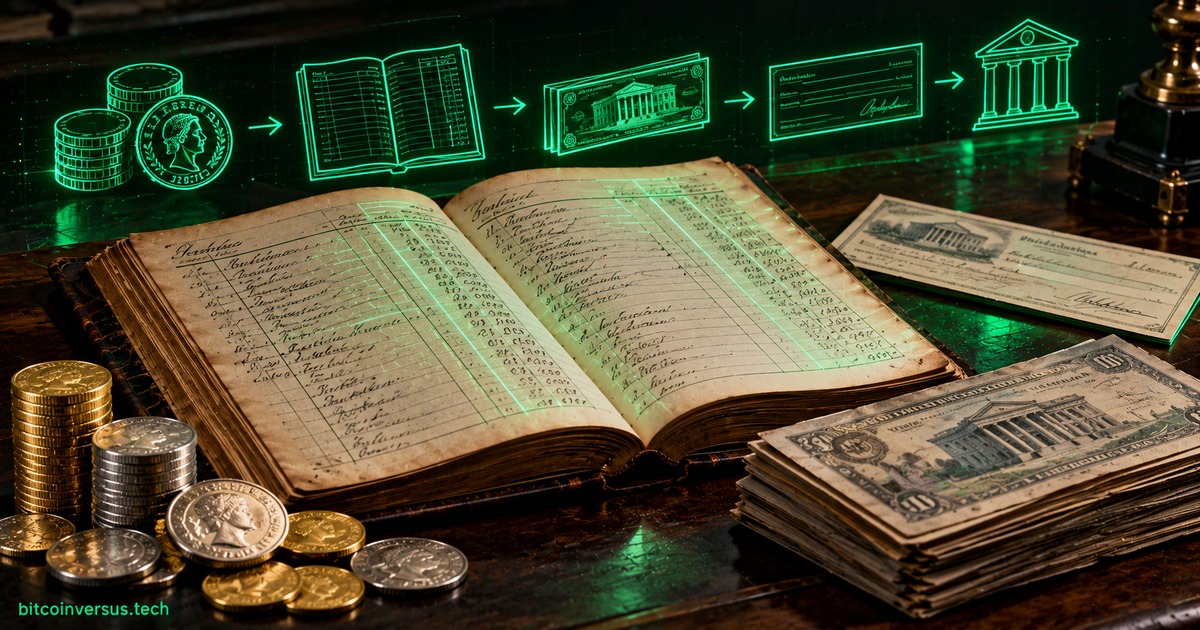
For the development of deposit accounting, claims and banknotes, see OSHistory.004 on early banking and ledger money.
How a merchant payment order worked
Consider a simplified historical example. A cloth merchant in Florence owes a trading partner in Bruges the equivalent of 100 units of account. Rather than sending a chest of coins, the merchant arranges for a trusted correspondent to pay the partner in Bruges. A bill documents the instruction and identifies who must pay, to whom and when. Settlement still requires funds, credit or a reciprocal balance somewhere in the network. The document is not itself a guarantee that every participant will perform.
Because different markets used different currencies, bills of exchange were also connected with exchange-rate quotations and the financing of trade. A time bill might mature after an agreed interval, allowing goods to be sold before the obligation came due. Merchants and bankers could sometimes discount a bill, paying its holder less than its face amount today in exchange for the right to collect its full amount later. These practices involved counterparty risk, liquidity and legal enforceability.
Worked example: discounting a trade bill
Suppose a merchant holds a bill promising payment of 1,000 monetary units in 90 days. A financier agrees to purchase it immediately for 980 units. The merchant receives working capital now, while the financier stands to collect 20 units more at maturity if the bill is honored. The simple discount relative to face value is (1,000 − 980) ÷ 1,000 = 2% over the 90-day term.
For a rough comparison using a 360-day commercial year, four 90-day periods imply a simple annualized discount of 2% × 4 = 8%. This is a deliberately simplified calculation: actual historical pricing, day-count conventions, fees, currency conversion and legal arrangements varied. The 8% figure is not a verified rate from a particular medieval market.
Receipts, paper money and bills of exchange are different
A tally stick could record an obligation or receipt, often with matching pieces that helped verify the record. A bill of exchange instead directs payment through named parties and may circulate or be discounted under applicable rules. A paper banknote is another form of monetary claim or currency instrument, with a distinct issuer and monetary context. These developments were related to the wider history of trust and recordkeeping but were not identical inventions.
The following existing illustration of early Chinese paper money offers a comparison with a different historical pathway toward paper-based monetary instruments. It should not be interpreted as an example of a European bill of exchange.

The development of transferable credit
As commercial law and banking institutions developed, bills and related instruments could be endorsed, transferred and used in trade finance. A bill’s acceptance and the creditworthiness of the parties mattered because the paper represented a claim on future payment rather than a commodity with inherent value. This helps explain why merchants cared about reputation, accounting records and legal procedures.
The broader history of banking panics and liquidity shows the limits of confidence-based payment systems. Credit instruments can reduce the cost of trade while transmitting losses if a debtor, accepting bank or settlement network fails. For modern context, the Bank of England’s explanation of payments distinguishes modern payment messaging and settlement from the historical instruments discussed here.
Why this matters to the history of technology and Bitcoin
Bills of exchange demonstrate that money’s history is also a history of information technology: records, authentication, counterparties, communication and settlement rules. They let merchants transmit instructions and credit claims across distances long before electronic networks. Modern electronic cash proposals and Bitcoin address different design problems involving digital transfer and verification. Bitcoin does not simply replicate a merchant bill: its ledger and consensus mechanism aim to verify transfers without relying on a particular drawee to honor a written payment order.
For related developments, review commodity money, ledger money, paper money in China and the history of electronic cash.
Knowledge check
- What roles do the drawer, drawee and payee perform in a bill of exchange?
- Why could a merchant prefer a bill of exchange to physically shipping coins?
- Why does discounting a bill not eliminate credit risk?
Answers: The drawer issues the order, the drawee is directed to pay and the payee receives payment; bills could reduce transportation and coordination costs; the person obligated to pay may still default or be unable to settle.
References and further reading
Read Britannica’s entry on bills of exchange, the Bank of England’s overview of payment systems for modern comparison, and the linked Open History lessons for context. Dates and institutional practices should be checked against specialist histories when studying a particular trading city or archival bill.
BitcoinVersus.Tech Editor’s Note: Support independent education about money, technology and Bitcoin with a contribution of 5,000 sats. Scan the Bitcoin donation QR below with a compatible wallet to help fund future lessons.

Display the QR code on another screen and scan it with your Bitcoin wallet.


Leave a Reply