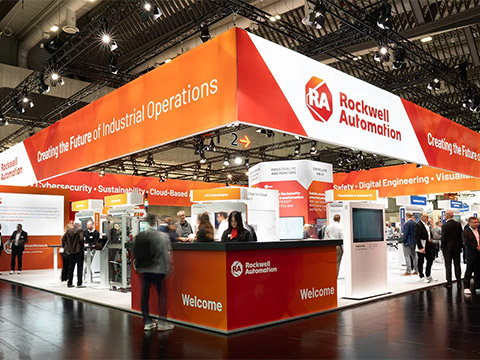
Industrial artificial intelligence is moving closer to production equipment. On November 17, Rockwell Automation announced two GPU-equipped industrial computers at its Automation Fair in Boston. The 6300B-SB1 EdgeAI 4000 integrates an NVIDIA RTX PRO 4000 Blackwell GPU, while the EdgeAI 2000 uses an RTX 2000E Ada Generation GPU. Both are designed to expand processing capacity at the supervisory level of factory automation rather than replace the programmable logic controllers already operating machinery.
The factory computing hierarchy
A manufacturing line may contain sensors, actuators, drives and controllers operating at different timescales. A programmable logic controller executes defined sequences, including responses to sensor inputs and instructions to motor drives. A supervisory computer can collect data from several machines, display production information and run analysis that would be computationally expensive on a conventional controller. Our earlier coverage of Rockwell’s LogixEdge platform examined a related approach to combining industrial control with edge software.
A discrete GPU provides parallel processing resources particularly suited to matrix operations and many image-processing algorithms. In visual inspection, for example, cameras may capture products on a moving conveyor while a neural network examines the frames for defects. A local computer can process the images without sending each frame to a remote cloud service. Actual inspection accuracy still depends on training data, lighting, camera geometry and the selected model.
Keeping AI close to equipment
Rockwell identifies machine vision, predictive maintenance, model predictive control and small language models as possible workloads. A maintenance assistant might combine readings from a motor or drive with approved documentation to help an operator diagnose abnormal conditions. It should not independently bypass machine safeguards or issue unvalidated control commands. Earlier BitcoinVersus.Tech reporting on safe torque off explains why safety functions require clearly defined operating boundaries.
Local processing can reduce dependence on the availability of an external network and allow sensitive operational records to remain on site. However, a GPU cannot guarantee a particular latency or production improvement without information about the software, workload, data movement and operating environment. A plant also must account for electrical consumption, heat dissipation, security updates and long-term hardware support.
An expanding industrial business
The announcement follows Rockwell’s proposed AGILOX acquisition and broader industry efforts to connect automation systems to intelligent software. Humanoid robot integration with factory controllers illustrates another use of coordinated local computing. Control Global independently reported the announcement. Neither report establishes measured inference performance or factory-wide economic savings for the new products. The next meaningful milestone will be documented production deployments with workload-specific benchmarks and validated operational reliability.
We volunteer daily to ensure the credibility of the information on this platform is Verifiably True. If you would like to support to help further secure the integrity of our research initiative, please scan the QR code below.

For mobile scanning, open the article on another display and scan the QR code with a Bitcoin wallet. The voluntary donation amount is 5,000 sats. Verify the receiving address 3C9o19EH5HSiwEPyCTmEKzxhNCbo2X6TTb before sending.
BitcoinVersus.tech is not a financial advisor. This media platform reports on financial subjects purely for informational purposes.


Leave a Reply