
Research announced by the Regensburg Center for Ultrafast Nanoscopy on July 3, 2026, investigated the limits of observing electron motion with lightwave-driven scanning tunneling microscopy. A November 7 retrospective brought renewed attention to the experiment. Its relevance to future electronics lies in understanding electron dynamics, not demonstrating a commercial processor speed record.
Featured illustration: an electron wave packet between a microscope tip and a sample, credit Brad Baxley for the University of Regensburg; artistic rendering, not a photograph.
What an attosecond represents
An attosecond is one quintillionth of a second. Electronic motion within atoms and materials can occur on time scales far shorter than the clock periods of contemporary digital processors. Studying such motion requires measurement techniques capable of resolving very short distances and brief temporal intervals.
A scanning tunneling microscope brings a conductive tip close to a sample. Quantum tunneling permits a measurable current across the gap. The current is sensitive to local electronic structure and tip position, allowing atomic-scale imaging. Measuring rapid changes requires additional temporal control.
Using light to probe electrons
Regensburg researchers used precisely controlled near-infrared light waveforms to influence electrons near the microscope tip. Excitation can increase the energy of an electronic wavefunction and reduce its localization. The study investigated the tradeoff while retaining atomic-scale spatial resolution under optimized conditions.
The physical limit reflects the quantum nature of matter and the relationship between localization and momentum. Improving temporal resolution does not automatically preserve unlimited spatial precision. A measurement technique must balance the characteristics of the excitation pulse with the behavior of the state being observed.
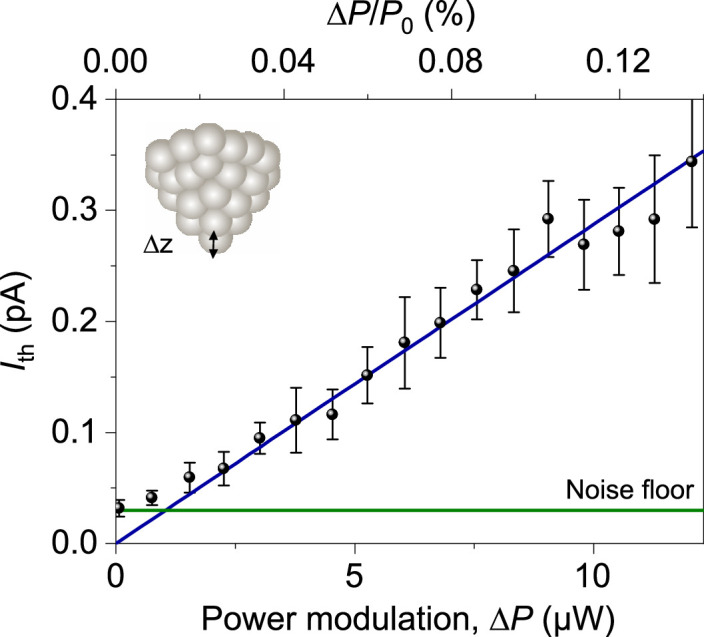
Laser stability is also essential. The researchers measured how small variations in laser power create unwanted thermal contributions to the tunnelling current, illustrating why isolating the optical signal requires careful experimental control.
The difference between observation and computation
The speed of an individual electronic process differs from the operating rate of a complete computer. Digital systems need reliable logic operations, memory access, interconnects, synchronization and readout. Thermal constraints and error rates also influence achievable performance. A microscope capable of resolving attosecond dynamics is not an attosecond computer.
Future research could use light-controlled electronic wave packets to investigate chemical reactions and new information-processing techniques. Practical technology would require controlled switching, reproducible logic operations, integration, energy accounting and performance measurements across larger systems. The immediate achievement belongs to experimental measurement science; faster computing remains a research direction.
July research announcement | Nature Photonics paper | November retrospective
Quantum control systems | Nanoscale fabrication | Electrical engineering | Photonics manufacturing
For scale, a hypothetical 1 GHz clock has a period of one nanosecond, equivalent to one billion attoseconds. A 100-attosecond measurement interval is ten million times shorter than that clock period. The arithmetic describes a comparison of timescales, not an achievable processor clock rate. Many independent physical processes and engineering constraints separate a measurement interval from a reliable computing cycle.
A future experiment demonstrating controlled electronic switching at comparable timescales would represent a separate milestone from microscopy. To evaluate a complete device, researchers would also need to measure switching energy, reproducibility, signal recovery and integration with other circuit elements. Without those measurements, projections about faster computing remain conditional.
We volunteer daily to ensure the credibility of the information on this platform is Verifiably True. If you would like to support to help further secure the integrity of our research initiative, please scan the QR code below.

For mobile scanning, open the article on another display and scan the QR code with a Bitcoin wallet. The voluntary donation amount is 5,000 sats. Verify the receiving address 3C9o19EH5HSiwEPyCTmEKzxhNCbo2X6TTb before sending.
BitcoinVersus.tech is not a financial advisor. This media platform reports on financial subjects purely for informational purposes.


Leave a Reply