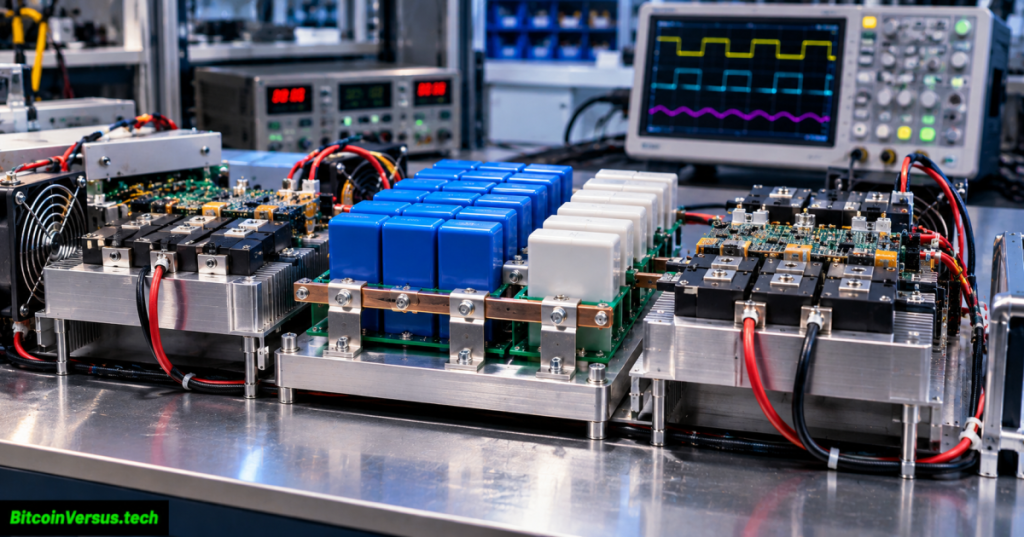
Electrical engineers at the University of Wisconsin–Madison have demonstrated a 2 kW DC-to-DC converter that substitutes an electric-field coupling network for the magnetic transformer normally positioned between two switching bridges. Their November 10, 2026 manuscript reports 94.3% conversion efficiency at 2 kW, with a separate operating condition achieving 92.6% while doubling the DC voltage. The laboratory prototype establishes the feasibility of capacitive isolation in a high-power conversion architecture; it does not establish a commercial substitute for utility transformers.
Replacing magnetic coupling with electric-field coupling
Conventional dual active bridge converters use semiconductor switches on either side of a high-frequency magnetic transformer. Switching converts DC into alternating waveforms, allowing energy to cross an isolation barrier before being converted back into DC. The transformer provides electrical separation and a voltage transformation ratio determined partly by its winding arrangement. Such circuits are important building blocks in electric vehicle charging, industrial power supplies and emerging solid-state transformer designs.
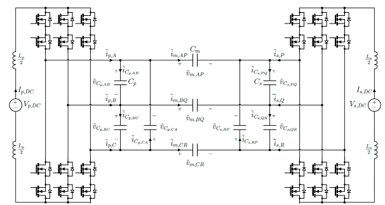
The Wisconsin design reverses several of those circuit relationships. Instead of two voltage-source bridges linked through magnetic coupling, it employs current-source bridges connected through a network of capacitors. Capacitors contain conducting electrodes separated by an insulating dielectric. A changing voltage produces displacement current across the dielectric without requiring a conductive path between electrodes. The surrounding switching circuits coordinate alternating currents so energy can transfer between the two DC terminals.
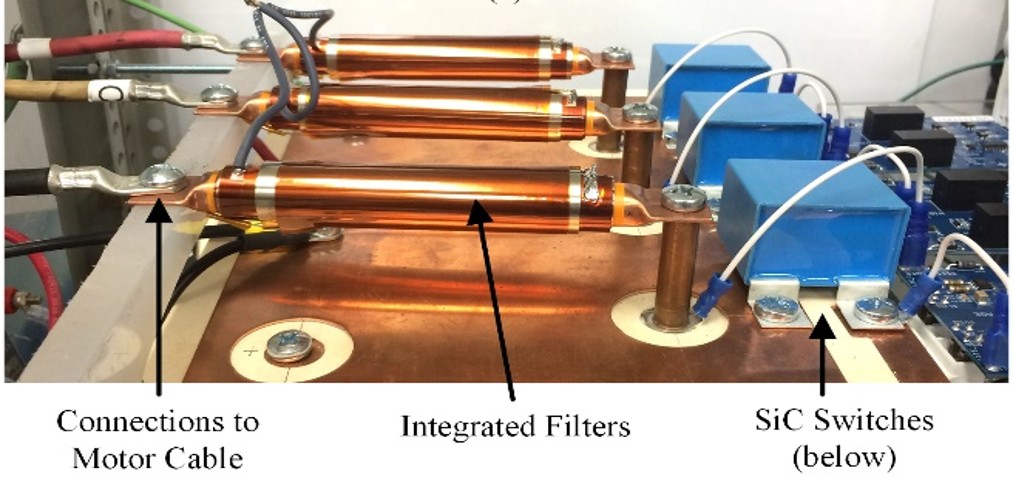
The Wisconsin Electric Machines and Power Electronics Consortium identifies high-frequency capacitive isolation and bidirectional semiconductor switches as research priorities. Faster switching can reduce the size of certain passive components, although dielectric losses, switching losses, thermal management and electromagnetic interference remain design constraints. The new circuit still uses inductors on its DC sides. Removing magnetic components from the AC coupling stage does not make the entire converter magnetics-free.
What 94.3% efficiency means
At the reported 94.3% efficiency, a converter delivering 2,000 W would draw approximately 2,121 W and dissipate 121 W, assuming 2 kW denotes output power. Under the same output-power assumption, 92.6% efficiency would imply approximately 160 W of losses. Those calculations illustrate why efficiency matters at kilowatt scale, rather than establishing independently measured thermal performance. The authors identify semiconductor diode losses as a target for further improvement.
The research is relevant to data-center power distribution, where Vertiv’s 5 MW power converter and Enphase’s medium-voltage conversion experiment illustrate the industry’s interest in direct-current architectures. Our 800 VDC engineering lesson explains the wider conversion and protection requirements. A separate transformer supply-chain study highlights why alternative component architectures warrant investigation.
The next engineering milestones are higher-power demonstrations, independently measured efficiency comparisons, insulation qualification and long-duration reliability testing. A successful laboratory converter cannot establish economic superiority over mature magnetic designs without evidence covering manufacturing cost, operating conditions and service life. The manuscript, which states that it has been submitted to IEEE for possible publication, offers a concrete experimental basis for evaluating those questions.
We volunteer daily to ensure the credibility of the information on this platform is Verifiably True. If you would like to support to help further secure the integrity of our research initiative, please scan the QR code below.

BitcoinVersus.tech is not a financial advisor. This media platform reports on financial subjects purely for informational purposes.


Leave a Reply