Quantum processors depend on conventional electronics to turn software instructions into physical operations. At the SC26 supercomputing conference in Chicago, Altera, Oxford Quantum Circuits (OQC) and NVIDIA demonstrated a reference design connecting a superconducting quantum processing unit (QPU), a field-programmable gate array (FPGA) and GPU-accelerated computing. Altera announced the design on November 16, 2026, and expects to release it in January 2027.
The collaboration addresses a problem separate from increasing qubit counts: generating precisely timed signals, measuring the quantum system and interpreting the resulting data quickly enough to support feedback. Conventional computing hardware remains essential even when the algorithm itself runs on a quantum processor.
Three processors, three responsibilities
The QPU manipulates quantum states. Altera’s Agilex 9 Direct RF FPGA provides configurable digital circuits for timing-sensitive operations, while NVIDIA GPUs handle more computationally demanding analysis. OQC supplies the quantum processor and radio-frequency conditioning electronics. Engineers interested in the distinction between general-purpose and specialized hardware can refer to our guide to processor architectures.
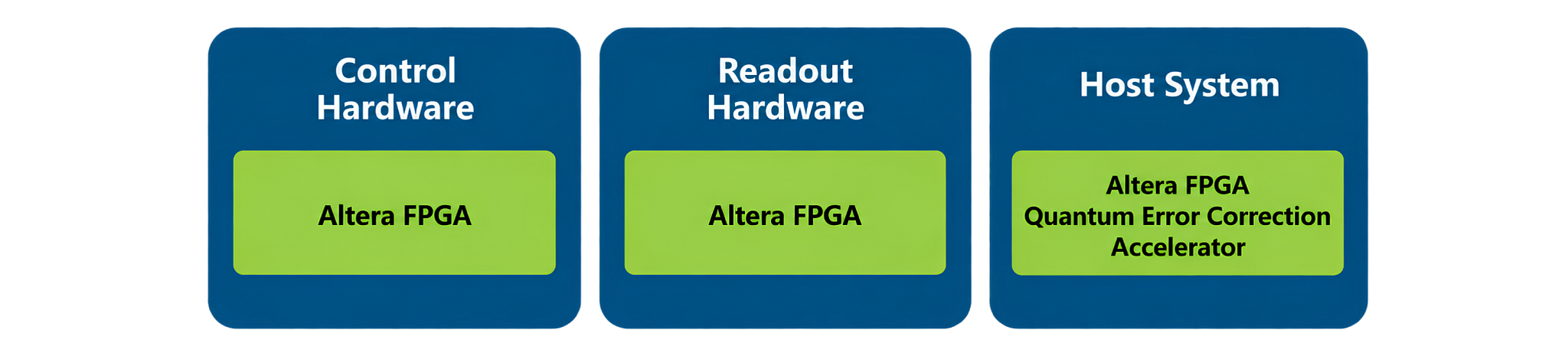
A field-programmable gate array differs from a CPU because its interconnected logic can be configured to implement dedicated hardware pipelines rather than relying entirely on sequential software instructions. A controller can consequently perform multiple operations concurrently, with timing determined by its configured circuitry. Our coverage of Agilex 27 and Lattice and NXP’s industrial platform examines related applications of programmable logic.
Moving radio-frequency conversion onto the FPGA
Superconducting qubits are manipulated and interrogated using electromagnetic signals. Digital instructions must therefore be translated into analog waveforms, while incoming analog measurements must be converted back into digital samples. The Agilex 9 family integrates analog-to-digital and digital-to-analog converters, eliminating certain external frequency-conversion stages in the demonstrated architecture.
Frequency multiplexing also permits signals occupying different frequency bands to share physical connections. Potential benefits include reduced cabling and a smaller control-equipment footprint. Neither benefit automatically scales in direct proportion to the qubit count: signal isolation, calibration, converter dynamic range and synchronization can impose additional constraints.
Why the GPU remains necessary
NVIDIA’s NVQLink platform advertises a maximum GPU-to-QPU data rate of 400 Gb/s and a minimum FPGA-to-GPU-to-FPGA round-trip latency below four microseconds. Those are platform specifications, not independently measured results from the Altera–OQC demonstration. The GPU can process batches of measurement data and apply machine-learning classifiers, while dedicated FPGA circuitry handles scheduled control operations.
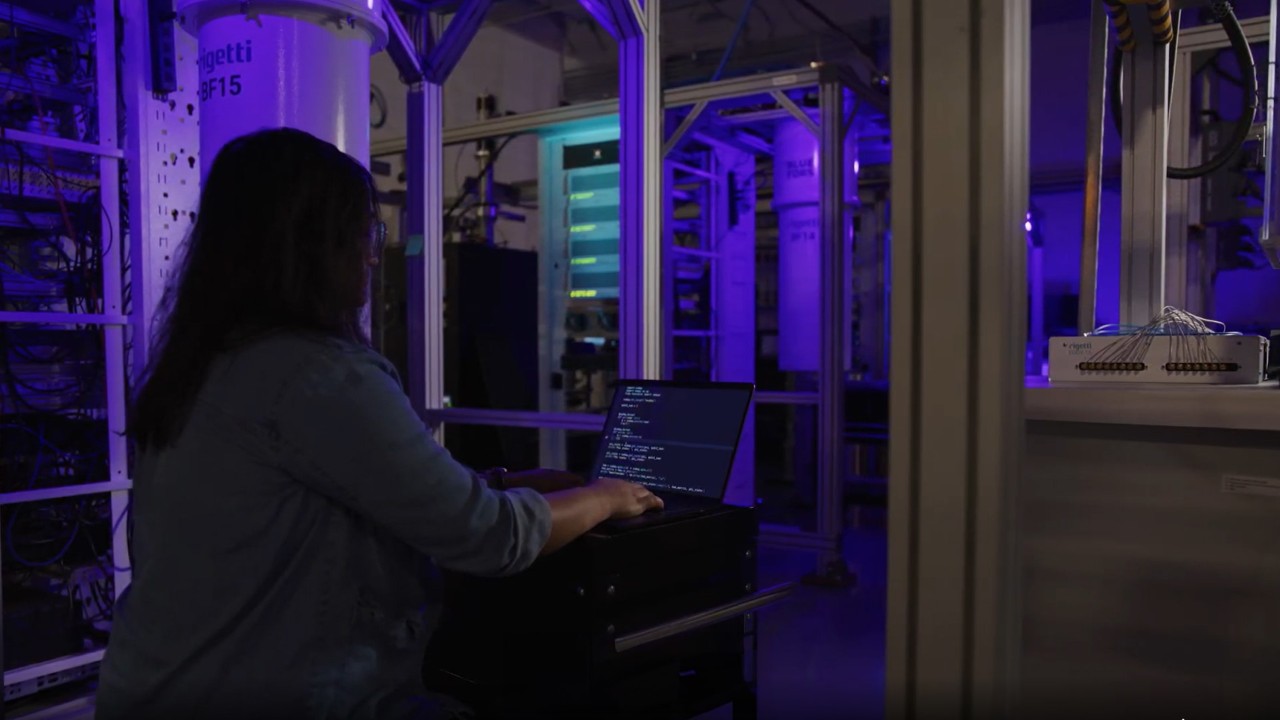
The engineering objective is to keep time-sensitive control close to the quantum hardware while using parallel classical compute for more complex analysis. A feedback cycle must account for measurement, data movement, computation and the return of corrective instructions. A fast network alone cannot eliminate delays elsewhere in that cycle.
A demonstration, not a fault-tolerant quantum computer
The reference design includes an emulation mode for testing controller software before connecting physical qubits. As explained in our quantum computing guide, physical qubits remain vulnerable to errors, and practical fault tolerance demands more than low-latency classical control.
The November demonstration establishes a reported integration milestone, not a new record for quantum computation or an independently verified reduction in energy consumption. Useful follow-up measurements would include end-to-end feedback latency, power per active readout channel, measurement fidelity and scaling behavior across additional qubits. January’s planned release could make those engineering questions easier for developers to investigate.
Sources: Altera, November 16, 2026; Quantum Computing Report, November 17, 2026; Altera quantum computing technical resources; NVIDIA NVQLink specifications.
We volunteer daily to ensure the credibility of the information on this platform is Verifiably True. If you would like to support to help further secure the integrity of our research initiative, please scan the QR code below.



Leave a Reply