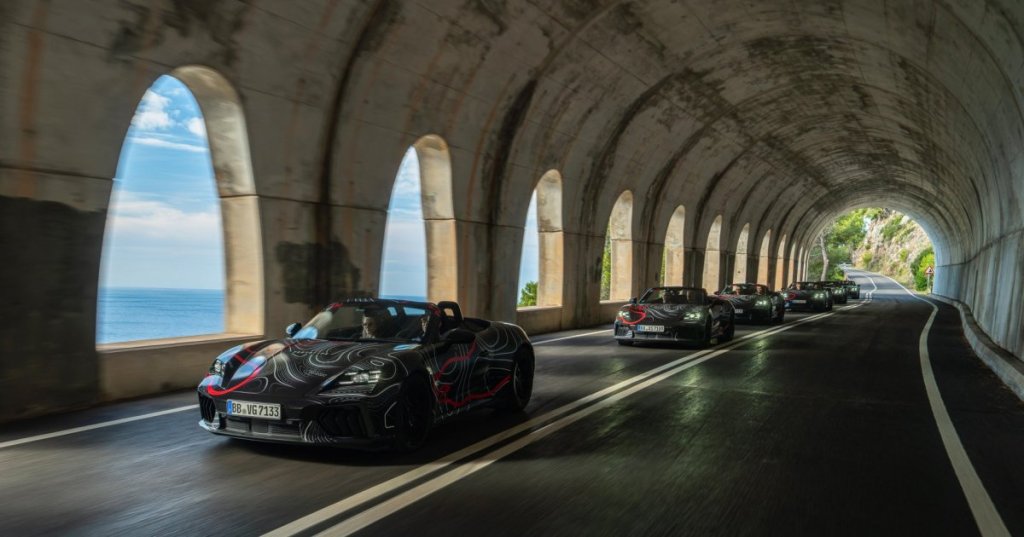
Porsche is approaching the production stage of its first battery-electric two-door sports car after an international prototype testing program. The company’s November 25 development announcement reports nearly 2.5 million miles of testing across more than 20 countries for the electric 718 Boxster. Porsche plans to unveil the vehicle in the first quarter of 2027, with manufacturing at its Stuttgart-Zuffenhausen plant.
An electric alternative to the mid-engine layout
Porsche calls its architecture E-Core. Rather than placing a broad traction battery under the passenger compartment, engineers position an 800-volt pack behind the seats. The company reports a 40:60 front-to-rear weight distribution and rear-wheel drive throughout the model range. The arrangement allows a lower seating position without requiring the occupants to sit above a thick battery enclosure.
Mass distribution matters independently of total vehicle weight. A simplified calculation of rotational inertia assigns a contribution proportional to mass multiplied by the square of its distance from the rotational axis. For an identical mass, halving that distance reduces its contribution to one-quarter. Centralizing heavy components can therefore reduce resistance to changes in vehicle orientation, although the complete chassis, battery geometry and tire behavior determine actual handling.
High voltage and extreme-temperature testing
An 800-volt electrical architecture can reduce current for a given electrical power compared with a 400-volt system. For example, an idealized 200 kW load would draw 250 amperes at 800 volts or 500 amperes at 400 volts. With identical conductor resistance, the resistive losses in the higher-voltage example would be one-quarter as large. Actual losses depend on battery voltage under load, cable dimensions, conversion efficiency and thermal conditions. The relationship also does not establish a specific charging rate for the Boxster.
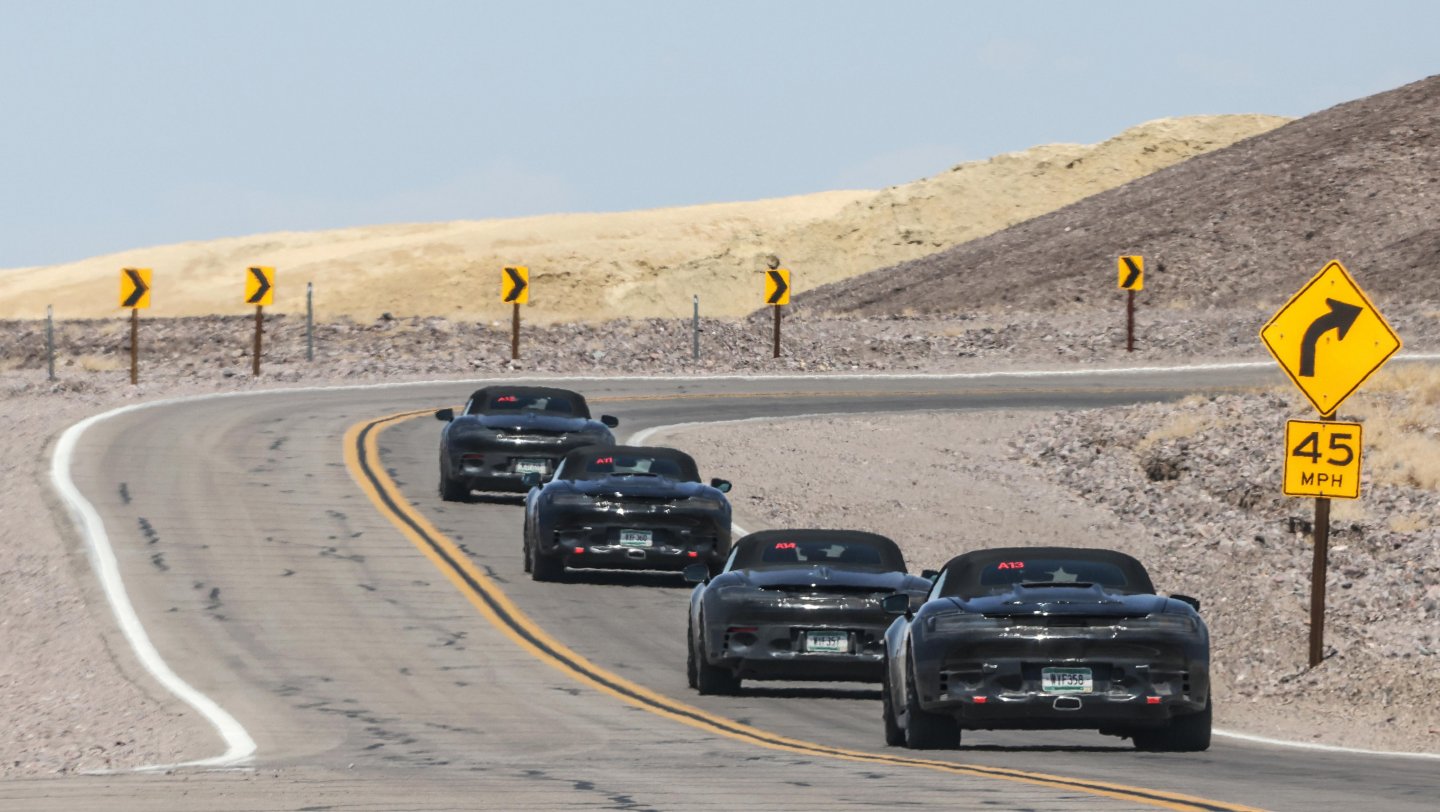
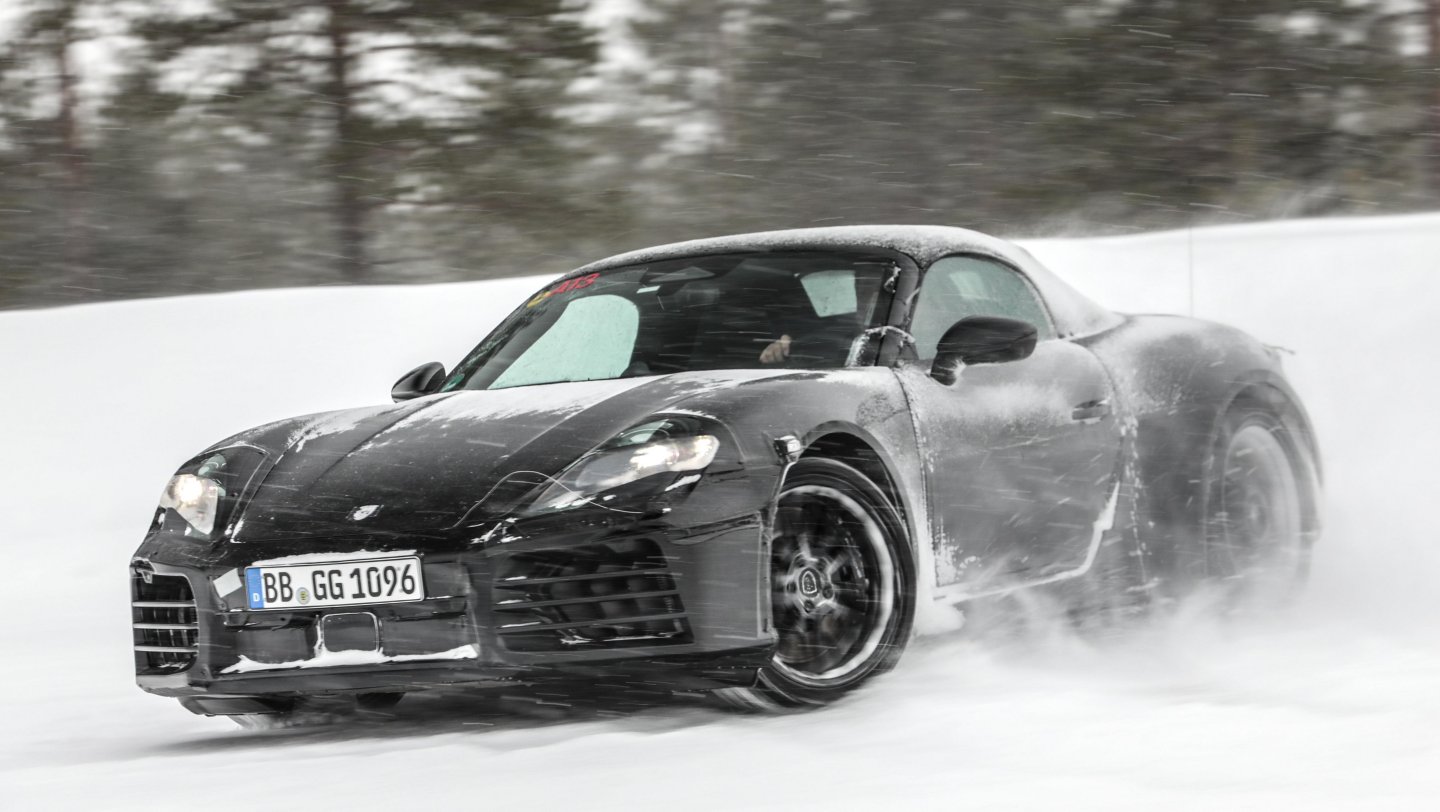
Porsche reports tests in temperatures spanning approximately −22°F to 124°F, alongside evaluations of five charging standards. High temperatures place additional demands on battery cooling, while low temperatures can restrict available power and charging performance. Battery chemistry, preconditioning and charging infrastructure all affect results. Related engineering developments include fast-charging graphite research at Rice University and the distinction between AC and DC vehicle charging.
Software-defined driving dynamics
The manufacturer targets a sub-three-second 0–60 mph acceleration time for the highest-performance version. Its E-Shift software emulates seven transmission ratios and recreates the sound of an earlier six-cylinder Boxster. With the simulation disabled, steering-wheel paddles select regenerative-braking levels. A November 24 Road & Track prototype evaluation describes the driving experience while noting that battery capacity and range remain undisclosed.
The architecture illustrates how electrification changes the relationship between mechanical design and software control. Related developments include electronic steering and vehicle-to-grid energy management. Porsche’s testing mileage demonstrates the scale of its development effort, not a verified service-life or range guarantee. Production specifications, repeatable track performance, charging curves and measured energy consumption will provide a clearer assessment of the electric sports car once it reaches customers.
Cover photograph: Porsche 718 Boxster development prototypes. Credit: Porsche AG.
We volunteer daily to ensure the credibility of the information on this platform is Verifiably True. If you would like to support to help further secure the integrity of our research initiative, please scan the QR code below.

BitcoinVersus.tech is not a financial advisor. This media platform reports on financial subjects purely for informational purposes.


Leave a Reply