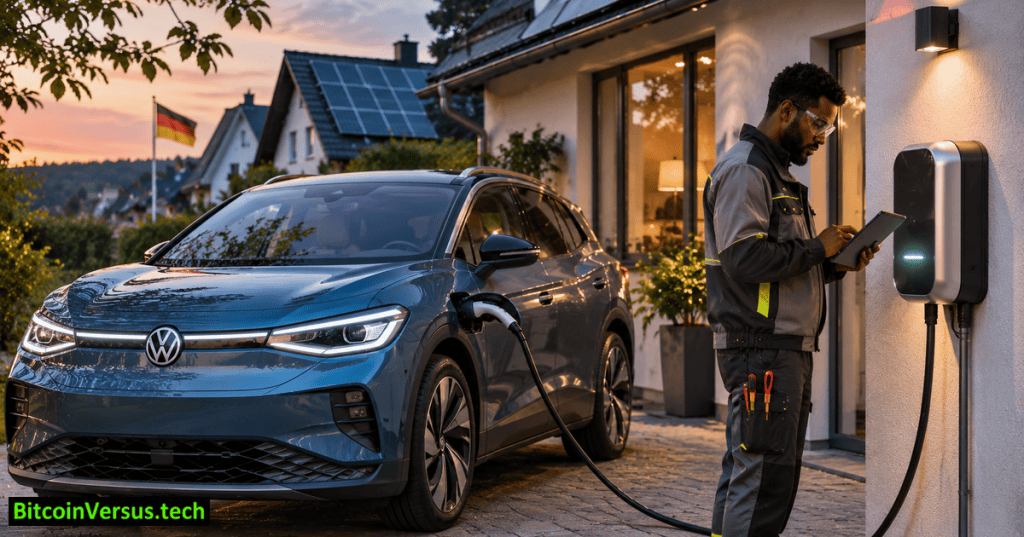
Electric cars could earn money even while parked. In a November 24 announcement, Volkswagen and its energy subsidiary Elli confirmed plans to begin selling a residential vehicle-to-grid package in Germany in December 2026. The package combines an 11 kW DC charger, an electricity contract, smart metering and software that manages energy around a driver’s schedule.
Customers can receive up to €720 in first-year connection bonuses, subject to eligibility. The charger costs €1,995 with tax and delivery included; installation requires a separate quotation. The immediate incentive rewards eligible connection time, not necessarily electricity delivered back into the grid.
Elli’s July 2026 product explanation from Power2Drive Europe, preceding the November launch announcement. Watch on YouTube.
How a parked car becomes a grid resource
Ordinary charging transfers energy into a battery. Bidirectional charging introduces the reverse path: power electronics convert stored DC electricity into grid-compatible AC when authorized. The vehicle battery management system, charger and utility-side controls must coordinate voltage, current, protection and scheduling. Our guide to EV chargers explains the underlying conversion process.
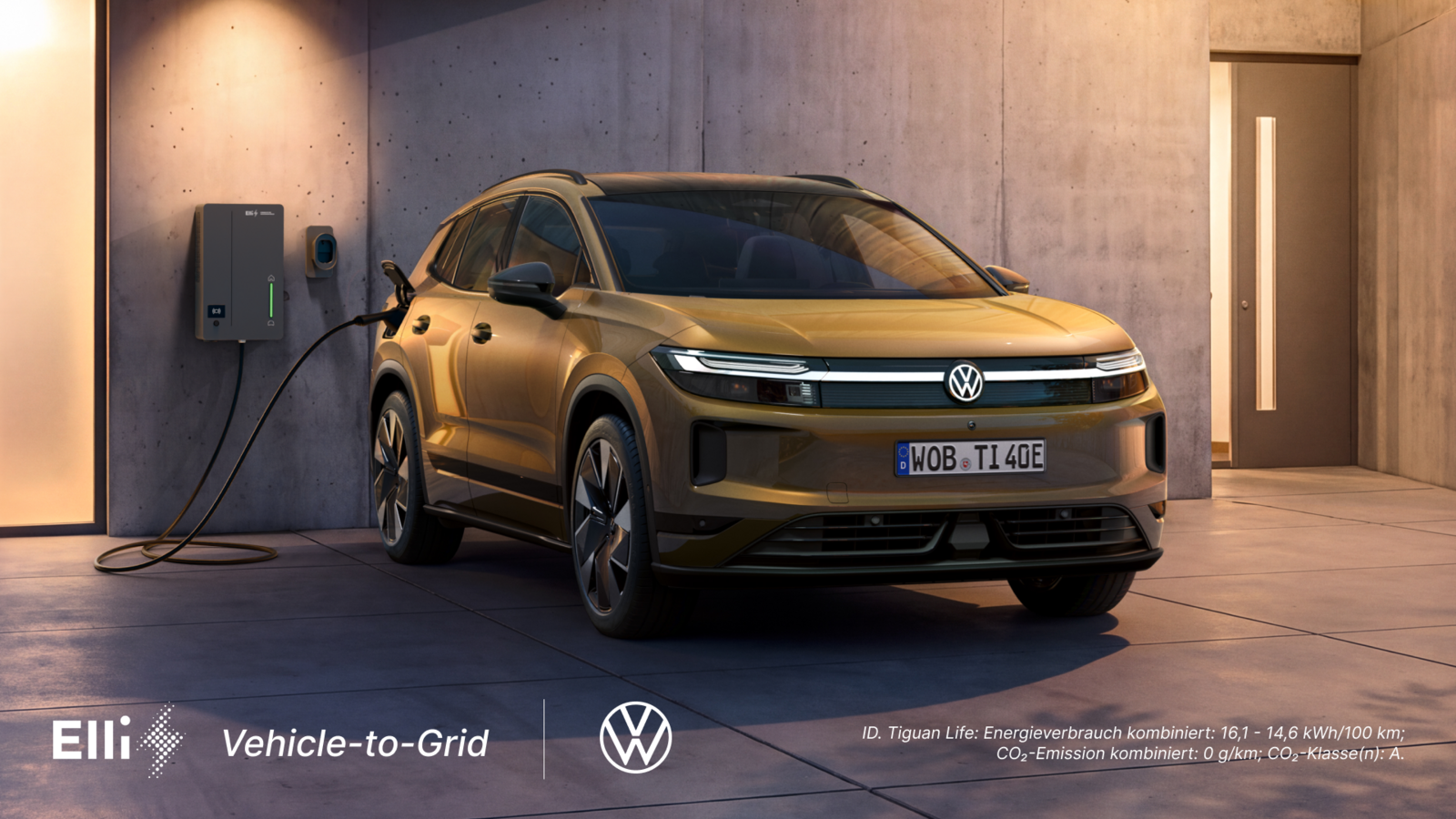
Elli specifies compatibility with 400 V and 800 V vehicle platforms and the ISO 15118-20 communication standard. Those specifications do not mean every electric vehicle can participate. Model-specific software permissions, a compatible meter and a suitable electrical installation remain essential.
An energy-market platform from The Mobility House Energy aggregates battery availability. Drivers specify departure time and required charge in the app, creating a boundary within which the service can manage energy.
The €720 calculation
At €0.24 per eligible hour, 250 hours of connection per month yield €60. Reaching the cap for 12 consecutive months produces €720. Each qualifying session must last at least three hours. The monthly target averages approximately 8.2 hours per day over a year.
Dividing the charger price by the maximum first-year bonus gives 2.77 years of equivalent bonuses, but that is not a reliable payback estimate: the advertised incentive applies to the first contract year, installation costs are excluded, and later-year terms are uncertain. Volkswagen also describes future export compensation of €0.40 per kWh without guaranteeing a minimum amount of exported energy.
Earlier Power2Drive Europe presentation of the Elli V2G package. Watch directly on YouTube.
CUPRA Germany’s earlier announcement of the Elli partnership and charging package. Original LinkedIn post.
Scale is potential, not deployed capacity
Volkswagen estimates roughly 360,000 vehicles in Germany already have technical preparation for bidirectional charging. If only 1% of that population enrolled, 3,600 chargers rated at 11 kW would represent 39.6 MW of nominal charging capacity. Actual available export capacity could be lower and would depend on equipment discharge limits, connectivity, battery state and market dispatch. No operating fleet of that size has been reported for the package.
Germany’s evolving V2G rules provide context for the launch. Volkswagen’s electric ID. Tiguan production illustrates the expanding vehicle base. Separately, Ford’s home-power approach highlights the distinction between serving a household and exporting to the grid. Elli plans a dedicated home-energy product in 2027.
The commercial test will be whether consumers earn enough to justify equipment and installation while retaining dependable mobility. Parked vehicles represent an attractive energy resource, but their economic contribution requires verified availability, interoperable hardware and a sustainable tariff.
We volunteer daily to ensure the credibility of the information on this platform is Verifiably True. If you would like to support to help further secure the integrity of our research initiative, please scan the QR code below.



Leave a Reply