
Australian researchers have demonstrated a rewritable reflective display that preserved a microscopic image for three months without electrical power. The research, conducted at RMIT University and the Australian National University through the ARC Centre of Excellence for Transformative Meta-Optical Systems (TMOS), was announced on November 24, 2026. The underlying study appeared in Advanced Photonics Research on November 14.
Instead of sustaining an image with a light source or continuously maintaining an electrical pixel state, the prototype encodes its appearance in the atomic arrangement of a thin film. Ambient light supplies the illumination needed to see the pattern.
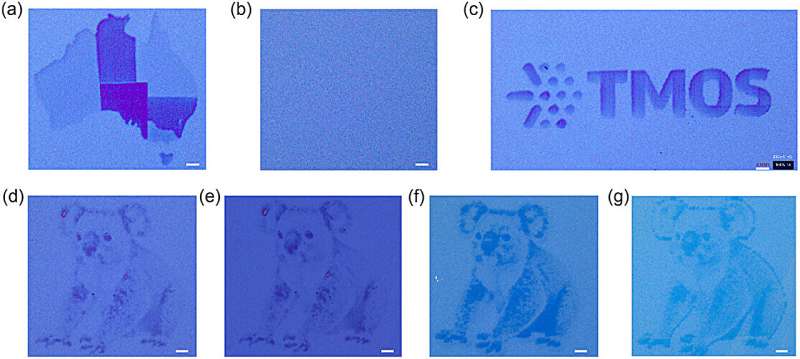
The display doubles as optical memory
Antimony selenide (Sb₂Se₃) belongs to a family of phase-change materials. Its crystalline and amorphous states have different optical constants. Crystalline material has long-range atomic order, whereas the amorphous state lacks that arrangement. Changing the fraction of crystallized material alters how incident light interacts with the film.
The researchers placed the active material within a stack of thin optical layers. One reported sample used 5 nm of indium tin oxide, 15 nm of antimony selenide and another 7 nm of indium tin oxide above a reflective substrate. Together, those three films measure 27 nm, excluding the substrate. Multiple reflected light waves interfere, enhancing or suppressing different wavelengths. Film thickness and crystallinity therefore become variables for controlling visible color.
The approach differs from the emissive pixels discussed in our coverage of TCL’s display transistors. It also differs from the electrophoretic particle technology used in E Ink’s color photo frames, which already retain static images without continuous pixel power.
Writing with light, erasing with heat
Short laser pulses modify local regions of the film. Rapid cooling can preserve disorder instead of allowing atoms to settle into the crystalline arrangement. Intermediate optical states provide additional color variation beyond a simple on-off transition. Uniform heating near 200°C restores the crystalline background for another writing cycle.
The experiment is not equivalent to a consumer screen with individually addressed electronic pixels. A commercial device would need practical local switching, reliable addressing and thermal isolation. Work on KAIST’s dual-purpose display and optical material characterization illustrates other routes to controlling light with engineered structures.
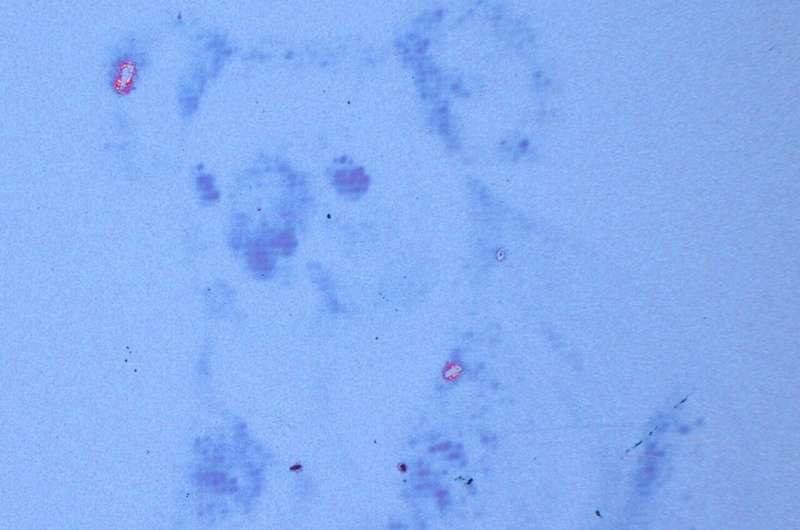
Where zero-power retention could matter
Consider a hypothetical illuminated display drawing 1 watt continuously. Over 90 days, it consumes 1 × 24 × 90 = 2,160 watt-hours, or 2.16 kWh. A nonvolatile reflective film would not need that continuous illumination under adequate ambient light. The calculation is illustrative, not a measured comparison between the prototype and a commercial panel.
Shelf labels, static information signs and archival images could benefit from infrequent updates. Video displays face a different challenge: the energy required for each rewrite, refresh speed, attainable color range and switching endurance may dominate performance. The laboratory result demonstrates persistent optical information, not a power-free television. As Tech Xplore’s November 24 report notes, electrical switching remains a research objective. Quantified update energy, repeated-cycle durability and large-area manufacturing are the next meaningful engineering benchmarks.
We volunteer daily to ensure the credibility of the information on this platform is Verifiably True. If you would like to support to help further secure the integrity of our research initiative, please scan the QR code below.



Leave a Reply