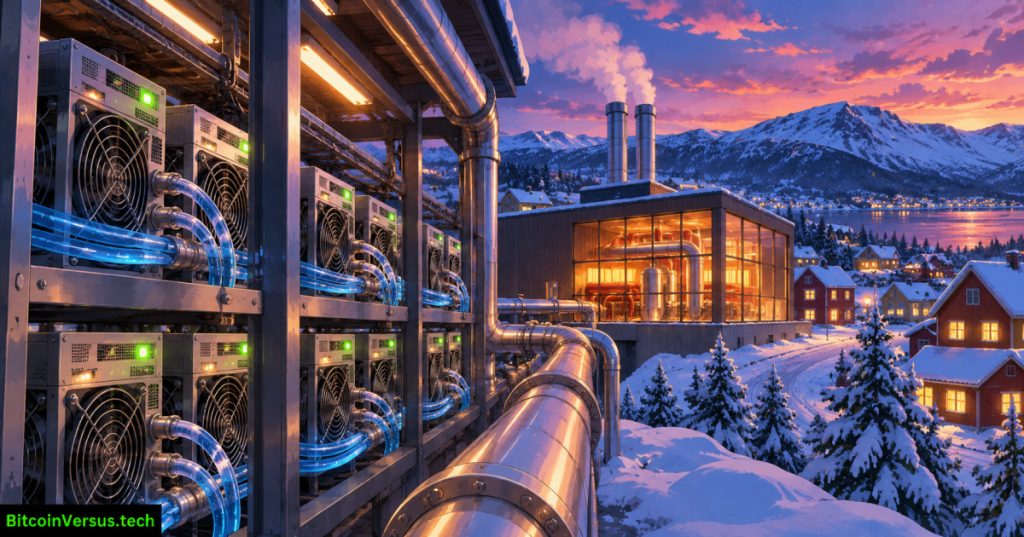
Bitcoin mining equipment could become part of the heating infrastructure serving thousands of Nordic homes. On November 25, 2026, Canaan disclosed two orders for customized liquid-cooled Avalon machines from returning customers. The company’s SEC filing describes a growing district heating portfolio, with almost 12 MW of combined capacity and a projected heating reach of nearly 8,000 homes. The estimate concerns the expanded portfolio, not the number of homes already receiving heat from the new equipment.
One electricity input, two useful outputs
The new orders total 430 customized A1566HA-500T machines. Multiplying the rated 500 TH/s per miner by 430 gives 215,000 TH/s, or 215 PH/s. Canaan specifies approximately 80°C (176°F) hot-water output for the customized equipment. The two orders supplement an 8 MW project announced in May.
A mining ASIC consumes electricity to perform SHA-256 calculations. Almost all of the electrical energy entering the computing equipment eventually becomes heat. Conventional mining sites reject that energy into the atmosphere. A liquid-cooled installation can instead transfer a substantial portion into a separate water circuit using a heat exchanger. Insulated distribution pipes carry useful thermal energy to connected buildings.
What nearly 12 MW means
At a constant thermal output of 12 MW, the theoretical annual heat production would be 105,120 MWh: 12 multiplied by 8,760 hours. Dividing by 8,000 homes gives approximately 13.1 MWh per home per year. The calculation assumes uninterrupted full-load operation, complete delivery of nominal heat and equal distribution. It is an illustrative upper-bound calculation, not measured consumption or a verified household service forecast.
Actual heat delivery depends on seasonal demand, machine availability, distribution losses and whether the district heating operator can accept the output. Canaan has not disclosed the full operating data or commissioning schedule for the additional orders in its announcement.
Why the economics are different
A mining operator ordinarily compares electricity expenditure with mining revenue and operating costs. Heat recovery adds another potential source of value: replacing purchased heat or earning revenue under a thermal supply agreement. However, pumps, exchangers, controls, maintenance and pipeline construction introduce costs. Electricity prices and the value of recovered heat determine whether the arrangement can compete with alternative heating systems.
Heat pumps also deserve consideration. A conventional resistive heater converts approximately one unit of electricity into one unit of heat, while a heat pump can transfer several units of heat per unit of electricity under favorable conditions. Mining heat recovery is therefore not automatically the most energy-efficient heating option. Its distinctive advantage is the simultaneous production of computational work and recoverable heat.
A market signal, not a completed buildout
The repeat orders indicate continued commercial interest from existing customers. Nevertheless, equipment orders should not be equated with installed capacity, contracted heat sales or demonstrated emissions reductions. The electricity generation mix, displaced heating fuel and operating schedule all affect environmental outcomes. The November 25 announcement establishes the order details; future commissioning and operating measurements will determine the real contribution to local heating.
Related coverage: Austria’s solar-powered mining heat reuse, seven mining heat-reuse applications, residential mining heat and hydro-cooled ASIC hardware comparisons.
Illustration note: The featured anime artwork is conceptual, not a photograph or engineering rendering of the actual sites.
Editor’s Note: We volunteer daily to ensure the credibility of the information on this platform is Verifiably True. If you would like to support to help further secure the integrity of our research initiative, please scan the QR code below.



Leave a Reply