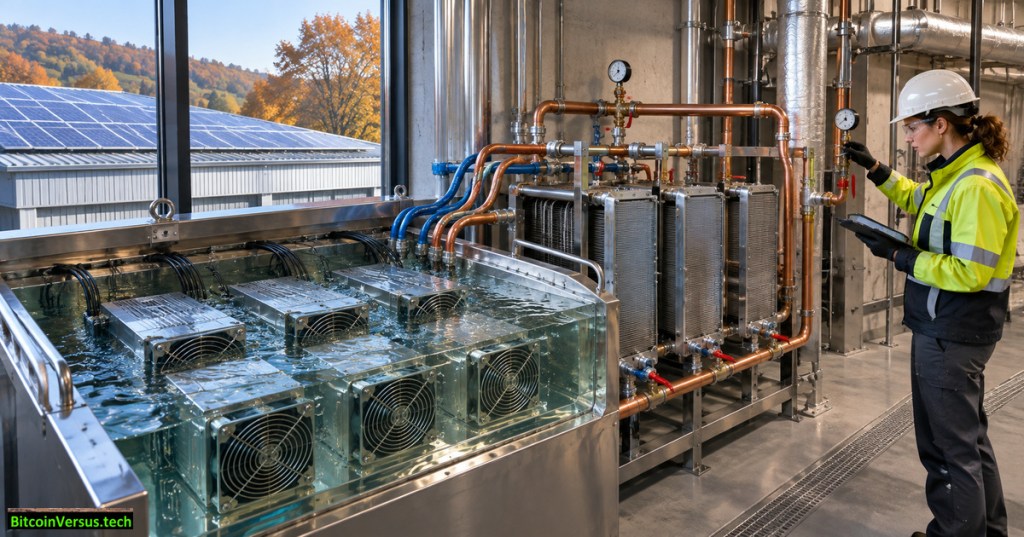
AUSTRIA, November 23, 2026. An eastern Austrian commercial property is putting nine immersion-cooled Bitcoin mining machines to work on two jobs: consuming otherwise low-value solar electricity and recovering heat for the building’s heating circuit. Austrian energy-tech company HASHLYNK says its EcoHash installation entered operation in November, but the promised energy savings and payback remain projections rather than independently audited outcomes.
The site has approximately 600 kW of solar capacity producing an estimated 620,000 kWh annually. About 100,000 kWh had been exported to the grid for slightly under €0.03 per kWh. Instead of automatically selling every surplus kilowatt-hour, the operator can now redirect suitable periods of excess generation into specialized Bitcoin computing hardware. Details come from HASHLYNK’s October 25 project case study, subsequently updated to report November commissioning.
2026 interview with HASHLYNK’s Thomas Ebner on surplus solar, Bitcoin mining controls and recovered heat, hosted by RETTE DEIN GELD. Watch directly on YouTube.
How the heat-recovery loop works
Nine miners sit inside liquid-filled, electrically insulated immersion modules, organized into three heating cassettes. Their electronic components turn nearly all consumed electricity into thermal energy. Liquid transports that heat to a heat exchanger, which can warm water returning from the property’s heating network. The heat does not return as electricity and is not counted twice; one energy input supplies a computing service and a recoverable thermal output.
The property previously relied on gas heating and is modernizing toward heat pumps. The mining unit is designed to raise the return-water temperature, reducing part of the heat pump’s required temperature lift. In summer, when solar surplus can be abundant but space-heating demand is low, unwanted mining heat can be rejected through a dry cooler. The economic benefit depends on how closely sunny hours coincide with demand for useful heat.
HASHLYNK lists a system range up to 60 kW and describes an operating scenario near 36 kW. Its model assumes approximately 2,050 mining hours annually, with at least 60% of produced heat usable in the heating circuit. The result is a projected 42,600 kWh of recovered heat per year. That is an engineering forecast, not a meter reading; the company says it will publish actual recovery and revenue data once enough operating measurements exist.
A 3.9-year payback is not a guaranteed return
The developer estimates a 3.9-year payback, combining prospective Bitcoin-mining proceeds with avoided heating costs. Compare the previous export arrangement: 100,000 kWh multiplied by €0.03/kWh would generate about €3,000 per year, before considering differences in actual feed-in rates and the timing of production. Mining profitability instead varies with ASIC efficiency, network difficulty, Bitcoin price, pool fees, repairs and machine uptime.
2025 Austrian mining panel featuring HASHLYNK’s Thomas Ebner, discussing photovoltaic electricity, thermal recovery and operating economics. Context video, not footage of the November 2026 EcoHash site. Watch directly on YouTube.
For a numerical cross-check, an average 36 kW draw over 2,050 hours would consume 73,800 kWh; 60% thermal utilization would be 44,280 kWh. That back-of-envelope result is close to the company’s 42,600-kWh estimate, but the published inputs are rounded, so no measured recovery rate can be inferred. Solar generation and heat consumption must also be matched hour by hour to test whether the claimed value materializes.
Why the pilot matters for mining infrastructure
Unlike a hyperscale mining farm that treats heat as a disposal problem, a site-sized installation can work with existing switchgear, photovoltaic generation, heat exchangers and building automation. Siemens profiles HASHLYNK’s energy-integration approach, while HASHLYNK’s product specifications describe automatic power control, immersion cooling and optional heat delivery up to 80°C. Those vendor specifications do not independently establish performance at the Austrian property.
What comes next is measurable: Bitcoin produced per consumed kWh, the amount of gas or heat-pump electricity displaced, coolant and water-loop temperatures, grid-export changes and total operating expense. The real achievement would be verified thermal utilization under actual seasonal loads, not merely a miner running on a sunny afternoon.
Related BitcoinVersus.tech research: seven Bitcoin-mining heat-reuse applications; Finnish Bitcoin boiler economics; Canaan’s 8 MW district-heating installation; data-center heat reuse explained; and Empire AI’s campus heat-recovery plan.
We volunteer daily to ensure the credibility of the information on this platform is Verifiably True. If you would like to support to help further secure the integrity of our research initiative, please scan the QR code below.



Leave a Reply