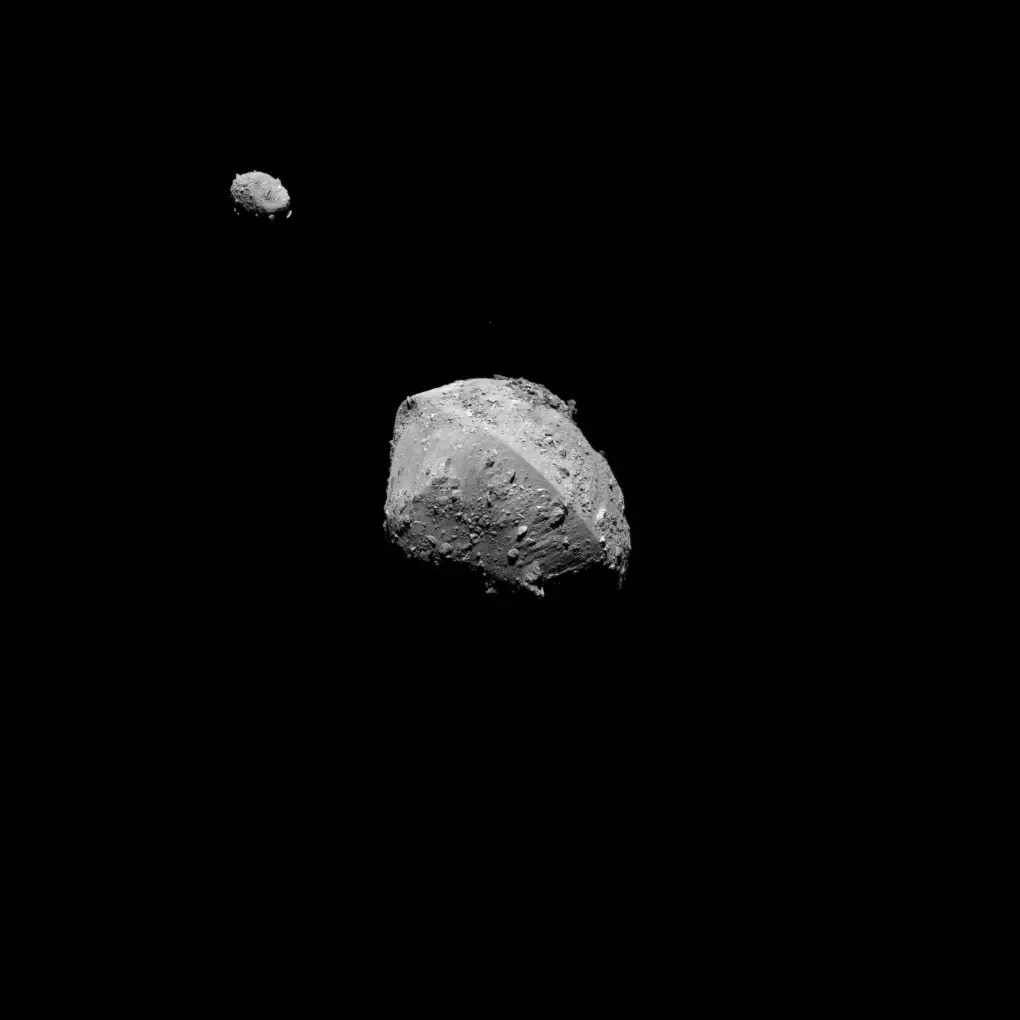
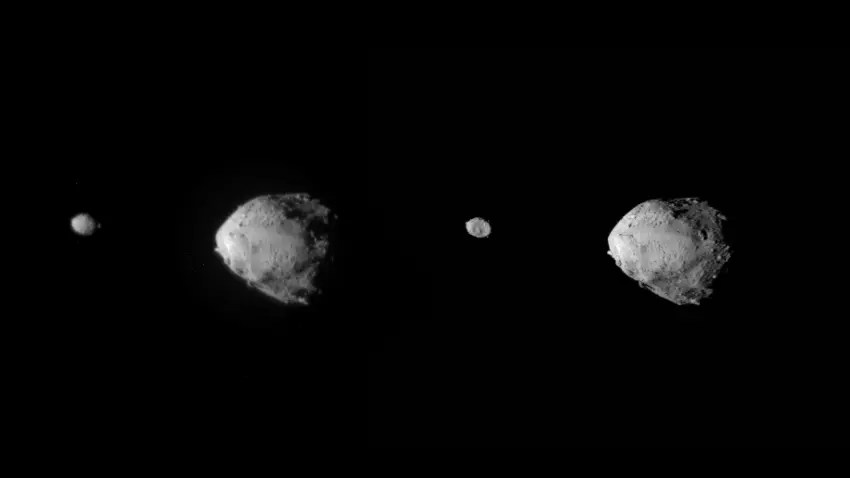
Four years after NASA deliberately altered an asteroid’s orbit, a European spacecraft has returned close-up evidence of the collision’s physical consequences. On November 25, 2026, the European Space Agency (ESA) released Hera imagery of Dimorphos, the smaller member of a binary asteroid system. The images reveal a flattened impact-facing surface, irregular rotation and numerous rocks moving around the asteroid pair.
The original Double Asteroid Redirection Test (DART) took place on September 26, 2022. Hera’s new observations are a separate milestone: researchers can now inspect the altered object directly rather than infer every surface feature from distant measurements. Featured photograph: ESA’s Asteroid Framing Camera image of the two asteroids, released November 25.
ESA’s November 25 presentation, Revealing Hera’s first images of asteroid Dimorphos.
The physical aftermath
Dimorphos measures approximately 151 meters across. It accompanies Didymos, whose diameter ESA currently estimates at roughly 730 meters. Newly released photographs show extensive deformation on the surface struck in 2022, although other boulder-covered areas appear comparatively similar to earlier imagery. The dimensions of the altered region and its depth will require further investigation.
SmartChart #9: Measuring the orbital change
In March 2024, NASA’s Jet Propulsion Laboratory reported an orbital reconstruction using spacecraft images, radar observations and changes in brightness recorded by ground telescopes. The analysis placed the initial reduction in Dimorphos’ orbital period at 32 minutes and 42 seconds. After several weeks, the estimated reduction reached 33 minutes and 15 seconds. The latter figure corresponds to approximately 4.65% of the original orbital period of roughly 11 hours and 55 minutes.
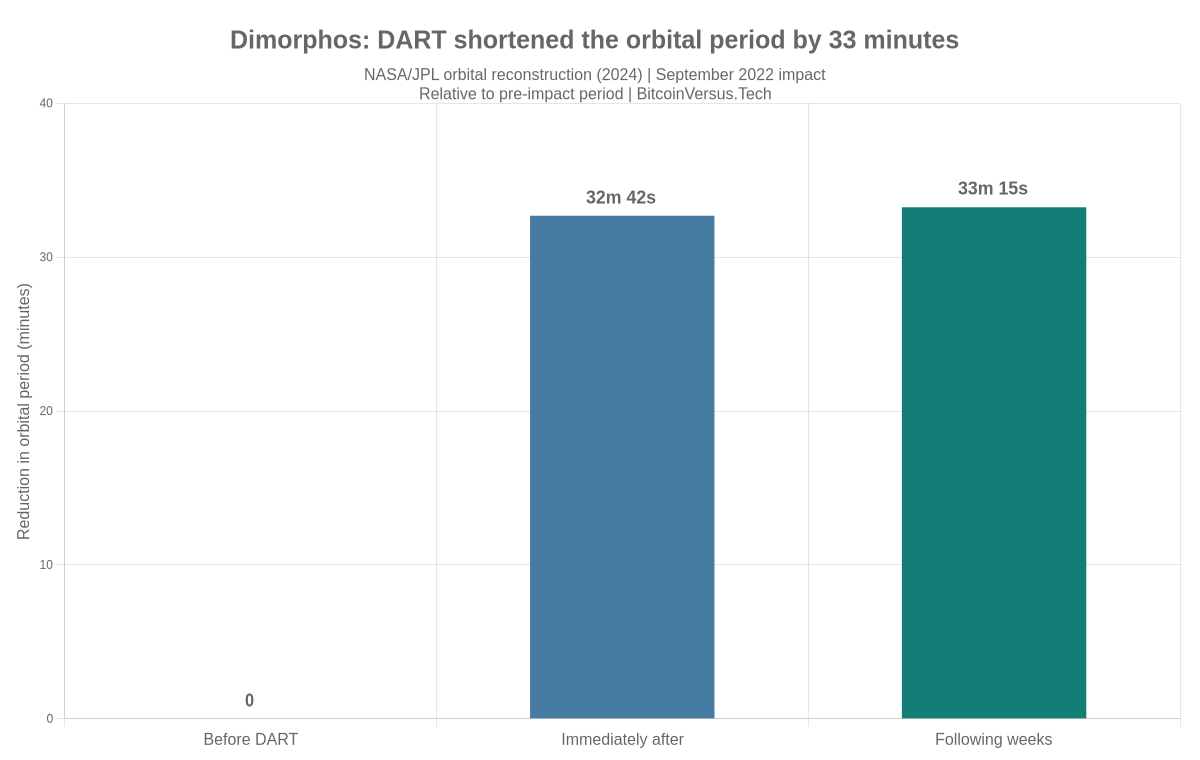
The shorter period concerns the smaller asteroid’s movement around its companion, not a 33-minute change in Earth’s orbit. Comparing the original and revised orbital periods provides a repeatable performance measure for the planetary-defense experiment. Surface imaging supplies complementary evidence about the response of a loosely assembled rocky object.
A spacecraft navigating a complex environment
Hera combines visible-light imagery, multispectral observations and infrared measurements to study the system. Earlier coverage of Hera’s thermal imaging explained how researchers can detect features even when visible illumination is limited. Independent observations across different wavelengths can help distinguish material properties from illumination effects.
ESA’s November 21 mission explainer provides background on the planetary-defense experiment.
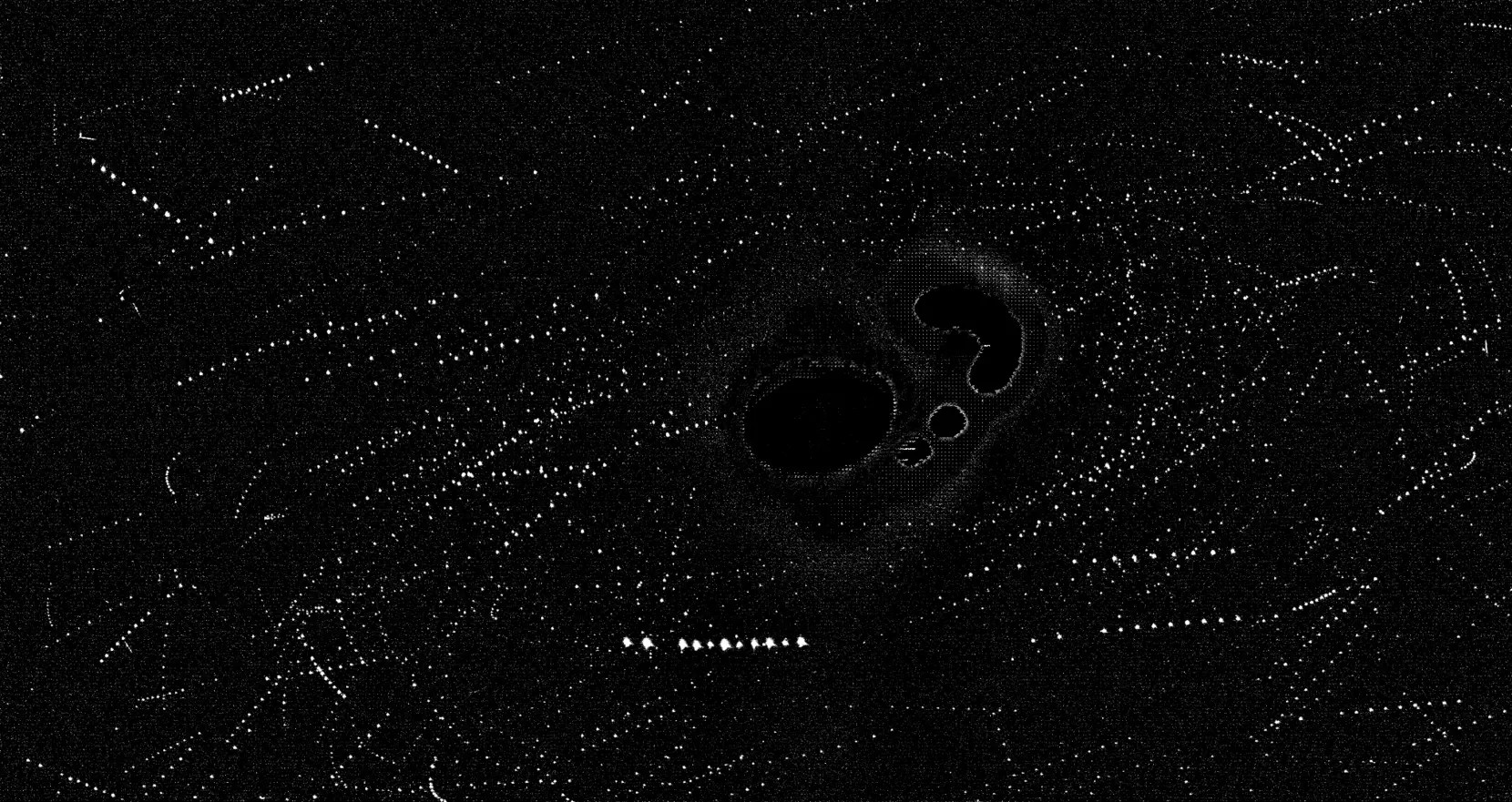
ESA reports that Hera is currently operating roughly 25 to 30 kilometers from the pair. The newly observed rocks complicate navigation as the spacecraft approaches. Related engineering coverage includes spacecraft attitude control, autonomous landing sensors and Dragonfly’s science cameras.
Hera’s investigation is incomplete. ESA plans a closer approach in December and deployment of two small companion spacecraft in January 2027. Measurements of mass, internal structure and surface properties will help researchers assess the uncertainty of future planetary-defense missions. Neither asteroid poses a known collision threat to Earth from the DART experiment.
We volunteer daily to ensure the credibility of the information on this platform is Verifiably True. If you would like to support to help further secure the integrity of our research initiative, please scan the QR code below.



Leave a Reply