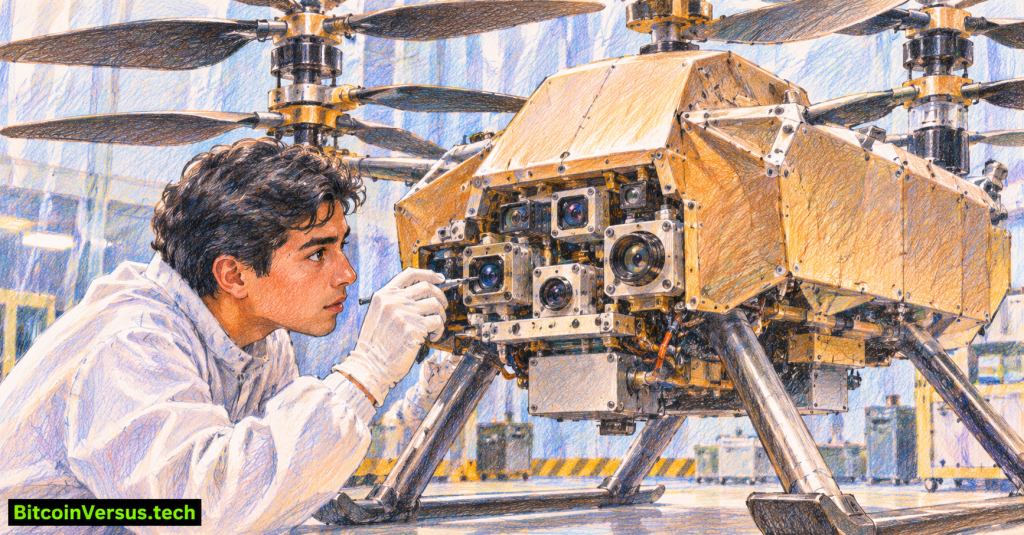
NASA’s Dragonfly rotorcraft has reached a new assembly milestone ahead of its planned journey to Saturn’s largest moon. In a November 24, 2026 mission update, NASA confirmed that the seven science cameras forming the DragonCam instrument had been mounted, tested and integrated by mid-November at Johns Hopkins Applied Physics Laboratory in Maryland.
The imaging equipment will help the vehicle investigate Titan from the air and the surface. Two additional navigation cameras, installed earlier in 2026, serve a separate role in helping the spacecraft navigate. Together, the nine cameras illustrate how an autonomous scientific aircraft can combine environmental awareness with detailed geological observation.
Seven cameras, different perspectives
DragonCam includes two forward-facing cameras with different angular coverage, two side-facing cameras, two cameras pointed toward the ground and one microscope-like imager. The forward wide-angle instrument covers 90 degrees; its narrower partner records finer detail in an overlapping region. Comparing the views supports stereoscopic interpretation of terrain. Sideward views can extend the visible landscape, while the downward instruments help characterize sites where scientific equipment may be deployed.
A close-range camera will examine grains near the sampling drill on millimeter scales. Such observations provide geological context: a chemical measurement is more informative when researchers know whether the material came from a dune, an exposed deposit or a different surface feature. The instrument manifest also describes equipment for chemical, seismic and atmospheric measurements.
Engineering for a dark, frozen world
Titan’s surface is approximately −179°C, according to the mission update’s temperature of −290°F. The cameras sit inside insulated enclosures and observe through windows. Engineers must preserve optical performance and electrical operation despite the temperature difference between the protected hardware and its surroundings.
Dragonfly’s lighting system spans infrared through ultraviolet wavelengths. By changing illumination, scientists can investigate how materials interact with light and potentially spot fluorescent organic compounds during the extended darkness. Fluorescence alone would not establish biological activity; further chemical analysis would be necessary.
From simulated flight to extraterrestrial exploration
Unlike a conventional terrestrial drone, Dragonfly cannot depend on immediate manual piloting from Earth. The spacecraft must execute flight decisions onboard. In an October 23 engineering update, NASA described a simulated flight using representative avionics and computer-generated camera imagery. That experiment was an important software and hardware integration test, not a real flight on Titan.
NASA’s mission overview targets launch no earlier than July 2028, arrival in late 2034 and approximately 3.3 years of exploration. Remaining instruments still require integration and the full spacecraft must undergo qualification. Flight schedules and mission plans remain subject to change.
Related reporting: Dragonfly’s named landing region, NASA’s autonomous lunar landing research, spacecraft attitude control and Hera’s asteroid thermal imaging.
The featured colored-pencil illustration is conceptual artwork, not a photograph of flight hardware. NASA’s official multimedia gallery includes actual camera installation photographs and images captured during cleanroom testing.
Editor’s Note: We volunteer daily to ensure the credibility of the information on this platform is Verifiably True. If you would like to support to help further secure the integrity of our research initiative, please scan the QR code below.



Leave a Reply