Energy Vault has secured construction financing for the SOSA Energy Center, a utility-scale battery storage project in Madison County, Texas. The company’s November 23 announcement identifies a 150 MW power rating and 300 MWh of energy capacity, supported by a $78 million bridge financing facility. Commercial operations are targeted for the third quarter of 2027.
A financing milestone, not a commissioning announcement
Construction started in late 2025. Energy Vault reports that earthworks and other civil construction are complete and the electrical substation is installed. Delivery of major equipment remains ahead. The company estimates an overall local investment of approximately $100 million. Those statements describe a construction project rather than an operating storage asset.
A Form 8-K filing with the Securities and Exchange Commission provides additional detail. Financing agreements were signed November 16. The $78 million facility is a preferred-equity bridge loan, accompanied by an $8.7 million letter-of-credit facility. Energy Vault reports drawing $27.2 million of the bridge loan on November 19. A third-party investor agreed to contribute $79.6 million in installments contingent on project milestones and other conditions.
The temporary loan is intended to be repaid using the equity commitment. Adding the face values of the bridge facility and the future equity contribution would therefore overstate permanent capital available to the project. The credit agreement also contains a repayment deadline and provisions governing changes in the investor’s expected contributions.
Why a 150 MW battery stores 300 MWh
Power and energy describe different physical quantities. A 150 MW rating expresses the nominal rate at which electrical energy can be delivered, while 300 MWh represents a nominal quantity of stored energy. Dividing 300 MWh by 150 MW yields two hours of discharge at rated power under idealized conditions. A lower discharge rate could extend the duration; actual performance depends on equipment limits, state of charge, temperature, aging and operating reserves.
If the plant supplied its rated energy once daily for a hypothetical year, nominal discharged energy would equal 109,500 MWh. The calculation assumes 365 full discharges and excludes losses, downtime and capacity degradation. It is not an operating forecast. At the company’s estimated $100 million total investment, the nameplate energy-normalized cost is approximately $333 per kWh; that includes project infrastructure and cannot be equated with a standalone battery-cell price.
The economic role of short-duration storage
Energy Vault plans to participate in the ERCOT North electricity market without an initial contracted offtake agreement. A battery can charge when electricity is less expensive and discharge when prices rise. It can also offer eligible grid-balancing services. Its profitability depends on price spreads, cycling costs, qualification rules, competition and availability. The operator retains the option to pursue contracted revenue later.
SOSA’s two-hour design contrasts with the planned 1.2 GWh Chelsea battery and the ten-hour Golmud liquid-air system. Other projects, including Virginia’s substation demand-management battery and Germany’s Dahlem battery, illustrate different deployment stages and operating roles.
The next material milestones for SOSA are equipment delivery, electrical commissioning, grid qualification and actual commercial operation. Until then, the 150 MW rating represents planned capability, while the financing close represents a documented commercial development.
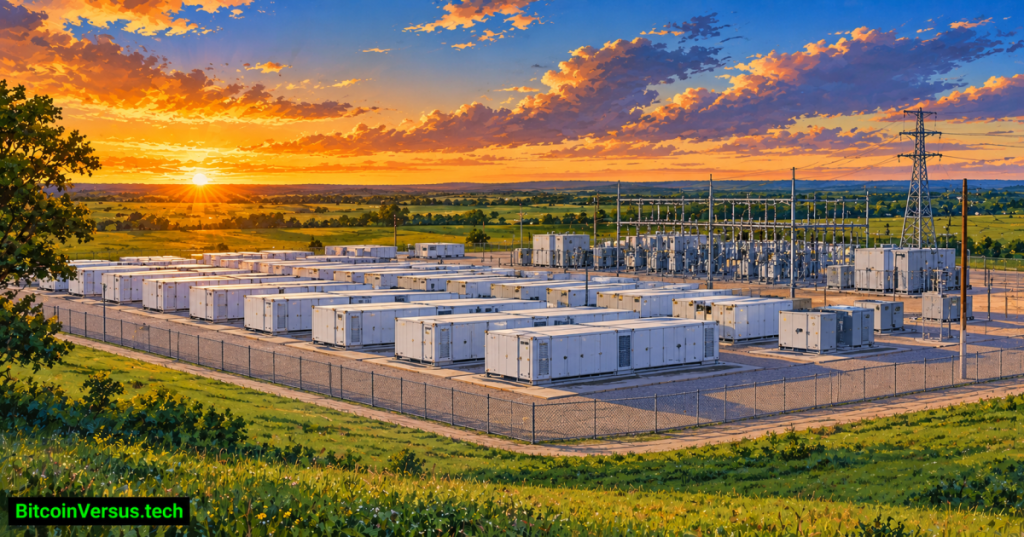
Featured cover: conceptual editorial illustration of a utility-scale battery storage facility, not a photograph of SOSA.
Editor’s Note: We volunteer daily to ensure the credibility of the information on this platform is Verifiably True. If you would like to support to help further secure the integrity of our research initiative, please scan the QR code below.

For mobile scanning, open the article on another display and scan the QR code with a Bitcoin wallet. The voluntary donation amount is 5,000 sats. Verify the receiving address 3C9o19EH5HSiwEPyCTmEKzxhNCbo2X6TTb before sending.
BitcoinVersus.tech is not a financial advisor. This media platform reports on financial subjects purely for informational purposes.


Leave a Reply