A milestone in international spaceflight
China launched Shenzhou-24 on November 25 with two Chinese astronauts and Pakistani payload specialist Muhammad Zeeshan Ali. The mission marked the first visit by a foreign astronaut to the Tiangong space station. According to the Chinese space agency’s announcement and Associated Press reporting, Ali is scheduled to conduct an experiment involving photosynthetic cyanobacteria during a short orbital stay before returning aboard Shenzhou-23. The planned experiment is not a report of completed scientific results.
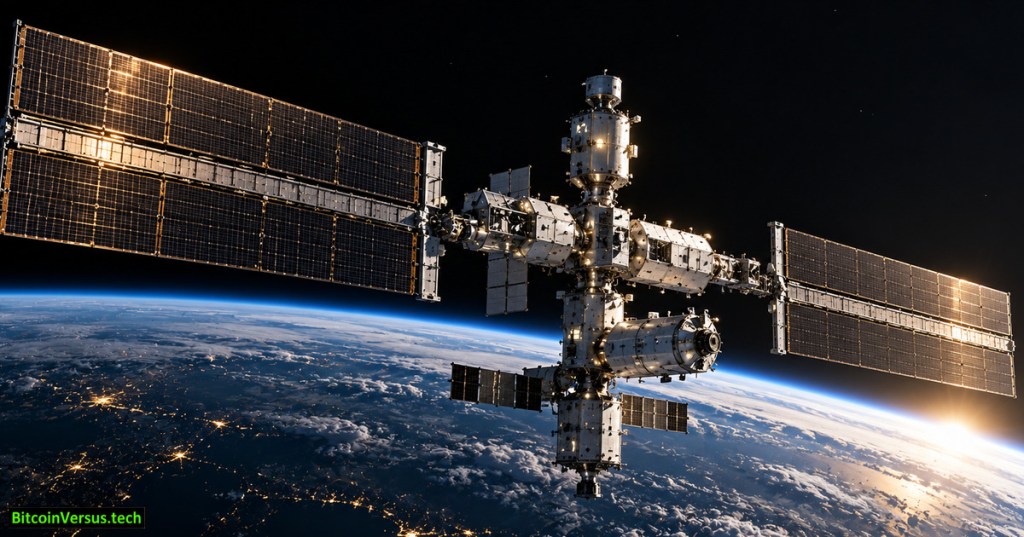
Featured cover: conceptual editorial artwork, not a documentary photograph of the named product or event.
Watch the video directly on YouTube if the embedded player is unavailable.
A laboratory beyond Earth
An orbital station allows researchers to examine physical and biological processes under sustained microgravity. Objects in orbit experience continuous free fall, producing a very different environment from a laboratory supported by Earth’s surface. Fluids can behave differently when buoyancy-driven convection and sedimentation are greatly reduced. Those effects matter in biological experiments because organisms depend on access to nutrients, gases and suitable environmental conditions. A laboratory must maintain controlled lighting, temperature and containment to interpret observations.
Why study photosynthetic organisms
Cyanobacteria are microorganisms capable of oxygen-producing photosynthesis. They use light energy to convert carbon dioxide and water into chemical energy stored in organic compounds. Photosynthetic biological systems have attracted research interest for potential applications in regenerative life support and resource recycling. A future closed-loop habitat could theoretically use organisms to contribute to gas exchange or biomass production. However, demonstrating biological activity in orbit is not equivalent to establishing a dependable life-support system for astronauts.
Measuring experimental performance
Scientists investigating a photosynthetic culture may measure growth, oxygen production, carbon dioxide consumption or changes in cellular behavior. A useful comparison requires an appropriate ground control and consistent measurement conditions. Light intensity, nutrient availability and temperature can affect outcomes independently of gravity. The public mission description does not establish the precise experimental protocol or the results of the work. Any conclusion about productivity or suitability for long-duration spaceflight must await documented measurements.
International collaboration and engineering
The mission illustrates how space stations can support scientific cooperation through shared laboratory infrastructure. Payload integration involves coordinating equipment requirements, safety procedures, power availability and the time astronauts can devote to experiments. Samples and recorded measurements may need to be returned or transmitted for analysis. Long-duration missions add constraints on maintenance and resource availability. The flight’s confirmed significance lies in expanding participation in Tiangong’s research program, while the scientific importance of the cyanobacteria investigation will depend on its documented findings. Future results could clarify how photosynthetic cultures respond to orbital conditions and inform subsequent experiments without establishing immediate practical applications.
Associated Press also confirmed that the crew entered the station and met the previous mission’s astronauts. The crew handover is important because laboratory procedures, maintenance responsibilities and emergency arrangements must continue across rotations. Coordination becomes particularly consequential when crew members have different planned return schedules.
Sources and related coverage
Report or primary announcement | Additional documentation
Orbital computing | Quantum chip manufacturing | Arm Cortex-M42 | Marvell optical networking
We volunteer daily to ensure the credibility of the information on this platform is Verifiably True. If you would like to support to help further secure the integrity of our research initiative, please scan the QR code below.

For mobile scanning, open the article on another display and scan the QR code with a Bitcoin wallet. The voluntary donation amount is 5,000 sats. Verify the receiving address 3C9o19EH5HSiwEPyCTmEKzxhNCbo2X6TTb before sending.
BitcoinVersus.tech is not a financial advisor. This media platform reports on financial subjects purely for informational purposes.


Leave a Reply