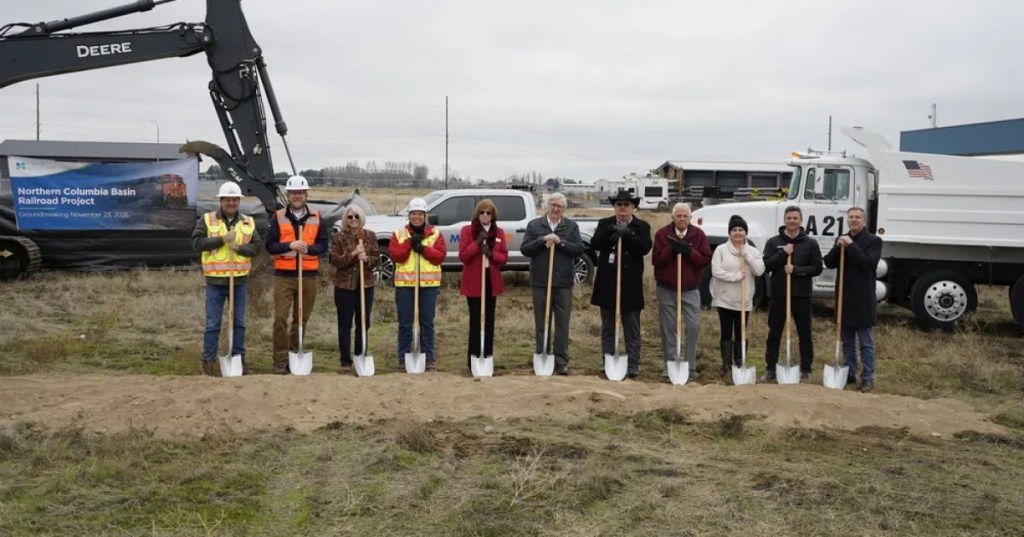
The Port of Moses Lake began construction of its $63 million Northern Columbia Basin Railroad Project on November 23, 2026, according to a port announcement. The eastern Washington freight corridor is intended to make more than 1,250 acres of industrial property accessible by rail. While national infrastructure coverage often concentrates on large passenger projects, including the Frederick Douglass Tunnel proposal, shorter freight connections can address a different economic bottleneck: access between manufacturing sites and the national transportation network.
New construction and rehabilitation
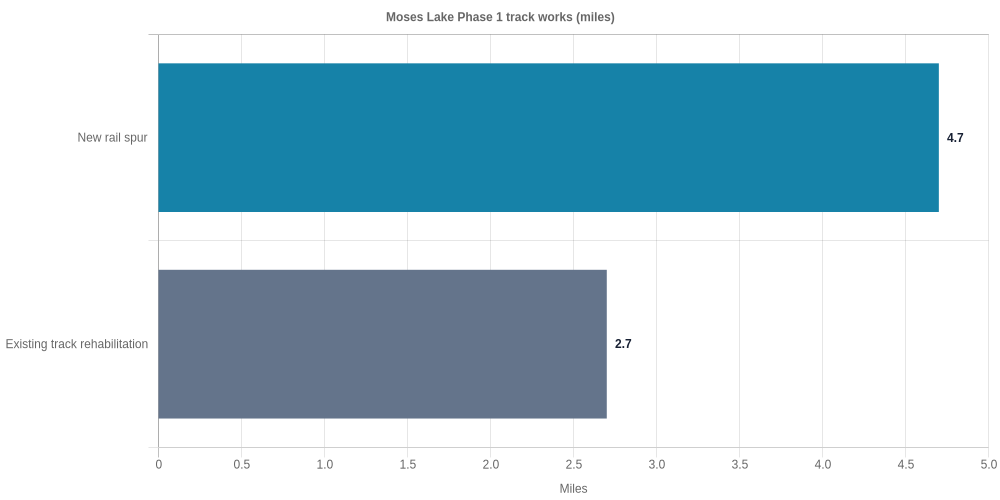
Martinus Rail received the $31.75 million first-phase construction contract. Its scope comprises approximately 4.7 miles of new spur track and 2.7 miles of rehabilitation, or 7.4 miles combined. New construction accounts for about 63.5% of those miles. The contract is not the entire project budget, and the two types of work cannot be assumed to have identical unit costs.
Railroad construction extends beyond placing rails and sleepers. The port’s September procurement notice specifies drainage, earthworks, bridge construction, road crossings, crossing controls and utility adjustments. A rail formation must distribute repeated axle loads while controlling settlement and water infiltration. Road crossings also require coordinated civil and signaling designs. The ability of individual infrastructure components to function together matters just as much as it does in major industrial developments, such as the Mississippi industrial computing campuses covered previously.
Connecting local industry to national freight routes
A short-line railroad serves local customers and exchanges freight cars with a larger carrier. The Columbia Basin Railroad connects with BNSF at Connell, as documented by local reporting on November 24. A direct industrial spur can reduce the need to move suitable heavy or bulk shipments by truck between a factory and a distant rail terminal. Actual savings depend on shipment volume, commodity characteristics, switching fees, schedules and available loading facilities.
RailfanJunction, February 2025: freight operations on the existing Columbia Basin Railroad. Historical footage, not the November 2026 groundbreaking.
Financing a regional industrial asset
The Washington State Department of Transportation and Federal Railroad Administration provided grants of $23.9 million and $9.9 million, respectively. Together, the awards amount to $33.8 million, approximately 53.7% of the reported project estimate. Local financing must support the balance. The port is using a tax increment area and increased borrowing authority, rather than relying entirely on federal or state support.
Tax increment financing generally relies on growth in eligible property-tax revenues within a designated area to support public improvements. The approach ties infrastructure financing to assumptions about future taxable development. As our analysis of historical American infrastructure investment explains, capital spending and realized economic returns are separate measures.
The November groundbreaking establishes a construction milestone, not a commissioned freight service. Future evaluations should track completed mileage, crossing acceptance, service agreements, freight volumes and maintenance requirements. Monitoring those operating measures, along with the engineering risks illustrated by our Hudson rail tunnel coverage, will clarify whether the investment delivers reliable connectivity to the industrial corridor.
We volunteer daily to ensure the credibility of the information on this platform is Verifiably True. If you would like to support to help further secure the integrity of our research initiative, please scan the QR code below.



Leave a Reply