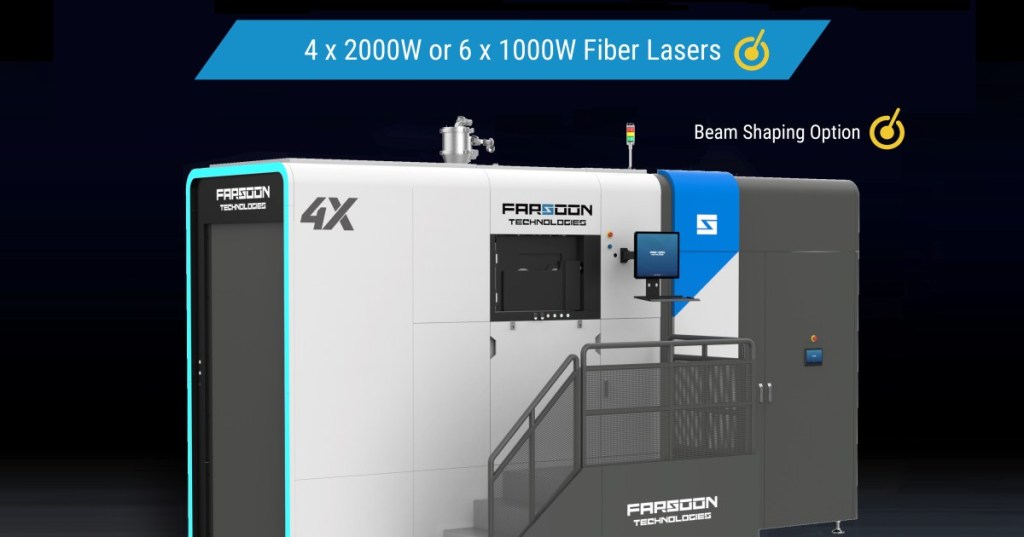
Electric motorcycle manufacturer Stark Future has agreed to purchase multiple Farsoon FS4X metal additive manufacturing systems for a dedicated production line. The November 17, 2026 partnership announcement describes plans to qualify an entire manufacturing workflow, from metal powder selection to final inspection. The agreement extends the companies’ work on titanium motorcycle parts, moving beyond prototype fabrication toward repeatable industrial production. Our introduction to additive manufacturing explains how digital geometries become physical components.
A 99-liter metal powder bed
Farsoon announced the FS4X on November 12. Its technical announcement specifies a build envelope measuring 425 × 425 × 550 mm, equivalent to 99.34 liters of geometric volume. The machine uses laser powder bed fusion, in which focused laser energy melts selected regions of successive metal powder layers. Cooling and solidification produce a metallurgically bonded structure. Unmelted powder surrounds the parts and can be recovered subject to material qualification requirements.
Four high-power lasers or six lower-power lasers
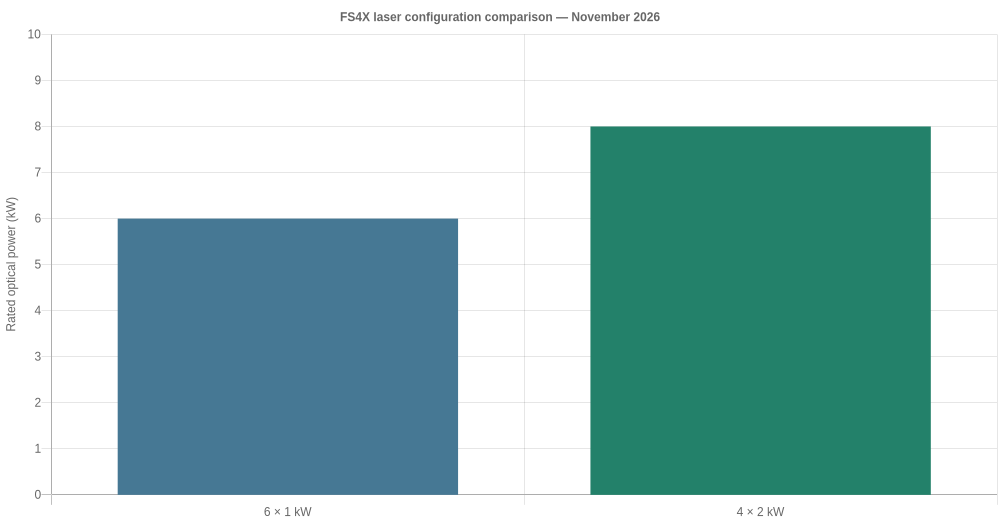
The six-laser configuration provides 6 kW of combined rated optical output, while four 2 kW lasers provide 8 kW, a 33.3% increase in nominal optical power. More power does not automatically produce an equivalent increase in accepted parts per hour. Laser allocation, scan speed, thermal history, material and geometry constrain the process. The system incorporates beam shaping and automated optical alignment. As in Northwestern’s lattice-printing research, production speed must be measured for defined parts and process conditions.
Removing bottlenecks outside the build chamber
A printer may remain unavailable while a completed build cools. Farsoon’s design supports sealed build-cylinder transport under inert gas, using automated guided vehicles to connect the printer to separate downstream stations. Powder recovery, screening and conveyance can also be integrated into the production cell. Independent coverage by VoxelMatters describes these features alongside closed-loop vertical-axis control. Manufacturing engineers must balance printer availability against cooling, finishing and inspection capacity. Similar workflow constraints appear in Machina Labs’ proposed automated factories.
From qualified parts to industrial scale
Farsoon reports that the earlier KLINGA collaboration produced more than 1,000 titanium parts through a validated serial process. The new agreement expands that relationship. Heat treatment, surface finishing, dimensional measurement, material traceability and fatigue testing remain essential to qualifying load-bearing motorcycle components. As our structural design research coverage illustrates, optimized geometry must still satisfy physical manufacturing and safety constraints.
The partners have not disclosed the exact number of FS4X machines, production-line capacity, price or commissioning date. The purchase agreement represents a manufacturing development milestone rather than evidence of an operating high-volume line. Future comparisons should measure accepted components per hour, scrap, rework, energy consumed per accepted part and validated mechanical performance. Those measures will determine whether additive fabrication can compete with conventional methods for the selected components.
We volunteer daily to ensure the credibility of the information on this platform is Verifiably True. If you would like to support to help further secure the integrity of our research initiative, please scan the QR code below.

For mobile scanning, open the article on another display and scan the QR code with a Bitcoin wallet. The voluntary donation amount is 5,000 sats. Verify the receiving address 3C9o19EH5HSiwEPyCTmEKzxhNCbo2X6TTb before sending.
BitcoinVersus.tech is not a financial advisor. This media platform reports on financial subjects purely for informational purposes.


Leave a Reply