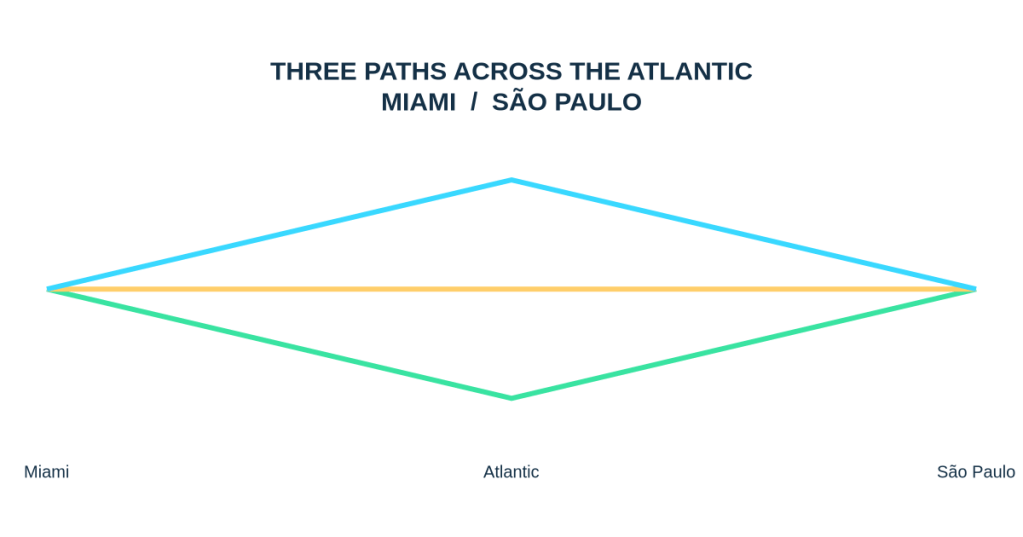
Zayo announced on November 10, 2026 that it activated capacity on the Monet submarine cable system, adding a third connection between its United States and Brazilian networks. The new service links Miami and São Paulo alongside existing paths over Seabras-1 and GlobeNet. Unlike the recently announced Vietnam–Thailand–Singapore cable project, the Zayo milestone concerns service capacity on existing infrastructure rather than construction of a new cable.
Three routes instead of two
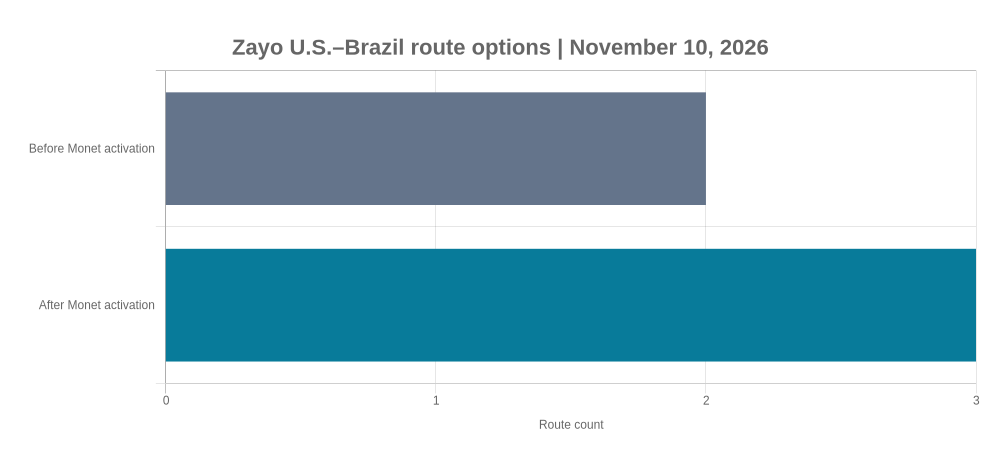
Adding Monet increases the number of named U.S.–Brazil cable systems available through Zayo from two to three, a 50% increase in route count. The company has not disclosed the capacity allocated to its new route, its measured latency or the amount of traffic already carried. The increase in route options cannot therefore be translated into a 50% increase in bandwidth, throughput or availability.
Monet entered ready-for-service status in December 2017, according to historical reporting on the consortium’s announcement. The system predates Zayo’s 2026 activation by nearly nine years. International carriers can purchase or provision capacity on existing systems without installing another transoceanic cable. Advances in subsea optical equipment can also improve utilization of installed fiber, subject to the engineering limits of each system.
Why physical diversity matters
Redundancy and diversity are related but distinct engineering concepts. Redundancy provides alternative resources, whereas physical diversity reduces the likelihood that a single incident disables multiple alternatives. Two circuits carried on separate logical interfaces may nevertheless traverse the same conduit, landing station or terrestrial backhaul.
A network operator assessing the three cable options must examine shared-risk link groups, landing facilities, power systems, optical equipment and the available capacity on surviving routes. A failure on one cable can redirect traffic onto another only when routing policies and spare capacity support the transition. The operational difficulties documented in our coverage of submarine cable repairs explain why contingency planning matters.
Connecting financial markets and data centers
Zayo’s November 13 technical overview identifies access to Equinix facilities SP2, SP3 and SP4 through its São Paulo metropolitan ring, alongside B3, Brazil’s principal exchange. The connection can support enterprise traffic, cloud applications and distributed financial infrastructure. A metro ring provides local routing options, but its actual fault tolerance depends on topology, switching behavior and physical separation.
Application performance also depends on transmission distance, optical propagation, switching delays and congestion. A faster access port alone cannot eliminate the propagation delay associated with long-distance communications. Financial firms may prefer a low-latency primary connection and a separate backup path, while cloud operators may emphasize sustained throughput and predictable recovery.
Measuring the operational result
The commercial significance of the activation will become clearer when customers can evaluate service commitments, measured end-to-end latency, failover behavior and provisioned capacity. As our reporting on Hurricane Electric’s Nairobi expansion demonstrates, international connectivity depends on both long-haul transport and local interconnection. A third cable system expands design options, but verified end-to-end independence remains essential.
Featured image: original conceptual illustration of three alternative connections, not a geographic route map.
We volunteer daily to ensure the credibility of the information on this platform is Verifiably True. If you would like to support to help further secure the integrity of our research initiative, please scan the QR code below.



Leave a Reply