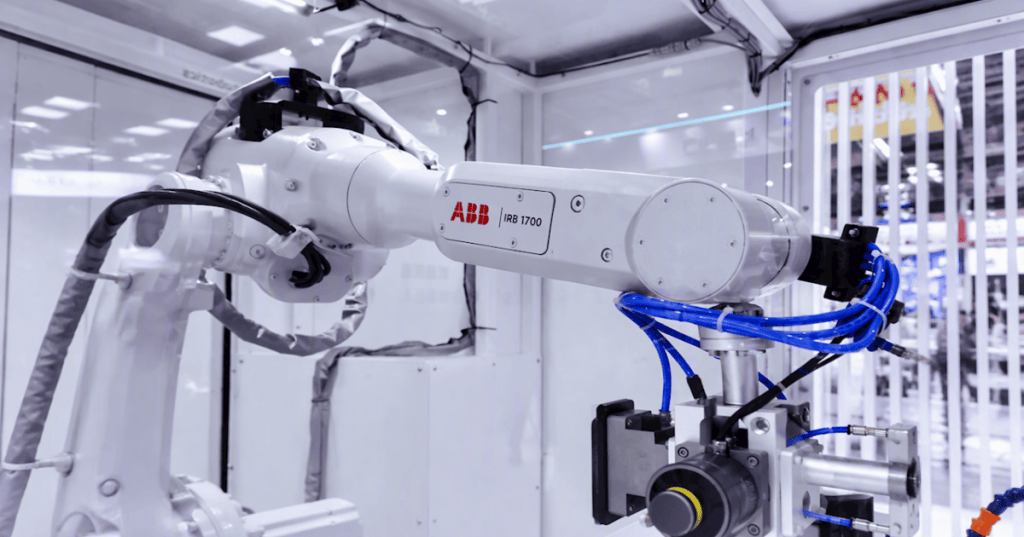
ABB Robotics introduced the IRB 1700 and IRB 1700ID on October 12, 2026, extending its articulated industrial robot portfolio for welding, surface finishing, machine tending and electronics manufacturing. The company reports cycle times as much as 20% shorter than comparable competing robots, alongside a smaller installation footprint and lower power consumption relative to its predecessor. The launch arrives as electronics manufacturing leads industrial robot installations.
Five configurations for production cells
The standard IRB 1700 is offered with 12 kg payload and 1.45 m reach or 10 kg payload and 1.65 m reach. The integrated-dressing model adds a 6 kg, 1.85 m version to those two configurations. The payload rating must accommodate both the end effector and handled workpiece, subject to the manufacturer’s permissible load conditions. An extended reach can improve access to recessed assemblies, but the appropriate variant depends on tooling geometry and the required trajectory.
Motion precision and production capacity
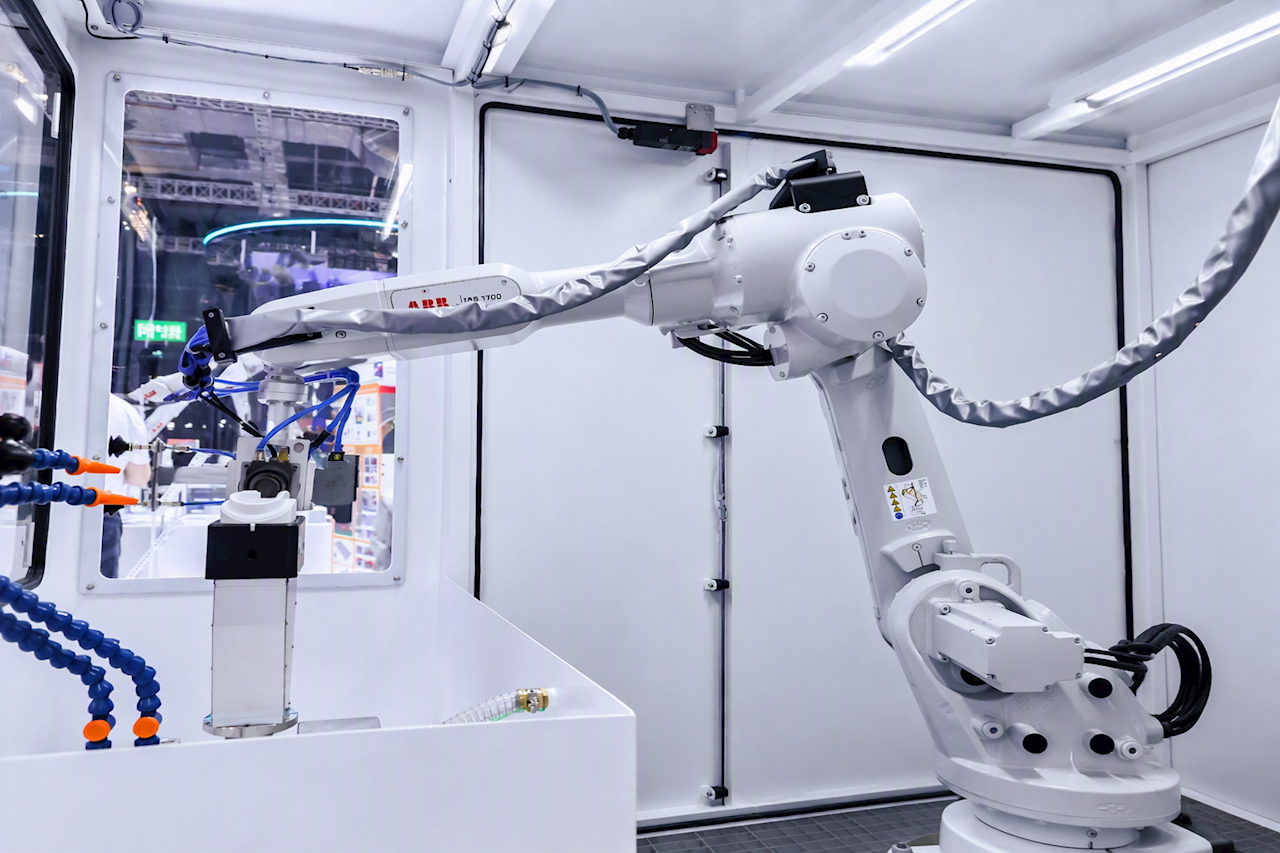
ABB specifies path repeatability down to 0.03 mm and maximum joint velocity of 700 degrees per second. Path repeatability describes consistency in retracing a commanded trajectory, not necessarily the absolute difference between the programmed and actual coordinates. Tool calibration, fixture stability, payload inertia and thermal effects remain relevant to finished-part quality. The distinction is explored in robot positioning accuracy and repeatability.
A shorter robot motion cycle can raise theoretical throughput, provided feeding, inspection and downstream operations keep pace. Actual production depends on the slowest process, planned maintenance, rejects and recovery from interruptions. ABB’s claimed improvement is an upper bound from the manufacturer, not a demonstrated increase in output across customer factories.
Integrating tools and utilities
ABB says the new family occupies half the installation footprint of its predecessor. Integrated Dressing routes tool utilities through the IRB 1700ID arm, reducing external cable and hose routing requirements. Fewer external service loops can simplify clearance planning in confined cells. Internal routing does not eliminate the need to validate bending limits, service access, collision envelopes and tool connections.
Energy efficiency and factory integration
ABB attributes a maximum 15% reduction in power consumption to a comparison with the IRB 1600 using the same load and OmniCore controller. The release also identifies oil-change intervals reaching 20,000 operating hours. Both figures require application-specific validation; maintenance demand and electricity use depend on motion profiles, duty cycles, environmental conditions and auxiliary equipment.
The OmniCore platform provides an integration point for motion control, simulation and vision-guided processes. Recent Kawasaki and Beckhoff control-system research illustrates a parallel industry effort to connect industrial robots with wider production systems. Reliable sensor-data acquisition is another engineering prerequisite for responsive automation.
For AI server assembly, smaller robots may offer advantages where fixture spacing and access constrain cell design. ABB has identified server rack manufacturing as a prospective application, but has not disclosed production yield, installed fleet size or independently measured performance for such deployments. Equipment selection should follow a representative cycle test, risk assessment and acceptance criteria based on the entire production cell rather than a robot’s advertised maximum speed.
Featured photograph: ABB Robotics IRB 1700, manufacturer press materials.
We volunteer daily to ensure the credibility of the information on this platform is Verifiably True. If you would like to support to help further secure the integrity of our research initiative, please scan the QR code below

BitcoinVersus.tech is not a financial advisor. This media platform reports on financial subjects purely for informational purposes.


Leave a Reply